
 E-mail :
 Call Us :
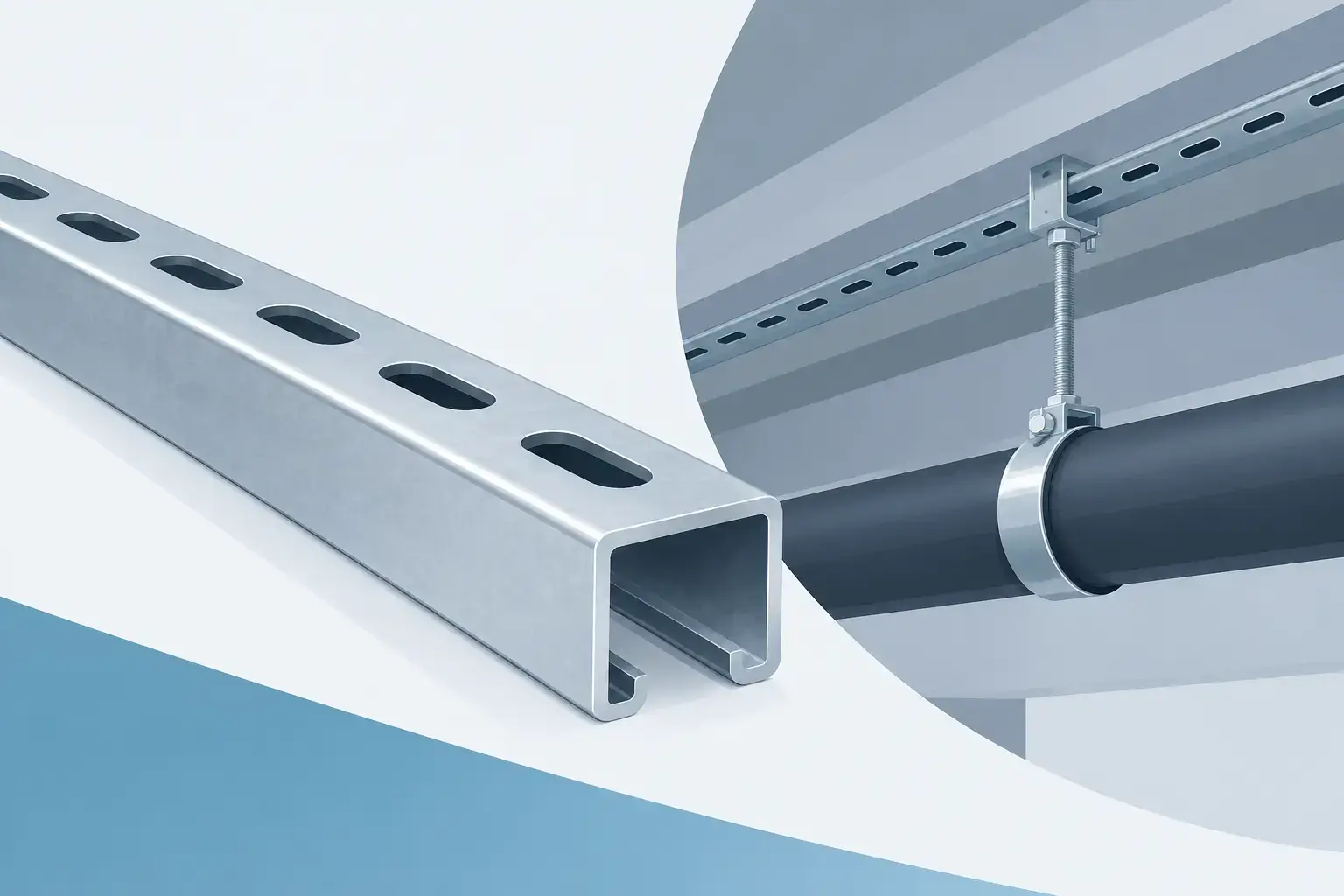
A uni strut solid channel is often selected when a support system needs continuous steel along its length rather than repeated slots. That detail matters in demanding electrical, HVAC, mechanical, industrial, and infrastructure installations, where channel behavior, attachment methods, corrosion exposure, and fabrication tolerances all affect field performance. For procurement teams and engineers, the right selection is not simply solid versus slotted. It is a specification decision that must match load paths, installation access, accessory compatibility, and project conditions.
What Is Uni Strut Solid Channel?
Uni strut solid channel is a roll-formed or fabricated structural channel with no pre-punched slots or holes along the web. It is part of the wider strut support system used to build frames, trapeze supports, equipment stands, pipe racks, cable tray supports, and custom assemblies without conventional structural steel fabrication at every connection.
The channel typically has inward-facing lips that accept channel nuts, spring nuts, bolts, and compatible fittings. This geometry allows installers to create adjustable connections while retaining a familiar modular framing method. The key difference is that a solid profile requires holes to be drilled or punched where fasteners must pass through the channel web. In return, the uninterrupted web can provide advantages where slot patterns are unnecessary or undesirable.
Solid channel is available in several dimensions, gauges, materials, and protective finishes. Common choices include mild steel with pre-galvanized or hot-dip galvanized finishes, stainless steel for corrosive service, and aluminum where lower weight or nonmagnetic material is needed. Dimensions should always be reviewed against the selected fitting system and the project’s engineering requirements.
When a Solid Strut Profile Makes Sense
A solid profile is not automatically stronger than a slotted profile in every practical assembly. Actual capacity depends on channel depth, wall thickness, span, loading direction, support spacing, connection design, and the manufacturer’s tested data. However, the absence of slots can be useful when the channel is expected to resist localized stresses around a connection or when a continuous web is preferred.
Solid strut is commonly specified for installations where mounting points are fixed and known in advance. A manufacturer can punch or drill holes to a required pattern, allowing assemblies to arrive prepared for repeatable installation. This is particularly valuable for OEM equipment frames, modular skids, machine guarding supports, solar-related mounting structures, and standardized mechanical assemblies produced at volume.
It can also be the better choice where uncontrolled field modifications are a concern. A slotted channel gives installers more flexibility, but that flexibility can lead to inconsistent fastener placement if the installation process is not tightly controlled. A solid channel with engineered hole locations supports repeatability and helps align the fabricated product with approved drawings.
There is a trade-off. Solid channel generally requires more planning before installation. If field conditions change, installers may need to drill additional holes, which takes time and must be completed without compromising coating protection or approved installation procedures. Slotted channel may be more efficient for adjustable, site-built supports where positions cannot be finalized until installation.
Uni Strut Solid Versus Slotted Channel
The choice between uni strut solid and slotted channel should begin with the assembly, not with the channel alone. A support frame is only as reliable as its channel, fittings, fasteners, anchors, and connection details working together.
Slotted channel is frequently favored for general-purpose construction because the pre-punched pattern simplifies attachment to walls, ceilings, beams, and other channels. It reduces drilling and provides adjustment during fit-up. This can lower installation time on variable job sites, especially for electrical conduit supports, cable management, and light-to-medium mechanical services.
Solid channel is better suited to controlled fabrication and applications that benefit from a continuous web. It offers a clean base for custom hole patterns, welded tabs, formed brackets, end plates, gussets, and other purpose-built features. For a buyer consolidating several custom parts into one fabricated assembly, this can reduce the number of separate components that must be managed in the field.
Neither option should be selected solely on material cost. A lower-cost slotted channel may add field labor, while a custom-punched solid channel may reduce installation steps and improve repeatability. For multi-site rollouts or high-volume OEM programs, that difference can be commercially significant.
Material and Finish Selection Affect Service Life
Channel material and finish must match the installation environment. Mild steel is a practical choice for many indoor, dry-service applications and is readily fabricated into brackets, frames, and welded assemblies. Zinc-coated finishes provide added corrosion protection, but the right coating process depends on exposure severity and the fabrication sequence.
Pre-galvanized steel is often appropriate for interior applications with moderate environmental demands. Hot-dip galvanized steel is commonly specified for exterior, damp, industrial, and more corrosive settings because the coating covers the finished component after fabrication. Where channel is cut, welded, or drilled after coating, those areas require careful review because exposed steel can become a corrosion point.
Stainless steel strut is often selected for food processing, water treatment, marine-adjacent work, chemical environments, and other locations where corrosion resistance is critical. Grade selection matters. Stainless steel is not one universal answer, and the surrounding atmosphere, cleaning chemicals, chloride exposure, and contact with dissimilar metals should guide the material decision.
Aluminum can reduce assembly weight and offers useful corrosion resistance in many applications. Its structural behavior, thread engagement, galvanic compatibility, and welding requirements differ from steel. Engineers should not substitute aluminum channel for steel solely by matching outside dimensions.
Design Details That Should Be Defined Before Ordering
A clear purchase specification prevents delays, unsuitable substitutions, and inconsistent fabrication. Procurement teams should provide the channel profile, width, depth, gauge or wall thickness, material grade, finish, required lengths, and quantity. If the part is custom, the drawing should identify hole diameters, center-to-center spacing, edge distances, weld locations, tolerances, and any required assembly hardware.
Load requirements need equal attention. State whether the channel carries static equipment, piping, conduit, cable tray, dynamic machinery loads, wind-related loads, or seismic restraints. Include span lengths, support conditions, and the direction of applied loads. A channel may perform well in vertical loading but require a different design when torsion, side loading, vibration, or cantilever action is introduced.
Connection compatibility is another frequent source of avoidable issues. Confirm whether the channel must work with a particular nut size, spring nut style, bracket family, clamp system, or established unistrut-compatible profile. Nominal channel dimensions can look similar while lip geometry and fitting engagement differ. For replacement parts or system extensions, a sample or dimensional verification can prevent field fitment problems.
For fabricated assemblies, establish the acceptable tolerance framework early. Tight tolerances may be necessary around equipment interfaces, while general support frames may allow more production flexibility. Specifying unnecessary precision can increase cost without improving function. The objective is fit-for-purpose manufacturing, not precision for its own sake.
Fabrication Options for Project-Specific Assemblies
Solid strut channel is a useful starting point for custom structural hardware because it can be cut, punched, drilled, bent into related components, and welded into assemblies. A single project may require channel sections with welded end plates, anchor tabs, diagonal braces, post bases, custom clamps, or mounting brackets. Producing these components through one manufacturing partner can help maintain consistent material, finish, dimensions, and inspection standards.
Punching is generally efficient for repeat hole patterns and production quantities. Laser cutting may be preferred for complex shapes or lower-volume custom parts. Bending and forming create brackets or reinforcing elements, while welding joins components into completed frames. The sequence matters: fabricating before final hot-dip galvanizing can provide full-coating coverage, whereas post-coating modifications may need touch-up procedures.
At Metallix Exports, solid strut-compatible components can be produced as standard supply items or as engineered fabrications built to customer drawings. This approach supports buyers who need catalog-style hardware alongside application-specific frames, brackets, and assemblies without splitting production across multiple vendors.
Quality Checks That Protect the Installation
Quality control for solid channel should extend beyond checking overall length. Profile dimensions, lip formation, wall thickness, hole position, straightness, finish condition, weld quality, and packaging all influence installation efficiency. A channel that is slightly distorted, inconsistently punched, or poorly protected in transit can create delays far beyond the cost of the component itself.
For export programs, packaging should be considered part of the specification. Bundling, edge protection, moisture control, labeling, pallet design, and part identification help ensure material arrives organized and usable. This is especially relevant when a shipment contains multiple channel sizes, fittings, fabricated supports, and hardware kits for phased installation.
The right uni strut solid channel is the one that supports the complete job: engineered load requirements, compatible hardware, appropriate corrosion protection, efficient installation, and repeatable supply. Defining those requirements early gives your fabrication and procurement teams a clearer path to dependable results in the field.