
 E-mail :
 Call Us :
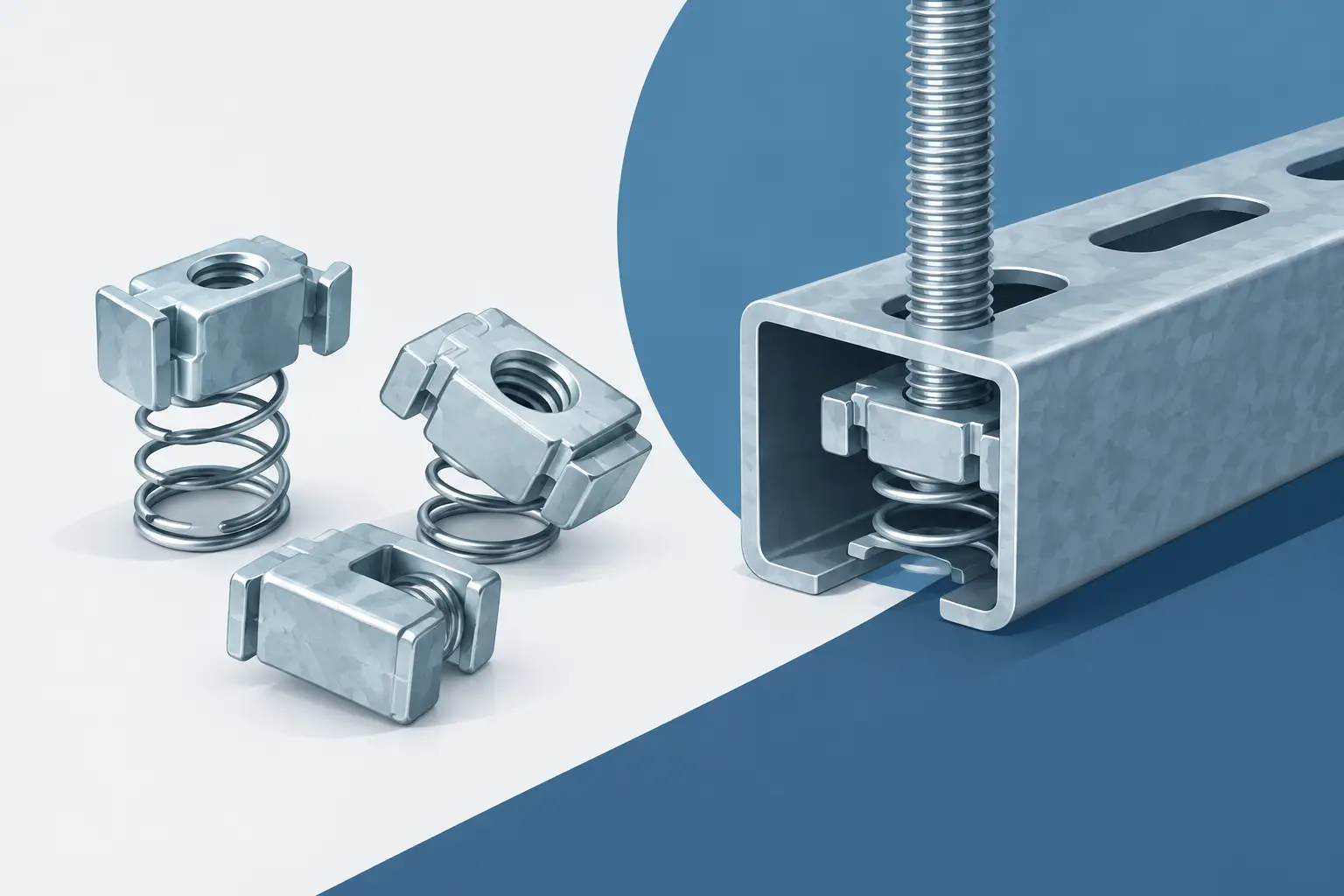
A strut system is only as dependable as the hardware holding each connection in place. Channel spring nuts create a threaded fixing point inside strut channel without drilling, welding, or accessing the back of the channel. For contractors, OEMs, and procurement teams, that means faster assembly, fewer site modifications, and a cleaner path from approved drawing to installed support.
The part itself is compact, but its selection deserves more attention than it often receives. A mismatch in channel profile, thread size, material, or finish can slow installation or compromise connection performance. The right spring nut should enter the channel easily, seat positively, and provide a stable threaded anchor for the intended bracket, clamp, or support assembly.
How channel spring nuts work
A channel spring nut combines a formed metal nut with a spring. The nut is inserted through the open face of a strut channel, turned into position, and held against the channel lips by spring pressure. Once a bolt is tightened through a fitting or bracket, the nut bears against the internal channel surfaces and creates the connection.
This simple arrangement solves a practical installation problem. Strut channels are frequently used for pipe supports, cable tray, HVAC equipment, electrical framing, machinery guards, solar support elements, and secondary steelwork. Many of these assemblies need adjustable fixing locations. Unlike a pre-drilled channel, a spring nut can be positioned where the field condition requires it.
The spring also helps retain the nut during overhead or vertical installation. That retention is useful, but it should not be confused with the final structural capacity of the connection. Load performance depends on the complete assembly: channel gauge and profile, nut design, bolt grade, fitting thickness, installation torque, edge distance, support spacing, and applied load direction all matter.
Selecting channel spring nuts for the application
The first requirement is channel compatibility. Strut systems vary in slot width, internal dimensions, lip geometry, and material thickness. A nut designed for one channel family may not rotate correctly or seat securely in another. Buyers sourcing hardware for unistrut-compatible systems should confirm the actual channel dimensions rather than relying on a general product description.
Thread size is the next decision. Common thread options are selected around the bolts and fittings already specified for the project. Standardizing thread sizes across a support package can simplify purchasing and reduce installation errors, but only when the selected size meets the connection requirements. Larger is not automatically better if it creates incompatibility with brackets, hole sizes, or field tooling.
Nut configuration affects installation as well. Some applications benefit from a short spring nut for compact fittings and standard duty connections. Others require a long spring, extended spring, or back-to-back arrangement for positioning, alignment, or specific channel conditions. Serrated or grooved bearing features may help resist movement during tightening, depending on the nut and channel design.
For purchasing teams, the most effective specification identifies the channel series, thread, spring configuration, material, finish, and intended application. A part number alone is useful only when it is tied to a controlled drawing or recognized standard. Clear specifications prevent substitutions that look similar but do not perform the same way in the installed system.
Material and finish decisions affect service life
Material selection should reflect the environment, not only the initial price. Zinc-plated steel channel spring nuts are widely used for dry indoor applications where ordinary corrosion exposure is limited. They are a practical choice for many commercial interiors, equipment rooms, and protected industrial installations.
Where moisture, chemicals, washdown conditions, coastal exposure, or outdoor weathering are expected, corrosion resistance becomes a primary design requirement. Stainless steel hardware may be appropriate for more demanding environments, although the grade should be selected with the actual exposure in mind. Stainless hardware can also require attention to galling during assembly, particularly where stainless bolts and nuts are repeatedly tightened or adjusted.
Hot-dip galvanized components are commonly considered for outdoor structural support work and environments where a heavier protective coating is required. The selection should be coordinated across the entire assembly. Combining dissimilar metals or finishes without considering galvanic exposure, coating damage, and long-term maintenance can create avoidable problems.
Finish requirements should also account for appearance, project standards, and traceability. For export programs or repeat OEM production, consistency in coating thickness, color, packaging, and labeling can be as operationally valuable as the base material itself.
Installation practices that protect the connection
Correct installation starts before the bolt is tightened. The installer should confirm that the nut enters the correct face of the channel and rotates into its intended bearing position. A nut that sits at an angle, binds against the channel, or fails to engage both channel lips should be corrected before the assembly is loaded.
The fitting must sit flat against the channel face, with bolt holes aligned and free of burrs or deformation. Tightening should follow the specified torque for the bolt, nut, and assembly design. Excessive torque can damage threads, distort lighter-gauge fittings, or strip hardware. Insufficient torque can allow movement, vibration-related loosening, or poor load transfer.
For critical supports, installation documentation should match the project requirements. This may include approved hardware schedules, lot identification, material certificates, coating records, inspection checkpoints, and torque verification. These controls matter most when the strut assembly supports building services, production equipment, safety-related infrastructure, or repetitive OEM builds.
What to verify before placing an order
A purchasing request becomes more reliable when it includes the details that affect fit and production. Before ordering channel spring nuts, verify:
- The strut channel profile, dimensions, gauge, and compatible system series.
- Required thread size, thread standard, bolt length, and mating fitting thickness.
- Material and surface finish based on indoor, outdoor, corrosive, or marine exposure.
- Required quantity, packaging method, labeling, and shipment schedule.
- Any drawing, inspection, certification, or custom manufacturing requirement.
These details help suppliers quote accurately and keep production aligned with the jobsite or assembly line. They also reduce the common problem of receiving a technically acceptable nut that does not suit the channel, finish requirement, or installed hardware package.
Standard hardware versus custom production
Standard spring nuts are often the efficient choice when a project uses established strut sizes and conventional thread options. They support predictable lead times and make it easier to maintain common inventory across contractors, distributors, and facilities teams.
Custom production becomes valuable when an OEM or project requires a nonstandard thread, specialized spring geometry, controlled material grade, unique coating, branded packaging, or a hardware assembly produced to a drawing. It can also be the better route when a buyer needs related channels, brackets, clamps, and fabricated supports supplied under a coordinated specification.
Metallix Exports supports this type of requirement with precision sheet metal manufacturing, structural hardware production, and export-ready fulfillment. For buyers managing repeat programs or complex support packages, sourcing compatible components from a manufacturing partner can reduce vendor fragmentation and improve control over dimensions, finish, packaging, and delivery planning.
Quality control should focus on fit, not appearance alone
A spring nut may look acceptable in a box yet still cause costly delays if thread engagement is inconsistent or the spring does not retain the nut correctly. Quality checks should address thread form, dimensional fit within the designated channel, spring position and tension, material verification, finish coverage, and visible damage from handling or plating.
For high-volume requirements, first-article approval and sample fit-up are sensible controls. A physical trial using the actual channel, bolt, and fitting can reveal issues that a catalog comparison will miss. This is particularly useful when hardware is being substituted, supplied across international markets, or incorporated into a custom fabricated assembly.
The best channel spring nut is not simply the one that fits the channel. It is the one specified for the full connection, produced consistently, and delivered ready for the conditions it will face. When those details are resolved early, installation crews can focus on building the system rather than correcting hardware at the point of use.