
 E-mail :
 Call Us :
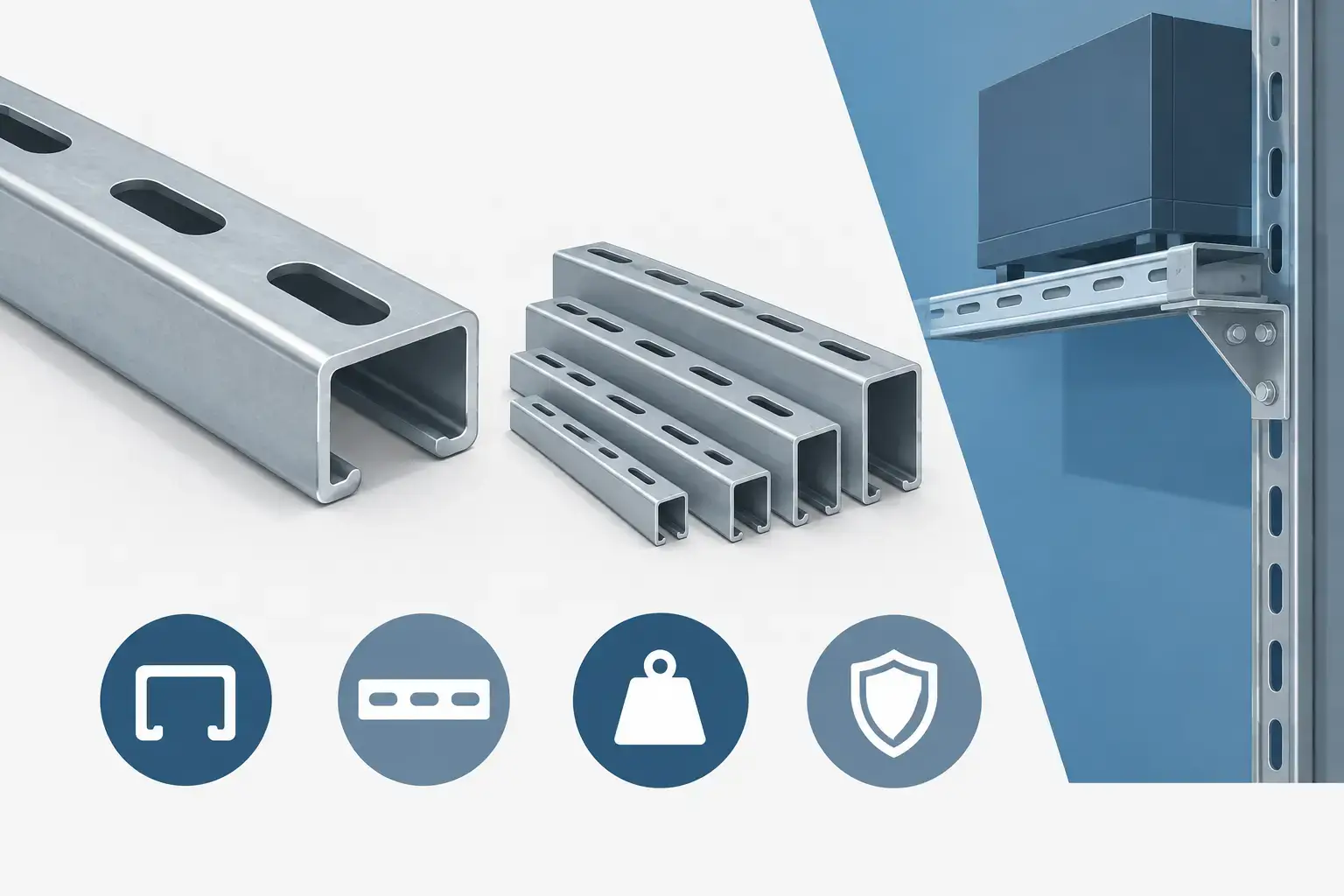
A uni strut channel shallow profile is often selected when a support frame must fit within a tight ceiling cavity, equipment enclosure, wall offset, or prefabricated assembly. That reduced depth can make installation cleaner and more economical, but it also changes how the channel handles bending, connection loads, and long unsupported spans. For procurement teams and engineers, the right decision starts with the application, not simply the lowest profile or unit price.
What Is a Uni Strut Channel Shallow Profile?
Shallow strut channel is a roll-formed or fabricated metal framing section with a lower profile than standard deep channel. It retains the familiar inward-facing lips and continuous slot arrangement used with compatible spring nuts, bolts, clamps, brackets, and other channel fittings. The profile allows installers to create adjustable support systems without field welding or drilling at every connection point.
A common comparison is between shallow channel, often around 13/16 inch deep, and standard 1-5/8 inch channel. Exact widths, wall thicknesses, slot patterns, and load ratings vary by manufacturer and product series. For that reason, a channel should never be specified by nominal depth alone. A complete purchase specification should define the section dimensions, material grade, thickness or gauge, finish, slot configuration, length, and required compatibility with associated hardware.
Shallow channel is widely used for light-to-moderate-duty support of conduit, cable tray components, pipe, HVAC accessories, controls, panels, machine guards, and secondary framing. It is especially useful where space is limited and the framing is closely supported. It is not automatically the right replacement for deep channel in heavily loaded trapezes, cantilevers, long spans, or equipment supports.
Why Profile Depth Changes the Design
Channel depth directly affects section stiffness. As depth decreases, the channel generally has less resistance to deflection under the same loading and span conditions. A shallow section may carry the required load when supported at close intervals, while the same component can deflect excessively if the span is extended or point loading is introduced.
This distinction matters in real installations. A lightweight pipe run distributed across several supports may be well suited to shallow channel. A single concentrated load from a valve, cable tray transition, motorized component, or suspended device may require a deeper channel, a heavier wall, additional bracing, or reduced support spacing.
Connection behavior matters as much as the channel itself. Loads transfer through spring nuts, bolts, fittings, welds, and anchors before they reach the building structure. A channel frame is only as capable as its least-rated component. Engineers should evaluate the complete assembly, including fastener grade, fitting geometry, anchor type, edge distances, substrate capacity, and applicable safety factors.
Selecting the Right Shallow Strut Channel
A practical specification process begins by identifying whether the application is primarily a light framing requirement or a structural support requirement. Shallow strut works best when its space-saving geometry provides a clear installation benefit and the support layout controls deflection.
Confirm the Actual Load Case
Start with the dead load of the supported service or equipment, then account for installation loads, maintenance access, vibration, thermal movement, wind, seismic requirements, and any accidental or temporary loading relevant to the project. Distributed loads and point loads do not affect a channel in the same way.
For engineered assemblies, loading should be calculated using the actual support spacing and connection locations. Published load tables can help compare channel families, but they apply only under their stated test conditions. They are not a substitute for checking the proposed frame geometry.
Match Material and Finish to the Environment
Material selection should reflect both mechanical needs and exposure conditions. Pre-galvanized steel is commonly used for dry interior applications where standard corrosion protection is sufficient. Hot-dip galvanized steel offers stronger protection for outdoor, damp, or more corrosive environments, although coating thickness and threaded connection details should be considered during assembly.
Stainless steel is appropriate where moisture, chemicals, washdown conditions, marine exposure, or hygiene requirements call for higher corrosion resistance. Aluminum can reduce weight and performs well in many corrosion-prone environments, but it has different strength, stiffness, and galvanic compatibility considerations than steel. Where dissimilar metals are present, isolation methods may be needed to reduce corrosion risk.
Specify Slot Pattern and Length Precisely
Slotted shallow channel provides installation flexibility and can reduce field drilling. Solid channel may be preferred where a continuous section is needed, where slot geometry does not suit the fitting arrangement, or where a cleaner face is required. Slot dimensions and spacing must match the intended hardware.
Standard stock lengths can simplify purchasing and reduce cost. Custom-cut lengths, mitered ends, punched holes, welded subassemblies, or pre-installed hardware can reduce jobsite labor and material waste on repeat programs. The value of custom preparation is strongest when installation volume is high or when dimensional consistency is critical.
Common Applications and Their Trade-Offs
Shallow channel is a practical choice for compact electrical and mechanical support systems. In a congested ceiling plenum, its reduced projection can preserve clearance around ductwork, sprinkler piping, and access panels. In OEM equipment, it can provide a modular mounting rail for sensors, guards, cable management, or auxiliary controls.
The trade-off is reserve capacity. A low-profile channel may reduce material use and fit more easily into the available space, yet it leaves less margin for unsupported spans and future load additions. If a facility expects frequent changes to cable routes or equipment, a deeper series may be more economical over the life of the installation.
Shallow channel can also be used as part of a mixed strut system. Deep channel can form the primary members, while shallow sections provide secondary rails, cross members, or attachment points. This approach targets material where it delivers the greatest structural benefit instead of overbuilding every part of the frame.
Hardware Compatibility Should Be Verified Early
Many buyers use the term “Uni Strut” to refer broadly to slotted metal framing systems. However, nominally similar channels and fittings are not always interchangeable. Lip dimensions, slot shapes, channel widths, wall thicknesses, and proprietary product tolerances can affect fit and load performance.
Before committing to a large order, confirm compatibility between the shallow channel and the selected spring nuts, brackets, beam clamps, post bases, splice plates, angle fittings, and channel nuts. This is particularly important when combining stock hardware with custom-fabricated components. A prototype assembly or dimensional review can prevent field issues such as loose-fitting nuts, misaligned holes, inaccessible fasteners, or interference between adjacent services.
For export projects, documentation should also be aligned with the buyer’s needs. This may include material certificates, coating information, dimensional inspection records, packaging requirements, part identification, and shipment-ready labeling. Consistency across these details helps distributors, contractors, and OEM production teams receive components that can move directly into installation or assembly.
Manufacturing Considerations for Custom Requirements
Standard shallow channel is suitable for many applications, but project requirements are often more specific. A manufacturer with punching, forming, bending, welding, and finishing capabilities can produce complementary brackets and fabricated frames that align with the channel system. This reduces the need to coordinate separate suppliers for structural hardware, custom connection plates, and secondary supports.
Tolerance control is particularly valuable for repetitive assemblies. If a bracket must align with a fixed machine mounting pattern or a modular enclosure, hole location and formed angles need to be controlled from part to part. Material thickness must also be consistent enough to provide reliable engagement with selected hardware.
Metallix Exports supports buyers requiring unistrut-compatible channel systems, standard framing hardware, and custom sheet metal fabrications produced to application-specific drawings. The objective is not simply to supply a channel length, but to provide components that fit the assembly, perform as specified, and arrive ready for efficient use.
Questions to Resolve Before Ordering
Before issuing a purchase order, confirm the design load and support spacing, channel dimensions and wall thickness, corrosion protection, slot configuration, fitting compatibility, required cut lengths, and any inspection or export documentation. These details prevent the common problem of receiving technically correct material that does not suit the installation sequence.
A shallow strut channel is most effective when it is treated as part of an engineered support assembly rather than a generic commodity. Select the profile for the available space, verify its capacity for the actual load path, and specify the hardware and finish with the operating environment in mind. That discipline leads to cleaner installations, fewer field modifications, and a supply package that supports the project schedule.