
 E-mail :
 Call Us :
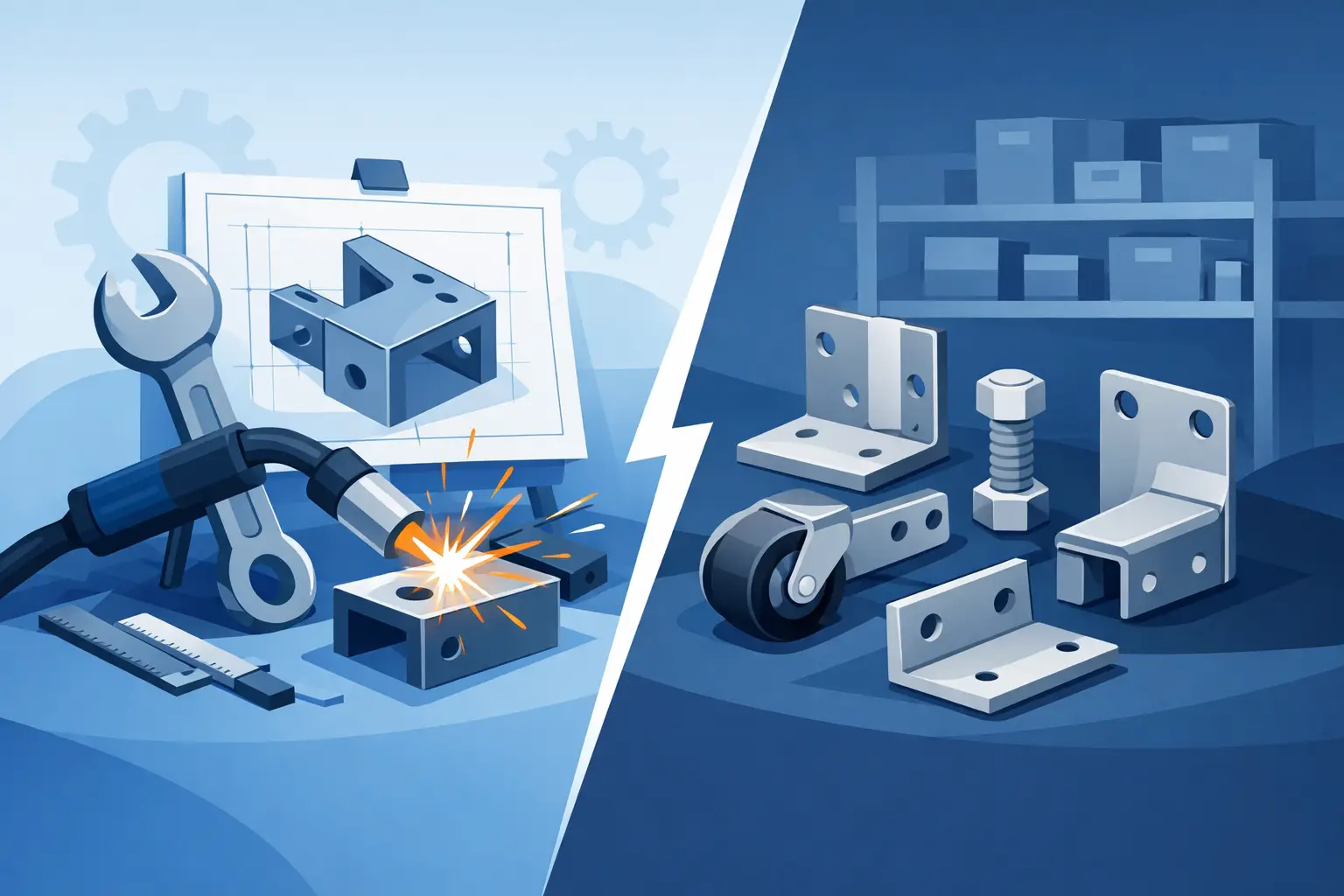
A mounting bracket that is nearly right can still cause a costly installation problem. A channel that does not match an existing support system, a clamp that interferes with surrounding equipment, or a post base that cannot carry the specified load can delay work well beyond the cost of the part itself. The decision between custom fabrication versus catalog hardware should therefore begin with the application, not simply the unit price.
For procurement teams, contractors, OEMs, and engineers, both sourcing paths have a clear place. Catalog hardware provides speed, familiarity, and repeatable availability. Custom fabricated metal components provide exact fit, application-specific performance, and the ability to consolidate several operations or parts into one engineered solution. The best option depends on how much variation the project can tolerate and what failure, delay, or rework would cost.
Custom Fabrication Versus Catalog Hardware: The Core Difference
Catalog hardware is produced to a predefined design. Standard channels, spring nuts, pipe clamps, brackets, framing hardware, post bases, fasteners, and dock fittings are typically available in established dimensions, material grades, finishes, and load ranges. Buyers select from known configurations rather than creating a new component from the ground up.
Custom fabrication starts with a drawing, sample, performance requirement, or installation challenge. The manufacturer then develops the part around required dimensions, hole locations, bend radii, material thickness, weld details, surface finish, assembly needs, and tolerances. It may be a modified version of a standard bracket or a completely new welded fabrication.
This distinction matters because the apparent savings of a standard item can disappear when it requires field modification, extra adapters, additional labor, or a separate vendor to complete the assembly. At the same time, a custom part is not automatically the better commercial choice if an established catalog item already satisfies the technical requirement.
When Catalog Hardware Is the Better Choice
Catalog hardware is generally the right choice when the requirement is common, the interface is standardized, and the quantities do not justify engineering or tooling effort. It is particularly effective for recurring construction and industrial support applications where installers already understand the product and where replacement availability matters.
A standard strut channel system, for example, can be an efficient solution for supporting conduit, cable tray, HVAC equipment, or light structural assemblies. Compatible channel nuts, clamps, brackets, and fittings allow adjustments in the field without waiting for a new part to be produced. This flexibility can be valuable on jobsites where site conditions change after installation begins.
Catalog products also simplify buying decisions. A procurement team can reference an established part number, compare specifications, and place repeat orders with less technical review. For distributors and maintenance operations, standardized hardware can reduce inventory complexity because the same item serves multiple customers or sites.
The limitation is that standard hardware is designed for a range of uses, not one exact use. Buyers should confirm load capacity, corrosion protection, dimensional compatibility, and applicable project requirements rather than assuming a familiar product will perform correctly in every environment.
When Custom Fabrication Creates Better Value
Custom fabrication becomes more compelling when the part must fit a defined space, connect to nonstandard equipment, carry unusual loads, or perform in demanding conditions. It is also valuable when an assembly contains multiple catalog items, spacers, plates, and field-drilled modifications that could be replaced with one purpose-built component.
Consider a structural bracket for equipment mounted within a restricted enclosure. A standard bracket may require multiple pieces, drilling at the site, and added hardware to achieve the required offset. A fabricated bracket can incorporate the exact mounting pattern, formed profile, gussets, weldments, and finish in one controlled manufacturing process. The result can reduce installation time while improving consistency across every unit.
For OEMs, custom production often supports better product integration. A part can be designed around the enclosure, frame, control panel, machine housing, or installation sequence rather than forcing the finished product to accommodate an off-the-shelf component. Features such as captive nuts, punched louvers, formed tabs, slots, reinforcement ribs, and welded subassemblies can reduce downstream operations.
Custom fabrication is also practical when material or environmental performance is highly specific. Stainless steel may be necessary for moisture exposure or marine applications. Galvanized steel may suit outdoor structural supports. Aluminum may reduce weight, while copper may be required for electrical or specialized industrial uses. Material selection should reflect structural demand, fabrication method, coating requirements, corrosion exposure, and total lifecycle expectations.
Compare Total Cost, Not Only Part Price
The most common sourcing mistake is comparing a catalog unit price with a custom unit price without accounting for the full installed cost. The lower-priced component is not necessarily the lower-cost solution.
Catalog hardware may have an advantage at low quantities because its design and production costs are already absorbed across many buyers. It can also reduce lead time when stock is available. However, its total cost rises when the application requires cutting, drilling, welding, shimming, repainting, or additional accessories. These activities introduce labor expense and make quality dependent on field conditions.
Custom components usually involve upfront engineering review, setup time, and potentially tooling or fixture requirements. That investment is easier to justify as quantities increase or when the design removes several secondary operations. For repeat programs, a controlled custom design can improve purchasing predictability, installation speed, and product quality.
A useful comparison should include material cost, fabrication operations, finishing, packaging, freight, installation labor, expected waste, and the cost of potential rework. Procurement should also consider whether using one manufacturing partner can replace multiple vendors, reduce incoming inspection, and simplify shipment coordination.
Lead Time Depends on More Than Stock Status
Catalog hardware is often associated with fast delivery, and for common stocked items that is true. Yet availability can vary by finish, size, material, required quantity, and destination. A specific configuration may still require production, and a project that needs several related items can be delayed by one missing component.
Custom fabrication requires a disciplined lead-time plan. Engineering clarification, material procurement, production scheduling, welding, finishing, inspection, and export packaging must be considered before a delivery commitment is made. A capable manufacturer will identify these requirements early rather than treating lead time as a simple production-date calculation.
For repeat demand, custom production can become highly dependable when drawings are approved, material specifications are stable, and production planning is aligned with forecast volumes. The objective is not merely to produce parts quickly. It is to produce conforming parts on schedule, in the correct quantity, with packaging suitable for transport and installation.
Engineering Detail Determines Sourcing Success
Whether purchasing standard or custom hardware, specification quality has a direct effect on results. A clear requirement prevents costly assumptions about fit, coating, load, and inspection expectations.
For custom work, the purchasing package should define the drawing revision, material grade and thickness, critical dimensions, tolerances, weld requirements, surface finish, quantity, packaging needs, and any inspection documentation. If the part interfaces with existing components, supplying samples, mating-part drawings, or installation photographs can prevent errors that dimensional callouts alone may not reveal.
For catalog items, buyers should verify the exact product dimensions, material, finish, compatibility standard, and rated performance. A part that is described broadly as a channel nut or clamp may vary significantly in thread size, spring configuration, plating, thickness, or intended load range.
Early discussion between engineering, purchasing, and manufacturing is especially valuable for parts with tight tolerances or multiple processes. Small design changes can reduce unnecessary welding, eliminate hard-to-form bends, improve nesting efficiency, or make assembly faster without compromising function.
A Practical Decision Framework
Use catalog hardware when the application accepts a standard configuration, the component is readily available, and its performance is verified for the job. Choose custom fabrication when exact fit, specialized material, integrated features, controlled tolerances, or reduced installation work create a measurable operational advantage.
The following questions help define the right path:
- Does a standard part meet the dimensional, load, and environmental requirements without modification?
- Will installers need to drill, cut, shim, weld, or combine several parts in the field?
- Is the requirement recurring at a volume that can support a dedicated fabricated solution?
- Would one custom assembly reduce vendor count, handling, or quality risk?
- Are material traceability, coating control, export packaging, or inspection requirements beyond what a standard item provides?
There is also a middle ground. Many projects benefit from standard hardware combined with custom transition plates, brackets, or welded assemblies. This approach retains the availability and familiarity of catalog systems while solving the specific interface problem through fabrication.
For buyers managing international supply, selecting a partner with both catalog depth and custom manufacturing capability can reduce handoffs between suppliers. Metallix Exports supports this approach through precision sheet metal processing, welded fabrication, finishing, assembly, and export-ready fulfillment across industrial and construction applications.
The right hardware decision should make installation simpler, performance more predictable, and future procurement easier. Start with the real operating conditions, then choose the sourcing route that delivers quality you can rely on from the first shipment through the next production cycle.


