
 E-mail :
 Call Us :
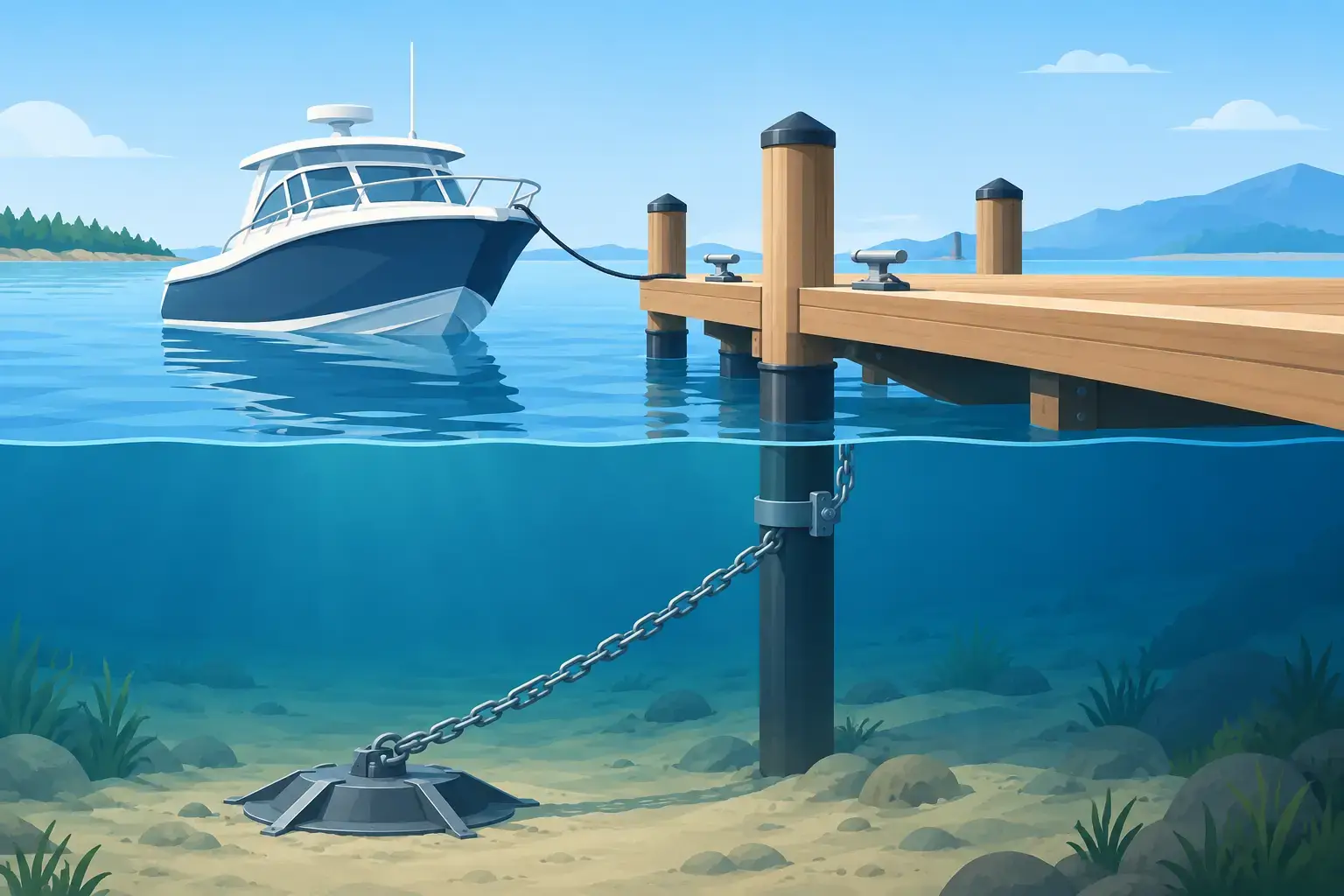
A floating dock can be built with a well-designed frame and quality decking, yet still perform poorly if its dock anchoring system is underspecified. The anchoring arrangement controls position, movement, access alignment, and the forces transferred into the dock structure. For contractors, marina operators, OEMs, and procurement teams, it is a structural decision that should be defined early, not treated as a final hardware purchase.
The right solution depends on water depth, bottom conditions, water-level variation, vessel traffic, wind exposure, ice, current, and the operating loads placed on the dock. A protected residential shoreline and a commercial marina may use similar floating sections, but they rarely require the same anchoring approach.
What Dock Anchoring Must Accomplish
Dock anchoring is designed to keep a floating structure within an acceptable operating area while allowing the vertical movement that changing water levels demand. A system must resist lateral drift, rotation, uplift, pull-out, and repeated cyclic loading. It must also maintain safe gangway geometry and avoid concentrating loads at a few weak connection points.
The anchor hardware is only one part of the system. Performance depends on the complete load path: the dock frame, connection brackets, chains or cables, pile guides, fasteners, anchor bodies, and the soil or seabed that receives the load. If one component has insufficient capacity or poor corrosion resistance, it can limit the entire assembly.
For commercial applications, design teams should also consider operational continuity. An anchor configuration that is difficult to inspect, adjust, or replace can create avoidable maintenance costs and downtime. Accessible, serviceable connections are especially valuable where docks support public access, workboats, equipment, or seasonal operations.
Common Dock Anchoring Methods
Pile-Guided Dock Systems
Pile-guided systems use vertical piles installed into the lakebed, riverbed, or seabed. Pile guide brackets attached to the floating dock slide along the piles as water levels rise and fall. This method provides strong lateral restraint and predictable positioning, making it a common choice for marinas, high-use waterfronts, and locations exposed to changing water conditions.
The key engineering considerations are pile depth, diameter, wall thickness or section profile, soil conditions, pile spacing, and guide bracket capacity. Brackets must accommodate movement without excessive binding, while the dock frame must distribute guide loads effectively. Galvanized steel, stainless steel, and application-appropriate wear materials may be selected according to the exposure environment and maintenance plan.
Deadweight Anchor Systems
Deadweight anchoring uses concrete blocks, steel weights, or purpose-built ballast anchors positioned on the bottom. The dock is connected to these weights with chain, cable, or rod assemblies. These systems are often useful where driving piles is impractical, restricted, or cost-prohibitive.
Their holding performance is based on more than anchor mass. Bottom composition, slope, chain length, connection angles, current, and seasonal water movement all affect real-world resistance. A deadweight anchor placed on soft sediment may shift or settle differently than one placed on dense material or rock. Design assumptions should reflect site conditions rather than relying on a standard weight per dock section.
Helical Anchor Systems
Helical anchors can provide a compact, engineered holding solution in suitable soils. Installed by rotating helical plates into the ground, they can offer substantial tension resistance with less surface disruption than some conventional methods. They are frequently considered for freshwater floating dock installations, shoreline structures, and applications where a defined load capacity is required.
Anchor shaft size, helix configuration, installation torque, soil profile, and connection detailing all matter. Helical anchors should be specified with verified capacity criteria and installed using procedures appropriate to the project. Their effectiveness depends on the subsurface conditions, so geotechnical information is valuable before selecting this method.
Shore Anchors and Cable Systems
In protected settings, shore-based anchors and tensioned cable systems may help control dock position. These can be practical for smaller docks or where water depth makes bottom anchoring difficult. However, cable systems can introduce trip hazards, changing line angles, and high localized loads during wind events. They require careful layout, adequate clearances, and reliable tension adjustment.
Match Hardware to Environmental Loading
A dock anchoring system should be selected for the harshest credible conditions, not merely normal day-to-day use. Wind creates sustained lateral pressure and can cause a dock to yaw. Current adds continuous force, while waves and boat wake introduce repeated shock loading. Ice movement may apply substantial lateral loads in cold-climate locations, even where the dock is removed seasonally.
Vessel use changes the calculation as well. A dock intended for occasional small-craft boarding has different needs from one receiving workboats, passenger vessels, or frequent side mooring. Bollard loads, cleat loads, gangway loads, and impacts during docking should be transferred through a frame and anchoring layout designed for the intended operation.
Engineers commonly evaluate both ultimate capacity and serviceability. Ultimate capacity addresses failure resistance. Serviceability addresses practical movement, alignment, and user safety under normal loading. A system may technically remain intact while allowing enough movement to make gangway access uncomfortable or cause repeated contact between dock sections. Both outcomes matter.
Specify the Connection, Not Just the Anchor
Many dock failures begin at the connection point. A high-capacity pile or anchor cannot compensate for undersized brackets, thin tabs, poor weld geometry, mismatched fasteners, or unreinforced dock framing. Connection hardware should be designed around load direction, movement range, wear points, and inspection access.
For fabricated steel components, material thickness, hole location, bend radius, weld procedure, and finish all affect field performance. Tolerances also matter. A pile guide with an incorrect internal clearance may bind during water-level changes, while excess clearance can lead to rattle, impact, and accelerated wear.
Galvanic compatibility deserves the same attention. Combining aluminum dock frames, stainless steel fasteners, galvanized steel brackets, and submerged hardware without considering electrical interaction can accelerate corrosion. Isolation materials, compatible fastener selection, drainage, and protective coatings should be addressed during specification rather than after installation.
Corrosion Protection Is a Lifecycle Decision
Marine and freshwater environments expose metal components to moisture, abrasion, UV radiation, and, in coastal areas, chlorides. The appropriate finish depends on whether hardware is above water, intermittently submerged, continuously submerged, or exposed to splash and tidal zones.
Hot-dip galvanizing is widely used for steel dock hardware because it provides durable zinc protection, including coverage around edges and fabricated details. Stainless steel may be appropriate for selected fasteners and highly exposed components, provided the grade matches the water chemistry and contact materials. Powder coating can provide an additional finish in suitable applications, but it should not be treated as a replacement for the corrosion strategy required by the environment.
Specify drainage and avoid water-trapping geometries wherever possible. Closed sections, overlapping plates, and tight crevices can retain moisture and shorten service life. A practical fabrication design gives water a way out and gives maintenance crews a clear view of critical surfaces.
Information to Provide When Requesting Dock Hardware
A manufacturer can produce more accurate, installation-ready dock anchoring components when the project brief includes the actual application conditions. At minimum, provide:
- Dock layout, section dimensions, freeboard, and frame material
- Water depth range and expected seasonal level change
- Bottom or soil information, including known rock, sediment, or scour conditions
- Environmental exposure, including wind, current, wake, ice, and saltwater conditions
- Expected vessel size, mooring activity, and occupancy loads
- Required material, finish, drawings, tolerances, and applicable project standards
This information allows the fabricator and project engineer to address bracket geometry, plate thickness, reinforcement, hardware selection, and protective finishing as one coordinated package. It also reduces rework caused by field dimensions that do not match prefabricated components.
Custom Fabrication for Dock Anchoring Projects
Standard dock brackets and mooring hardware are efficient for repeatable applications, but custom fabrication is often the better choice when docks have nonstandard frame profiles, unusual pile sizes, high design loads, or project-specific installation constraints. A custom component can incorporate exact hole patterns, formed gussets, welded reinforcements, drainage details, and finishes that match the rest of the dock system.
For B2B buyers, the value is not limited to a single bracket or anchor connection. Coordinating channels, plates, clamps, pile guides, mooring tabs, structural brackets, and fastening hardware through one capable manufacturing partner simplifies quality control and procurement. Metallix Exports supports this type of requirement with precision sheet metal fabrication, welding, forming, and finishing for standard and custom marine hardware programs.
The best dock anchoring specification creates confidence long before the dock reaches the water. Define the loads, confirm the site conditions, protect every connection from corrosion, and require fabrication that matches the drawings. That discipline turns anchoring hardware from an overlooked accessory into a dependable foundation for safe marine access.