
 E-mail :
 Call Us :
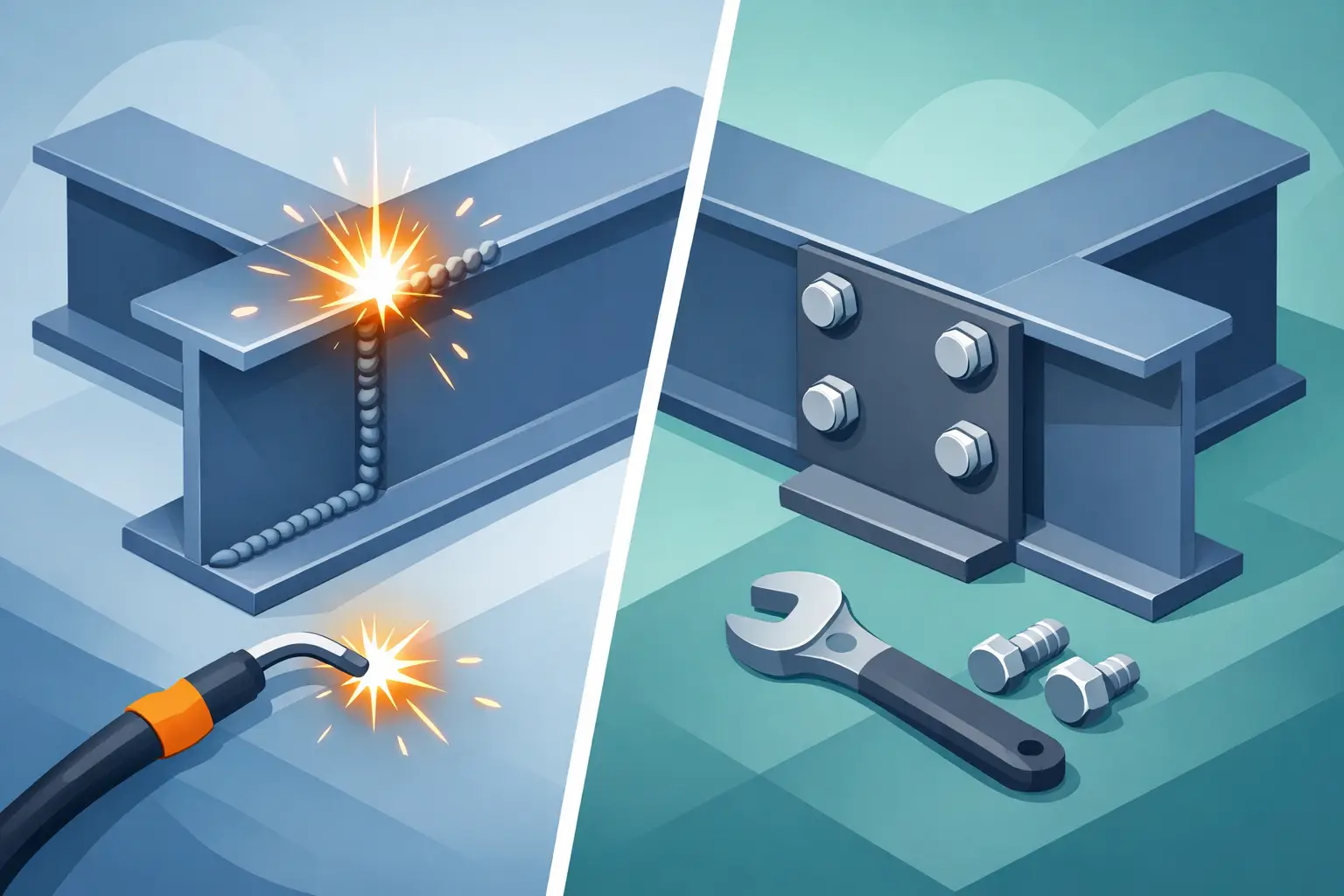
A connection decision made early in design can determine whether a fabricated assembly installs cleanly in the field or creates costly rework at the jobsite. When evaluating welded versus bolted connections, engineers and procurement teams must look beyond initial strength. Fabrication sequence, access for installation, coating requirements, inspection, transport, maintenance, and project schedule all affect the right choice.
Neither method is universally better. A welded connection can create a compact, permanent assembly with efficient load transfer. A bolted connection can simplify shipment, adjustment, field installation, and future replacement. The most dependable solution is the one designed around the actual service conditions and produced to controlled specifications.
Welded Versus Bolted Connections: The Core Difference
A welded connection joins metal components by applying heat, pressure, or both to form a continuous joint. Common processes in sheet metal and structural fabrication include MIG, TIG, spot welding, and stud welding. Once completed, the connection is generally permanent unless it is cut apart.
A bolted connection uses mechanical fasteners such as bolts, nuts, washers, threaded inserts, or structural hardware to clamp components together. Depending on the design, the bolts may transfer load through bearing, friction created by bolt preload, or a combination of both. Bolted assemblies can be removed, adjusted, or replaced when service conditions require it.
The difference affects more than assembly. Welding changes the parent material locally through heat input, while bolting requires accurately located holes and sufficient access for tools. Both can deliver reliable performance when connection geometry, materials, fabrication controls, and installation practices are properly specified.
Strength Depends on the Load Path, Not the Joining Method Alone
It is tempting to assume a welded joint is always stronger because it appears continuous. In practice, strength depends on joint design, weld size, base-metal thickness, fastener grade, edge distances, load direction, and the forces transferred through the assembly.
A properly sized fillet or groove weld can provide high static strength and distribute load along a joint. This makes welding particularly useful for rigid frames, brackets, custom enclosures, post bases, support assemblies, and fabricated structural hardware where a permanent configuration is preferred. Welded construction can also eliminate the need for overlapping flanges and fastener clearances, helping keep an assembly compact.
Bolted connections are equally capable of carrying significant structural loads. High-strength bolts are widely used in steel structures, equipment frames, channels, clamps, and field-assembled support systems. Their performance relies on correct bolt selection, hole type, tightening method, washer use, and installation torque or tension. A connection designed for bearing behaves differently from a slip-critical joint, so the specification must clearly state the intended design approach.
For cyclic loading, vibration, and fatigue-sensitive applications, details matter even more. Weld toes, abrupt geometry changes, and poor starts or stops can become fatigue initiation points. Bolted joints can loosen under vibration if they are not preloaded or secured correctly, but they can also be designed for reliable fatigue performance. The correct answer requires an application-specific load review rather than a general preference for welding or bolts.
Heat Effects and Material Behavior
Welding introduces a heat-affected zone around the joint. On mild steel, this may be manageable with the right procedure. On stainless steel, aluminum, galvanized sheet, or thin-gauge material, heat control becomes more critical. Excessive heat can cause distortion, discoloration, loss of corrosion resistance in localized areas, burn-through, or reduced mechanical properties.
Bolting avoids heat distortion, which is valuable where tight flatness, alignment, or finished surfaces are required. However, it introduces holes that reduce net section and may require local reinforcement. For thin sheet, standard bolts may crush the material or permit movement unless supported with formed features, backing plates, inserts, or properly designed washers.
Fabrication Accuracy and Field Installation
Welded assemblies can reduce field labor by arriving as finished, ready-to-install units. This is useful when site welding would be slow, unsafe, difficult to inspect, or impractical due to limited access. Factory welding also gives manufacturers greater control over fixturing, weld parameters, dimensional checks, and finishing before shipment.
The trade-off is that welded fabrications require careful control of distortion. Heat can pull components out of square, especially in long channels, thin sheet, asymmetric brackets, and multi-part frames. Experienced fabricators plan the welding sequence, use fixtures, balance welds where possible, and verify critical dimensions after welding. Where tolerances are tight, machining, straightening, or secondary forming may be necessary.
Bolted connections generally offer greater flexibility during installation. Components can be shipped flat or in manageable subassemblies, then joined at the site. This can lower freight volume, simplify handling, and make large structures easier to transport. Slotted holes or controlled clearances can also provide limited adjustment for alignment.
That flexibility should not become an excuse for vague tolerances. Oversized holes, uncontrolled field modifications, or poor fastener access can compromise fit and performance. A bolted design should account for wrench clearance, assembly order, bolt orientation, access after adjacent parts are installed, and the practical ability to reach specified tightening requirements.
Inspection, Quality Control, and Traceability
Both connection methods need defined quality controls. For welded fabrications, inspection may include visual examination of weld profile, size, continuity, undercut, porosity, spatter, and distortion. Higher-risk applications may require weld procedure qualification, certified welders, magnetic particle testing, dye penetrant testing, ultrasonic testing, or radiographic examination as specified by the applicable code or customer requirement.
For bolted assemblies, quality control focuses on fastener grade, coating, thread engagement, hole location, washers, tightening method, and final torque or tension where required. Fasteners should be traceable when the application calls for certified materials or specific mechanical properties. Mixing incompatible fastener grades or finishes can undermine an otherwise sound design.
Procurement teams benefit when drawings clearly define these requirements before production begins. Calling out materials, finish, weld symbols, fastener specifications, torque values, inspection criteria, and critical dimensions prevents ambiguity between design, manufacturing, and site installation teams.
Corrosion Protection and Surface Finishing
Connection selection has a direct effect on corrosion performance. A welded joint can create crevices, weld scale, and heat-tinted areas that need proper cleaning and finishing. On galvanized steel, welding burns away zinc near the joint, making post-weld touch-up or recoating necessary. Stainless steel welds may require cleaning and passivation to restore corrosion resistance at the affected surface.
Bolted assemblies can create crevices between overlapping parts where moisture may collect. Dissimilar metals also require attention. For example, stainless fasteners used with aluminum or galvanized steel may create galvanic corrosion risk in wet or marine environments unless material combinations, isolators, and coatings are selected carefully.
For outdoor, coastal, and industrial environments, connection details should be reviewed alongside the full finish system. Hot-dip galvanizing, zinc plating, powder coating, paint systems, and stainless material selection each have different implications for fastener fit, weld preparation, and long-term maintenance.
Cost Should Be Measured Across the Full Project
The lowest unit fabrication cost does not always produce the lowest installed cost. Welding may increase factory labor, inspection, and finishing requirements, but it can reduce the number of purchased fasteners and shorten field assembly. Bolting may reduce fabrication time and improve shipping efficiency, while adding hardware, hole-making operations, installation labor, and tightening controls.
A practical cost review should consider four areas:
- factory fabrication time, fixtures, welding consumables, and inspection;
- fastener cost, hole preparation, and hardware kitting;
- freight weight, package size, and shipment configuration; and
- field labor, installation access, maintenance, and future replacement.
For repeat OEM production, welded subassemblies can deliver consistency and speed once fixtures and work instructions are established. For modular systems, large structures, or products requiring service access, bolted designs often provide better lifecycle value.
Choosing the Right Connection for the Application
Choose welding when permanence, compact geometry, controlled factory production, and rigid load transfer are the primary requirements. It is often well suited to custom brackets, fabricated frames, welded structural hardware, equipment bases, and assemblies that must arrive ready for installation.
Choose bolting when field assembly, transport efficiency, adjustability, disassembly, or component replacement matters. It is commonly preferred for strut support systems, modular framing, serviceable machinery, structural steel assemblies, and installations where field welding is restricted.
Hybrid designs are frequently the most effective option. A manufacturer may weld precision subcomponents in a controlled facility, then use bolted interfaces for shipment, adjustment, and site assembly. This approach can combine factory quality with practical installation flexibility.
The best connection is one that carries the required load, fits the manufacturing process, survives its environment, and can be installed as specified. Providing complete drawings and performance requirements early gives a fabrication partner the information needed to recommend a connection strategy that supports quality you can rely on and on-time delivery.


