
 E-mail :
 Call Us :
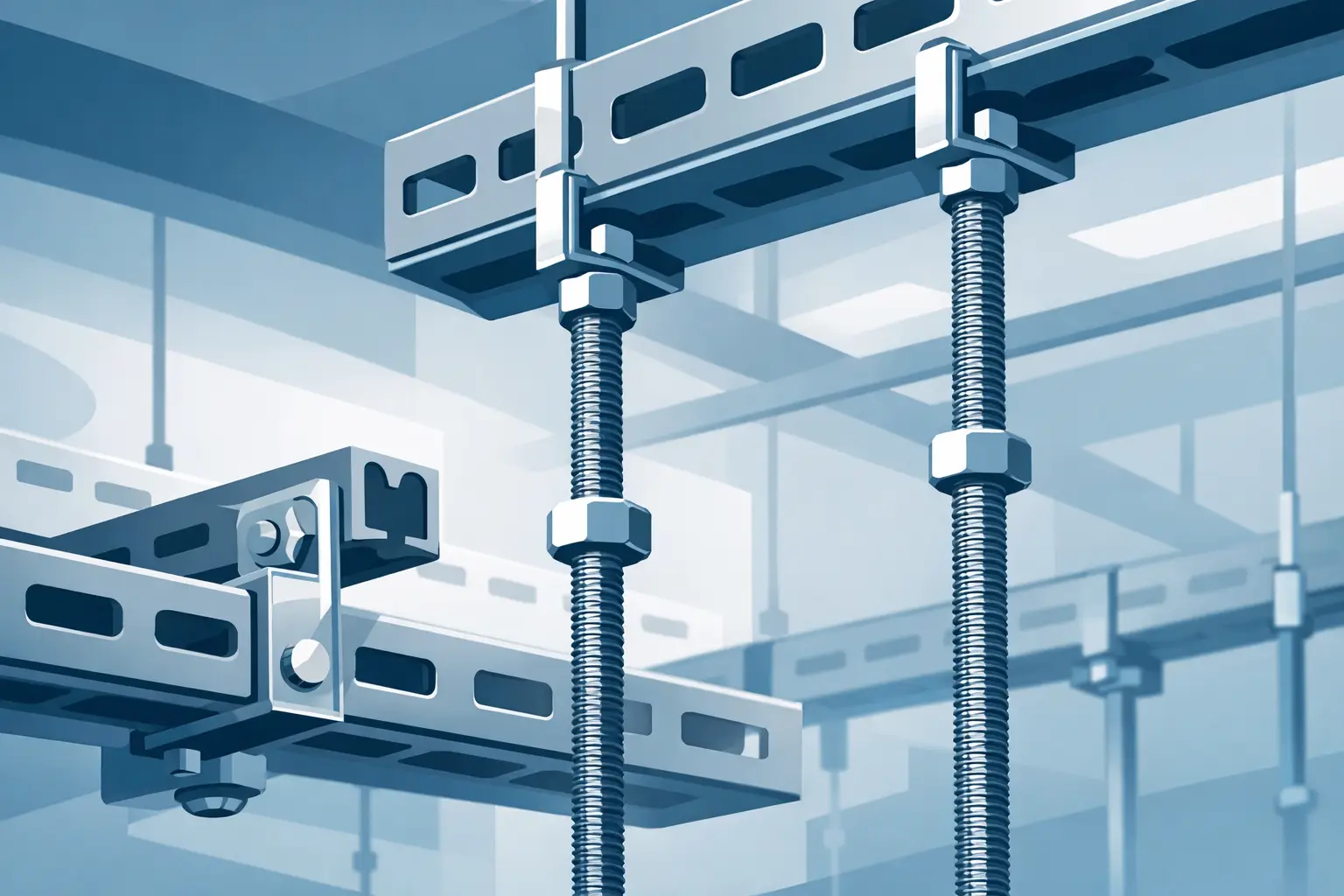
A suspended cable tray, pipe rack, or HVAC trapeze is only as dependable as the hardware transferring its load to the structure. Uni strut threaded rods provide that critical vertical connection, pairing with strut channel, spring nuts, washers, and fittings to create adjustable support assemblies for commercial and industrial installations.
For procurement teams and engineers, the requirement is rarely just “threaded rod.” Diameter, thread form, material grade, finish, length, channel compatibility, and load path must align with the application. A rod that fits the assembly but cannot withstand the environment or specified load creates avoidable risk, rework, and schedule pressure.
What Uni Strut Threaded Rods Do in a Support System
Threaded rod is a continuously threaded metal bar used to suspend, secure, or position strut framing and attached services. In a typical overhead trapeze, two vertical rods anchor into the building structure. A horizontal strut channel spans between them, creating a support point for conduit, piping, ductwork, cable tray, or equipment.
The continuous thread is what makes the system adaptable. Nuts and washers can be positioned along the rod to set elevation, level a channel, and secure the assembly without welding or field drilling. That adjustability is especially valuable where site dimensions vary from drawings, multiple services share a corridor, or installers need to coordinate around existing utilities.
Uni strut threaded rods are commonly specified for electrical, mechanical, plumbing, data-center, solar, process, and general construction work. They also support machine guards, light-duty equipment frames, and custom industrial assemblies. The correct configuration depends on the imposed load, anchor design, span, spacing, seismic requirements, corrosion exposure, and governing project specifications.
Start With the Complete Load Path
A threaded rod should not be selected as an isolated item. Its performance is tied to every component above and below it: the structural anchor, rod, nuts, washers, channel, channel nut or fitting, and the supported service. The assembly is limited by its weakest approved component.
For example, increasing rod diameter may improve the rod’s tensile capacity, but it does not automatically increase the allowable capacity of the concrete anchor, channel span, channel nut, or attachment point. Similarly, a heavy-duty channel cannot compensate for undersized rod, poor anchor embedment, or inadequate edge distance in concrete.
Engineers should establish the actual loading condition before finalizing hardware. Consider dead load, operating load, concentrated equipment weight, dynamic or vibration effects, lateral forces, wind exposure for exterior applications, and seismic demands where applicable. Where systems support life-safety services or critical infrastructure, installation details and applicable codes should be reviewed by the responsible design professional.
The practical objective is straightforward: specify a system in which every part is compatible, traceable, and capable of carrying its portion of the intended load with the required safety factors.
Choosing Diameter, Length, and Thread Type
Rod diameter is generally the first dimensional decision. Common imperial sizes used in strut systems include 1/4 inch, 3/8 inch, 1/2 inch, 5/8 inch, and 3/4 inch, although project requirements may call for additional sizes. Larger diameters generally provide greater tensile capacity and stiffness, but they add material cost, weight, and may require matching fittings or larger anchors.
Length should account for the anchor connection, required drop, channel depth, washers and nuts, leveling adjustment, and enough usable thread for secure engagement. Ordering rod that is exactly the measured drop often leaves little room for field adjustment. Excess length, however, can create interference, present a safety concern, or require cutting during installation. The most efficient solution depends on whether standard stock lengths or cut-to-length production better serves the project.
Thread type must also match the rest of the assembly. In US construction applications, Unified National Coarse threads are widely used for general-purpose support hardware because they assemble quickly and provide dependable engagement in standard nuts and channel accessories. Fine-thread rod may be appropriate for specialized requirements, but it should not be substituted without confirming component compatibility.
Thread quality matters at installation. Clean, consistently formed threads allow nuts to travel smoothly and achieve full engagement. Damaged threads, inconsistent coating buildup, or poor dimensional control can slow field work and lead to cross-threading, loose connections, or rejected material.
Material and Finish Must Match the Environment
Finish selection is often where short-term purchase price conflicts with long-term service performance. The right choice depends on indoor humidity, chemical exposure, coastal conditions, washdown procedures, temperature, and the expected service life of the installation.
Plain mild steel rod may suit controlled indoor environments where corrosion is not a meaningful concern and the project specification permits it. Zinc-plated rod is commonly used for dry interior applications and provides a practical level of protection for many general construction assemblies. It is not, however, a universal corrosion solution.
Hot-dip galvanized threaded rod is better suited to exterior installations and environments where moisture exposure is expected. Its heavier zinc coating provides stronger corrosion resistance than typical electroplating, though designers should account for coating thickness, mating hardware compatibility, and the potential for thread fit issues if components are not produced to the appropriate tolerances.
Stainless steel threaded rod is often selected for corrosive, hygienic, marine, food-processing, pharmaceutical, or washdown environments. Grade selection matters. Stainless steel does not mean identical resistance in every setting, and chloride-rich locations may demand a more corrosion-resistant alloy than a general indoor stainless application.
Where dissimilar metals are present, galvanic corrosion should also be considered. The channel, rod, nuts, washers, clamps, anchors, and adjacent materials should be evaluated as a system rather than purchased independently by finish alone.
Compatibility Is More Than “It Fits”
Strut framing is valued because it is modular, but modularity still requires dimensional discipline. The rod must work with the channel’s spring nuts, rod couplers, beam clamps, post bases, brackets, and other fittings used in the assembly. A nominal diameter match is not enough if thread standards, coating thickness, slot dimensions, or accessory geometry differ.
For unistrut-compatible systems, verify the channel profile, gauge, slot pattern, and fitting dimensions against the design requirement. This is particularly relevant when sourcing components from multiple vendors. A mixed assembly may appear workable during a dry fit yet create inconsistent engagement, alignment issues, or installation delays at scale.
Commercial buyers should also specify whether rod is supplied with matching nuts and washers, pre-cut lengths, chamfered ends, identification, packaging by project zone, or other fulfillment details. These decisions reduce field sorting and help installers keep work moving when material reaches the jobsite.
When Custom Manufacturing Adds Value
Standard threaded rods cover many support applications. Custom production becomes valuable when a project requires nonstandard lengths, special materials, alternate thread forms, formed ends, welded assemblies, unique finishes, or coordinated hardware kits.
For OEMs and repeat industrial programs, custom fabrication can reduce secondary operations and simplify purchasing. A rod can be produced to a controlled length and supplied with associated brackets, channels, clamps, or fabricated support elements, reducing the number of separate vendors involved. This approach is especially useful when tolerances, finish consistency, or packaging requirements are critical to downstream assembly.
Metallix Exports supports both standardized strut hardware and project-specific fabricated components, helping buyers combine compatible support products with manufacturing flexibility. The best manufacturing partner will confirm drawings, material requirements, thread details, coating expectations, inspection needs, and shipment configuration before production begins.
Specify for Installation, Not Just the Bill of Materials
A complete purchase description should make installation intent clear. State the rod diameter and length, thread standard, material, finish, quantity, associated hardware, and any applicable project or testing requirements. If the rod will be cut in the field, define whether cut ends need protection or whether extra length is required. If it will be exposed, identify the actual environment rather than using a generic “corrosion resistant” note.
Quality control should include dimensional verification, thread inspection, finish confirmation, and packaging checks. For export programs, consistent labeling and protected packing are equally important. Thread damage in transit can turn otherwise compliant hardware into a field problem.
Reliable support systems are built from ordinary-looking components that must perform without surprises. When uni strut threaded rods are specified as part of a complete, compatible load path, they give contractors and industrial teams the adjustment, strength, and repeatability required to keep installation work on schedule.


