 E-mail :
 Call Us :
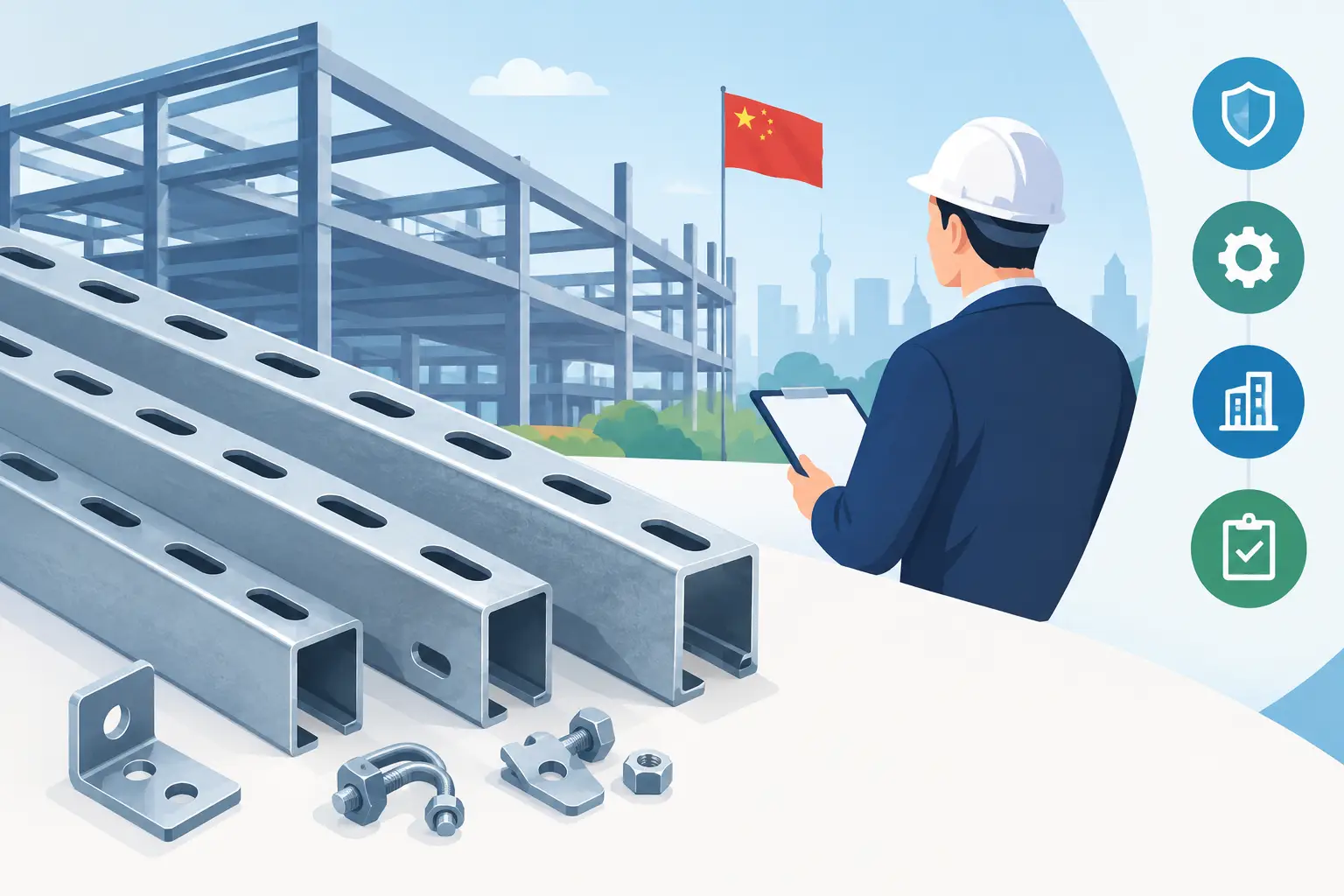
A low unit price can look attractive until a strut channel arrives with an inconsistent slot pattern, undersized wall thickness, or coating that fails before installation is complete. When sourcing uni strut China products, experienced buyers look beyond the catalog image. They define the system, application, material, finish, and verification requirements before production begins.
For contractors, distributors, OEMs, and project procurement teams, strut framing is not a minor commodity purchase. It supports conduit, cable tray, HVAC equipment, pipework, machinery, solar assemblies, and engineered support structures. A small deviation in profile geometry or hardware fit can create delays across an entire installation. The right sourcing process protects both the project schedule and the finished system.
Start With the Required Strut System
“Uni strut” is commonly used in the market to describe metal framing channel and compatible fittings. However, not every channel has the same dimensions, lip geometry, slot layout, load capacity, or accessory compatibility. Buyers should avoid relying on a general product name alone.
Start by establishing whether the requirement is for a specific branded-system equivalent, a compatible channel profile, or a custom strut section designed around the application. Standard profiles may include shallow and deep channels, single channels, back-to-back configurations, solid channels, and slotted channels. Each serves different span, loading, mounting, and adjustment requirements.
The channel dimensions must be documented in a controlled drawing or specification. Width, height, material thickness, inward lip dimensions, slot size, slot spacing, and cut length all affect performance and field fit. This is especially relevant when new channels must work with existing spring nuts, brackets, clamps, beam clamps, post bases, or channel nuts already used on site.
Compatibility Is More Than a Nominal Size
A channel described as 1-5/8 inch may still vary enough to cause problems with installed hardware. The internal opening and lip shape determine whether a channel nut seats correctly and whether fittings tighten without distortion. Slot alignment affects adjustability and connection positioning.
For repeat programs, procurement teams should approve a physical sample or first article against the mating hardware. This simple step is more meaningful than comparing broad catalog dimensions. It confirms that the full assembly works as intended, not just that one component appears close to specification.
Define Material and Coating for the Environment
Material selection should follow the operating environment, expected load, corrosion exposure, and fabrication requirements. Mild steel is widely used for indoor structural support where cost efficiency and strength are primary considerations. Pre-galvanized steel can suit many general commercial applications, while hot-dip galvanized channel offers stronger corrosion resistance for outdoor, industrial, and moisture-prone environments.
Stainless steel may be necessary for food processing, chemical exposure, marine locations, washdown areas, or highly corrosive conditions. Aluminum is useful where reduced weight or natural corrosion resistance is required, although its strength, stiffness, and compatibility with other metals must be evaluated carefully.
Finish requirements need the same level of precision as the base material. “Galvanized” is not a complete instruction. Buyers should specify the coating process, required coating weight or thickness where applicable, appearance expectations, and whether cut edges, weld zones, or fabricated fittings require post-fabrication protection. For a strut system, the finish must also be consistent across channels, brackets, clamps, fasteners, and accessories. Mismatched protection levels can shorten the service life of the overall installation.
What to Include in a Uni Strut China RFQ
A well-prepared request for quotation reduces back-and-forth and makes supplier comparisons more reliable. It should communicate the actual production requirement rather than only a product description. At minimum, provide:
- Channel drawings with all critical dimensions, tolerances, hole or slot patterns, and cut lengths
- Material grade, nominal thickness, mechanical property requirements, and approved substitutions
- Surface finish and corrosion-protection requirements
- Compatible accessory details, including nuts, bolts, brackets, clamps, and welded assemblies
- Required testing, inspection records, labeling, packaging, and shipment quantities
- Forecast volume, order frequency, target delivery timing, and destination requirements
If the project has published engineering standards, installation requirements, or third-party approval requirements, include them before quotation. A supplier cannot accurately price controls that were not disclosed. More importantly, late-added requirements often lead to avoidable cost changes and schedule pressure.
Evaluate Manufacturing Control, Not Just Capacity
Many factories can roll-form or fabricate standard strut channel. The more useful question is whether the supplier can maintain the same profile, thickness, finish, and fit across production runs. That depends on tooling condition, material control, process documentation, inspection discipline, and the ability to manage associated hardware under one quality plan.
For punched or slotted channel, confirm how the supplier controls slot location, burrs, deformation, and hole-to-end dimensions. Improper punching can leave sharp edges, reduce fit-up quality, or create variation that becomes visible during installation. For welded brackets and support assemblies, review weld size, weld placement, distortion control, cleaning, and finish restoration after welding.
Thickness deserves particular attention. It should be verified using the agreed measurement method and stated as the applicable base-metal thickness, not a vague overall figure that may include coating. If structural capacity is critical, request material certificates and confirm whether the design is based on tested load ratings, engineering calculations, or a defined customer-provided requirement.
First Articles and Production Inspection
A first article inspection is a practical control for new tooling, custom slot patterns, unusual finishes, and assemblies with multiple mating parts. The approved sample becomes the reference for future production. It should capture critical dimensions, material confirmation, coating condition, fit with accessories, marking, and packaging.
For larger orders, buyers may also require in-process inspection and final pre-shipment verification. The inspection plan should focus on characteristics that affect use in the field: channel profile, wall thickness, slot pitch, straightness, cut length, coating coverage, thread engagement, and correct kit contents. Checking only appearance is not enough for structural hardware.
Consider Logistics at the Design Stage
Strut channel is long, heavy, and vulnerable to damage when bundled poorly. Export packaging should keep channels straight, protect finished surfaces, separate different sizes, and prevent fittings from shifting during transit. Bundle labels should identify the profile, length, finish, quantity, purchase order, and batch where traceability is required.
Shipment planning also affects the best product format. Standard full lengths may minimize fabrication cost but increase freight complexity. Pre-cut lengths can reduce on-site labor and waste, though they require accurate schedules and may increase handling requirements. Bundled channel with matching fittings can simplify receiving for project installations, especially when work is phased across multiple locations.
For US-bound or international orders, procurement teams should also establish commercial terms, documentation responsibilities, tariff classification support, and delivery-point requirements early. These details do not change the channel’s engineering performance, but they can materially affect landed cost and delivery certainty.
Choose a Supplier That Can Support the Full Assembly
Sourcing channel from one vendor and hardware from several others can create hidden risk. Differences in tolerances, plating, thread quality, and compatibility may only appear during installation. A manufacturing partner with capability across channels, brackets, clamps, nuts, post bases, welded fabrications, and custom sheet metal components can reduce that fragmentation.
The best fit depends on the program. A straightforward distributor order may only require standard, readily available profiles. An OEM or infrastructure project may need custom punching, formed brackets, welding, assembly, controlled finishes, and repeatable export packaging. In those cases, a supplier should be evaluated as a production partner, not simply as a source of channel.
Metallix Exports supports unistrut-compatible framing systems and custom fabricated hardware with specification-driven manufacturing, quality control, and export-ready fulfillment. The objective is straightforward: supply components that fit correctly, perform consistently, and arrive ready for the next stage of the project.
Before releasing the next order, put the channel drawing, mating hardware, coating requirement, inspection plan, and packaging details in one controlled specification. That discipline turns a basic uni strut purchase into a dependable supply program.