
 E-mail :
 Call Us :
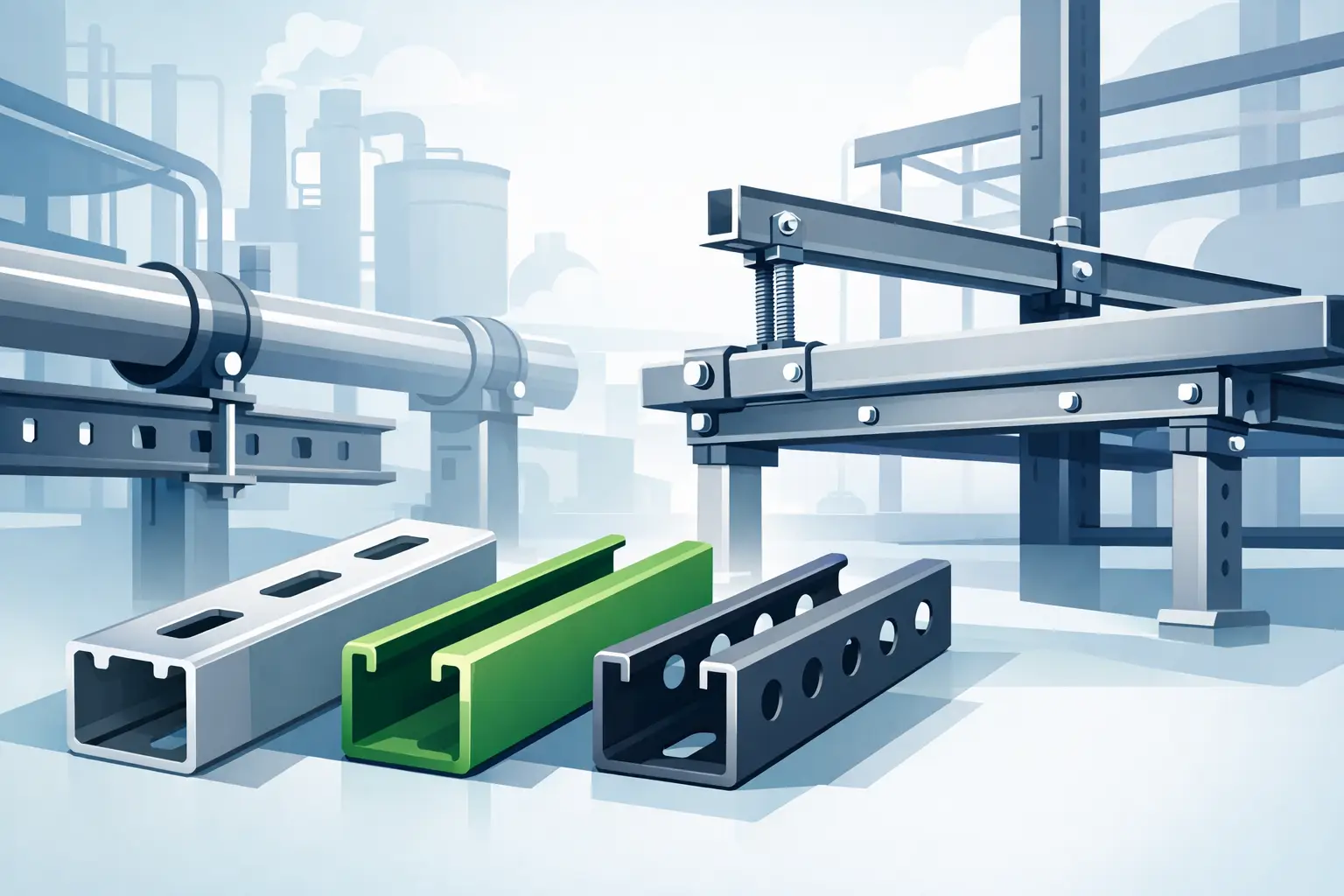
When a support system fails, the cost rarely stops at the hardware. Delayed installation, field rework, alignment issues, and inspection problems can quickly affect the entire project schedule. That is why uni strut channels remain a standard choice across electrical, HVAC, mechanical, construction, and industrial applications where dependable support and installation flexibility matter.
Uni strut channels are used to create framing and support systems for conduit, cable trays, piping, ductwork, equipment mounts, panel structures, and custom assemblies. Their value is not only in basic load support. It comes from the combination of strength, repeatability, adjustability, and compatibility with a wide range of brackets, clamps, spring nuts, fittings, and fastening hardware. For contractors, OEMs, and procurement teams, that translates into faster installation, cleaner layouts, and fewer surprises on site.
What makes uni strut channels so widely specified
The appeal of uni strut channels is straightforward. They provide a modular metal framing solution that can be configured in the field or produced to project-specific requirements. Instead of fabricating every support from scratch, installers can work from a proven channel-based system that accepts standard accessories and allows adjustment during assembly.
That flexibility matters in real-world projects. Mechanical and electrical layouts often change during construction, and equipment dimensions can vary from the drawing set. A properly manufactured channel system gives teams room to adapt without compromising structural integrity. Slots, hole patterns, channel depth, material grade, and finish all affect how well the system performs in service.
For buyers, the specification process should go beyond selecting a nominal channel size. Load requirements, environmental exposure, corrosion resistance, connection method, span length, and accessory compatibility all need to line up with the application. A channel that works well in an interior electrical room may not be the right choice for rooftop HVAC support, marine exposure, or corrosive industrial settings.
Where uni strut channels are used
In commercial and industrial construction, uni strut channels are commonly selected for overhead and wall-mounted support systems. Electrical contractors use them for conduit routing, trapeze supports, cable management structures, and panel mounting. HVAC teams use them for duct supports, pipe hangers, condenser stands, and equipment frames. In industrial facilities, they are often integrated into machine guarding, utility racks, support skids, and maintenance platforms.
OEM applications are equally important. Manufacturers use channel systems inside equipment assemblies, support frames, control panel structures, battery racks, and modular enclosures. In these cases, dimensional consistency becomes critical. If channel profile, slot placement, or material thickness varies too much, it affects downstream assembly and can create fit-up problems across multiple production runs.
This is where manufacturing discipline matters as much as product design. Consistent punching, accurate forming, controlled tolerances, and dependable finishing are what turn a standard channel profile into a usable production component.
Material and finish selection for uni strut channels
Material choice should always follow the service environment and the mechanical demands of the application. Mild steel remains a common option for general indoor use because it offers solid strength and cost efficiency. For projects where corrosion protection is required, galvanized finishes are often specified to improve durability in exposed or humid conditions.
Stainless steel is frequently preferred in food processing, marine, chemical, clean-room, and high-corrosion environments. It carries a higher material cost, but that trade-off is often justified by service life and reduced maintenance risk. Aluminum can also be a practical choice where lower weight is beneficial, though it needs to be evaluated against load requirements and connection design.
Finish quality should not be treated as a minor detail. Coating performance, edge condition, and surface consistency affect both appearance and field life. If channels are cut, punched, and formed without proper process control, exposed edges and inconsistent finishing can reduce corrosion resistance and create problems during installation.
Why profile accuracy matters
A uni strut channel system only performs as intended when the channel geometry is right. The depth, width, lip dimensions, slot spacing, and straightness all influence how the channel accepts fittings and how loads are transferred through the assembly. Poorly formed channels may still look similar at first glance, but they tend to create friction in the field - spring nuts bind, brackets sit unevenly, and alignment takes longer than it should.
For project buyers managing volume orders, profile consistency across batches is especially important. If one shipment fits correctly and the next requires field modification, the cost of inconsistency shows up immediately in labor hours and schedule pressure.
Standard versus custom channel production
Not every project can be served by off-the-shelf dimensions alone. Many buyers need uni strut channels in custom lengths, hole configurations, material grades, wall thicknesses, or finishes to match exact engineering drawings. Others need fabricated assemblies that combine channels with brackets, gussets, plates, clamps, or welded subcomponents.
The right production partner should be able to support both requirements. Standardized channel lines help with speed and interchangeability, while custom manufacturing helps reduce secondary processing, simplify installation, and improve fit for specialized applications. For OEMs and larger construction packages, this can reduce the number of vendors involved and improve procurement control.
A custom requirement does introduce added planning considerations. Lead times may depend on tooling, finish availability, inspection requirements, and shipping volume. That does not make custom channels less attractive. It means the supplier should have the engineering and production structure to translate drawings into repeatable output without compromising delivery.
What procurement teams should evaluate
Price matters, but it should not be the only filter when sourcing uni strut channels. Industrial buyers usually feel the effects of poor sourcing later, not at the quote stage. If the channels arrive with inconsistent dimensions, rough slotting, inadequate finish, or incomplete hardware compatibility, the project absorbs the cost.
A stronger evaluation starts with manufacturing capability. Buyers should look at whether the supplier can control cutting, punching, bending, welding, forming, and finishing in a disciplined production environment. Quality systems matter here because channel products often appear simple while carrying strict fit and performance expectations.
Export readiness is another practical consideration for international buyers and distributors. Packaging quality, labeling accuracy, documentation support, and shipment coordination are all part of a reliable supply program. A capable manufacturer should be able to serve both recurring standard demand and project-based custom requirements without creating avoidable delays.
The role of accessory compatibility
Channels are only one part of the support system. Their usefulness depends heavily on compatibility with spring nuts, hex nuts, clamps, beam fittings, angle brackets, post bases, joining plates, and other framing accessories. Even slight dimensional variation can affect how these components fit and perform together.
That is why buyers often prefer suppliers who understand the full support system rather than only the channel profile itself. A broader manufacturing approach helps ensure that the channel and the associated hardware work as a complete assembly, not as a mix of parts that happen to share similar dimensions.
Why manufacturing partnership matters
For contractors and OEM buyers, uni strut channels are not just commodity metal sections. They are part of a larger system that needs to arrive on time, fit correctly, and perform under load. The supplier's ability to maintain tolerances, offer material and finish options, support custom fabrication, and ship reliably can have a direct effect on installation efficiency and project risk.
This is where an engineering-focused manufacturer adds value. Metallix Exports supports standardized and custom metal components for industrial and construction applications, including unistrut-compatible systems produced with attention to specification, finish, and delivery discipline. That approach is useful for buyers who want more than a catalog item and need a dependable production partner for repeatable supply.
The strongest channel solution is usually the one that fits the job without forcing workarounds in the field. When material selection, profile accuracy, accessory fit, and production quality are aligned from the start, uni strut channels do what they are supposed to do - carry the load, simplify installation, and keep the project moving.


