
 E-mail :
 Call Us :
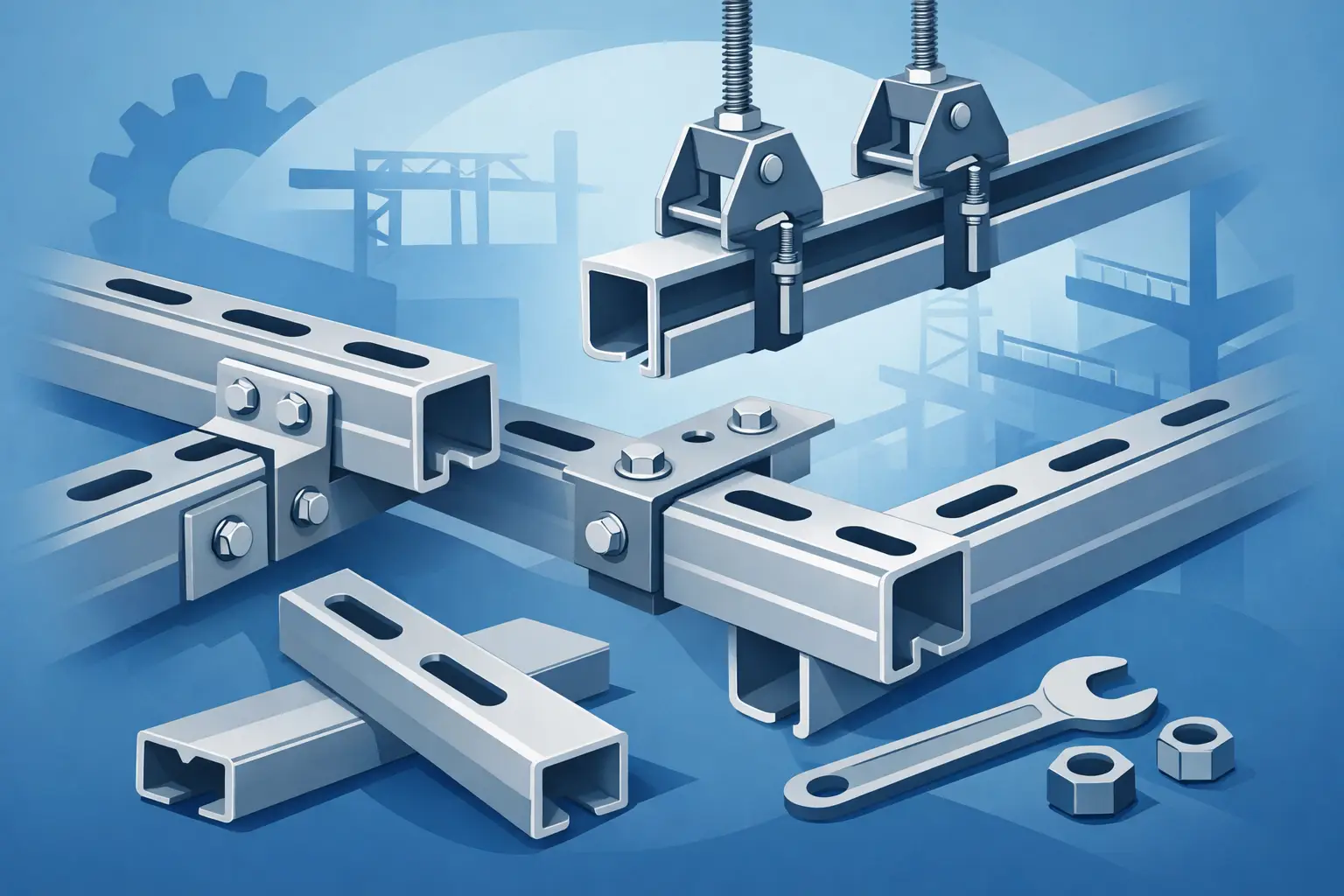
A support system can look straightforward on a drawing and still become a source of delays, rework, or safety concerns in the field. Buyers searching for uni strut channnels are usually looking for more than a formed metal profile. They need compatible dimensions, dependable load performance, corrosion protection suited to the environment, and hardware that arrives ready to install.
Uni strut channels are widely used to create adjustable framing and support assemblies for electrical conduit, cable tray, pipework, HVAC equipment, solar structures, machinery guards, and general industrial installations. Their value is in the combination of strength and flexibility: installers can assemble, reposition, and expand a structure without welding or drilling every connection point. That flexibility only performs as intended when the channel, fittings, fasteners, and finish are specified as one system.
What Defines a Quality Uni Strut Channel?
A uni strut channel is a cold-formed metal section with inward-facing lips that accept channel nuts and compatible fittings. The slot pattern, wall thickness, profile geometry, and material grade determine how the channel works under load and how easily it integrates with standard accessories.
Common profiles include shallow channels for lighter support duties, standard-depth channels for general framing, and deep or reinforced sections for longer spans and higher loads. Slotted channel allows attachment points to be adjusted along the run, while solid channel can be appropriate where a continuous profile is preferred or where localized strength and a cleaner appearance matter more than adjustment.
Profile compatibility deserves close attention. “Unistrut-compatible” is often used broadly in procurement, but nominally similar channels may differ in lip dimensions, slot spacing, gauge, and tolerances. A channel that accepts a nut in a sample assembly may not provide the intended fit, pull-out resistance, or alignment across a large installation. For repeatable site assembly, buyers should confirm the complete dimensional interface rather than relying on a product name alone.
Selecting Uni Strut Channels by Application
The right channel begins with the load path. Engineers and contractors should identify the supported item, its operating weight, span between supports, point loads, anticipated vibration, and whether the assembly will see impact or seismic movement. Channel capacity is not simply a function of metal thickness. Span length, support condition, eccentric loading, connection design, and the capacity of the bracket or anchor all affect the final result.
For electrical and data infrastructure, slotted galvanized channel is frequently selected for its installation flexibility and broad accessory compatibility. Cable trays, conduit banks, junction boxes, and panel supports often require field adjustment as routes change around existing services. The channel must also work with the selected clamps, threaded rods, beam clamps, and post bases without creating clearance issues.
HVAC and mechanical supports may place greater emphasis on concentrated equipment loads, vibration, and corrosion exposure. Rooftop installations, process plants, and chilled-water systems can require heavier gauge channel, reinforced brackets, or stainless steel components depending on the service environment. When pipe insulation is present, the assembly must account for the pipe shoe, clamp geometry, and the actual centerline of the load rather than treating the pipe diameter as the only dimension.
Industrial machinery, safety barriers, and custom workstations often benefit from fabricated channel assemblies rather than individual catalog parts. Welded frames, formed brackets, base plates, gussets, and preassembled hardware can reduce field labor and improve consistency. This approach is particularly useful where a project requires a standard channel interface combined with unique mounting dimensions.
Material and Finish Choices That Affect Service Life
Mild steel remains a practical option for indoor, controlled environments because it offers strength, formability, and cost efficiency. A painted, powder-coated, or plated finish may provide adequate protection where moisture and chemical exposure are limited. The trade-off is that finish damage at cut edges, drilled holes, or installation contact points can create corrosion risks if the environment is more demanding than expected.
Pre-galvanized and hot-dip galvanized steel are common choices for construction, outdoor support systems, and humid locations. Pre-galvanized material provides a consistent coated surface for many general applications, while hot-dip galvanizing typically offers more substantial protection for severe outdoor exposure. Neither option should be selected by label alone. Coating thickness, fabrication sequence, edge treatment, and the project’s exposure classification should guide the decision.
Stainless steel is often specified in coastal, marine, washdown, food-processing, chemical, and high-humidity environments. It offers strong corrosion resistance, but the correct grade still depends on the chemicals present, chloride exposure, temperature, and cleaning process. Stainless components also carry a higher material cost, so they should be used where lifecycle performance justifies the investment.
Aluminum channel may be useful where weight reduction and corrosion resistance are priorities, particularly in certain marine or equipment applications. However, its structural behavior, fastening requirements, and interaction with dissimilar metals need careful review. Combining aluminum with stainless or galvanized components without considering galvanic corrosion can shorten service life in wet environments.
Dimensions, Tolerances, and Hardware Compatibility
A channel purchase specification should state more than width and length. It should define profile type, nominal and minimum material thickness, slot dimensions and pitch, material standard, finish, cut length tolerance, burr requirements, packaging method, and required inspection documentation. For export orders, unit conventions, labeling, bundle quantities, and shipping marks should be confirmed early to prevent avoidable receiving errors.
Hardware compatibility is equally critical. Spring nuts, flat plate nuts, channel bolts, washers, angle fittings, splice plates, post bases, pipe clamps, and beam clamps should be matched to the channel profile and intended load. An assembly can fail at the connection even when the channel itself has adequate capacity. Thread engagement, tightening torque, slot orientation, and bracket deformation all matter.
For OEM and distributor programs, consistency across production lots is especially valuable. Changes in gauge, slot position, lip form, or finish quality can disrupt automated assembly, packaging, and downstream installation. A capable manufacturer controls these characteristics through defined tooling, calibrated production equipment, in-process checks, and final inspection procedures.
When Standard Channel Is Not Enough
Standard sizes are efficient for common support layouts, but they do not solve every project requirement. Custom uni strut channels and related fabrications can address unusual lengths, hole patterns, welded attachments, special coatings, heavier material, project-specific brackets, and packaged assemblies. The goal is not customization for its own sake. It is to reduce installation complexity, eliminate secondary operations, and provide a component that fits the intended application from the start.
For example, a contractor may need channel sections cut to exact lengths with deburred ends, pre-punched mounting holes, and matched brackets grouped by installation zone. An OEM may require a proprietary hole pattern, a specific powder-coat color, or a reinforced channel frame that supports equipment during transport as well as operation. These requirements are best reviewed before production, when drawings, tolerances, quantities, and inspection points can be aligned.
Metallix Exports supports this type of sourcing through standard strut support products and custom sheet metal fabrication across cutting, punching, bending, welding, forming, assembly, and surface finishing. This combination can simplify vendor management for buyers who need both compatible channel hardware and application-specific fabricated parts.
Procurement Checks Before Releasing an Order
Before approving a uni strut channel order, procurement teams should confirm the channel profile and dimensions, material and finish, load-related requirements, accessory compatibility, cut-length tolerances, quantity breaks, packaging, and delivery schedule. If the channel will be used in a regulated or engineered installation, required test data, material certificates, coating information, and drawings should be identified before production begins.
Price should be evaluated in context. A lower unit cost can be offset by inconsistent dimensions, poor coating coverage, mixed hardware compatibility, field modification, or delayed replacement shipments. For multi-location projects and export programs, reliable packaging and shipment coordination are part of product quality because damaged or incomplete support hardware can hold up an entire installation.
The most dependable channel system is one specified around the real installation conditions, not just the catalog image. Clear requirements at the start give manufacturers the information needed to deliver components that fit correctly, install efficiently, and support the work long after the project is complete.


