
 E-mail :
 Call Us :
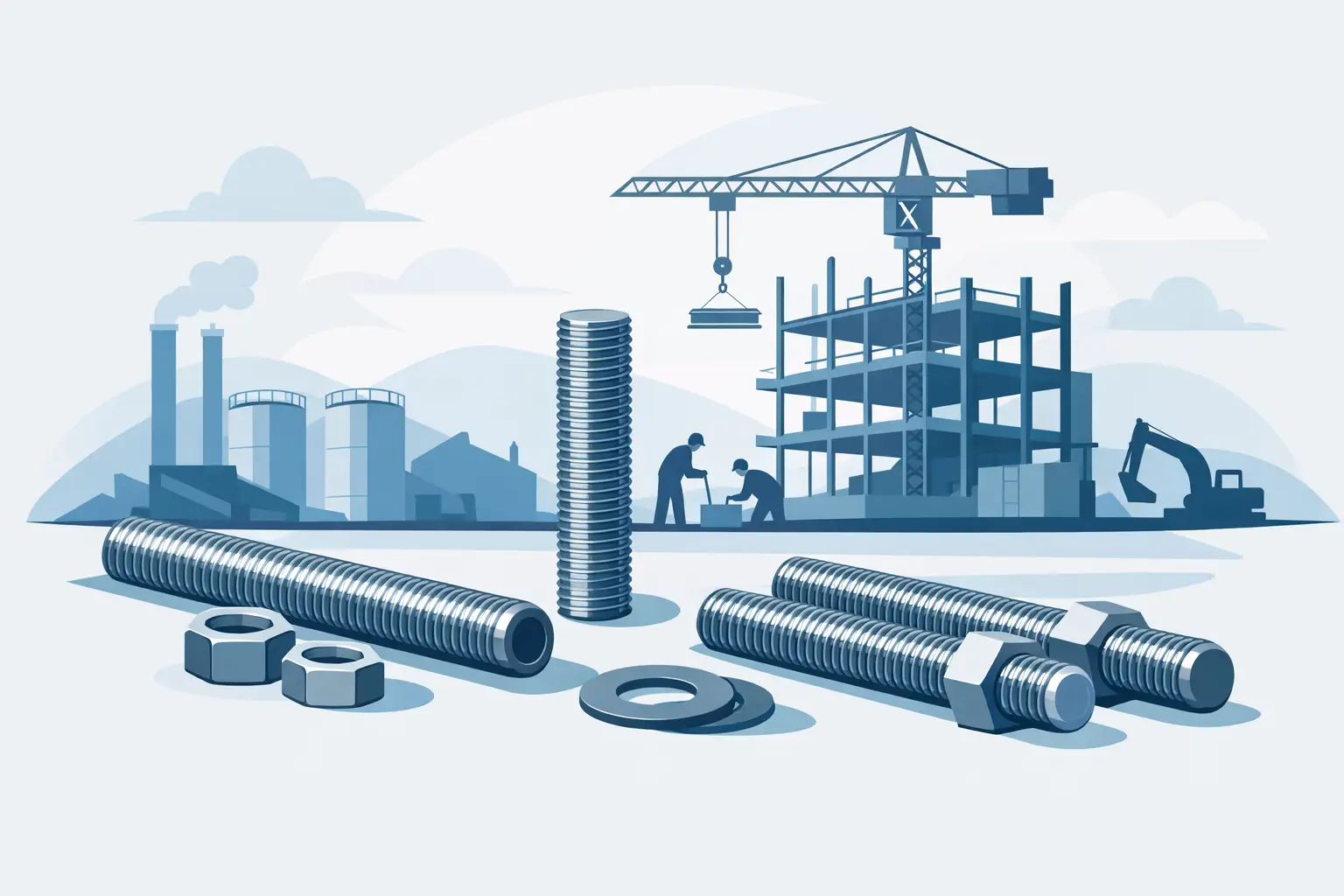
When a project calls for load support, adjustable installation, or reliable field fastening, thread rods often become one of the most practical components on the bill of materials. They are simple in form, but in industrial and construction applications, their performance depends on exact dimensions, material selection, thread quality, finish, and compatibility with the surrounding hardware.
What thread rods do in real applications
Thread rods are externally threaded fasteners designed to work with nuts, washers, anchors, couplers, and support hardware. In practice, they are used to suspend piping, HVAC systems, cable trays, ductwork, strut frameworks, equipment assemblies, structural connections, and foundation-related hardware. Their value comes from versatility. A single threaded rod can be cut to length, adjusted in the field, joined with couplers, and integrated into multiple support systems without requiring complex machining at the installation stage.
That flexibility matters to procurement teams and contractors because it reduces sourcing complexity. Instead of carrying multiple specialized fasteners for every support condition, buyers can standardize around a thread rod system that works across many installation scenarios. For OEMs and fabricators, the same principle applies. Consistent thread accuracy and dimensional control help assemblies move from drawing to production with fewer fitment issues.
Why specification matters more than the part looks
At a glance, a thread rod may appear interchangeable across suppliers. In actual use, small manufacturing differences can create installation delays or performance risk. Thread pitch consistency affects nut engagement. Straightness affects alignment through channels, supports, and mounting points. Diameter tolerance influences load behavior and compatibility with anchors or couplings. Surface finish affects corrosion resistance and service life.
For industrial buyers, this is where thread rods stop being commodity items and become specification-driven hardware. A rod installed in an indoor support frame has different demands than one exposed to moisture, salt, chemicals, or vibration. A suspended HVAC load has different priorities than a concrete anchoring application. The right selection depends on environment, load path, code requirements, and adjacent components.
Common materials for thread rods
Material choice should follow the application, not just the lowest initial cost. Mild steel thread rods are widely used for general-purpose fastening and support where environmental exposure is limited and cost control is important. They are common in interior construction, equipment support, and fabricated assemblies.
Stainless steel thread rods are preferred when corrosion resistance is a priority, especially in marine, food-related, chemical, outdoor, and high-moisture environments. They generally cost more, but they can reduce maintenance issues and premature replacement.
Galvanized options are often selected for construction and infrastructure conditions where extra corrosion protection is required without moving fully to stainless steel. Aluminum and other specialty materials may also be appropriate in weight-sensitive or application-specific assemblies, although load requirements and thread durability need close review.
The trade-off is straightforward. Lower-cost material may work perfectly in controlled conditions, but in exposed environments it can create a much higher lifecycle cost. Over-specifying material, on the other hand, can inflate project spend where standard carbon steel would have performed adequately. Good sourcing decisions come from matching the rod to the service conditions.
Thread quality, tolerances, and fit
For engineers and procurement teams, thread quality is one of the clearest indicators of manufacturing discipline. Clean, consistent threads support smooth nut engagement, proper adjustment, and reliable assembly performance. Poorly formed threads can slow installation, damage mating hardware, and create unnecessary rework in the field.
Tolerances are equally important. Straightness, length accuracy, and diameter consistency affect whether the rod performs as intended once combined with channels, clamps, brackets, washers, and nuts. In export and large-volume supply programs, variation between batches can become a major issue if incoming parts do not match the approved specification.
This is why buyers often prefer a supplier that treats thread rods as part of a complete engineered hardware system rather than as a standalone item. The closer the control over manufacturing and related hardware compatibility, the lower the risk during assembly and installation.
Where thread rods are used most often
In construction, thread rods are heavily used in suspended mechanical and electrical systems. They support strut channels, trapeze hangers, pipe brackets, duct assemblies, and cable management frameworks. Because they allow on-site height adjustment, they help installers achieve alignment without redesigning the support layout.
In industrial settings, they are used in machinery support, equipment mounting, guard structures, fabricated frames, and maintenance assemblies. In foundation and anchoring work, threaded rods may be integrated into post bases, embedded connections, or structural hold-down systems, depending on the design.
Marine and dock applications can also rely on threaded hardware where corrosion resistance and secure fastening are critical. In these environments, finish and material selection are not secondary details. They are central to product life and safety.
Standard versus custom thread rods
Standard thread rods are the right choice for many routine installations. They support fast procurement, predictable pricing, and compatibility with common nuts, washers, channels, and clamps. For distributors and contractors managing high-volume demand, this standardization simplifies inventory and project planning.
Custom thread rods become necessary when the application has nonstandard length requirements, specific material grades, unique coatings, special threading configurations, or integration with fabricated assemblies. OEM buyers may need rods supplied to exact cut lengths to streamline production. Infrastructure and marine projects may require application-specific corrosion protection. Some assemblies need custom packaging, labeling, or batch traceability to align with procurement and installation workflows.
The decision is not always either-or. Many B2B buyers use standard thread rods for general applications while sourcing custom variants for critical assemblies or export programs. A capable manufacturing partner should be able to support both without forcing the customer into separate vendor channels.
What buyers should evaluate before sourcing
Price matters, but it should not be the only filter. A low unit cost can quickly lose its value if thread engagement is inconsistent, lengths vary outside tolerance, or shipments arrive late. For procurement teams, the stronger evaluation criteria are manufacturing consistency, quality control, material verification, finish reliability, packaging discipline, and lead time performance.
It also helps to assess whether the supplier understands the larger hardware ecosystem. Thread rods rarely work alone. They are used with support channels, clamps, brackets, nuts, washers, anchors, and fabricated metal components. When one supplier can align these products to the same specification and production schedule, project coordination becomes much easier.
Metallix Exports serves this kind of requirement well because many industrial buyers are not simply looking for a rod supplier. They are looking for a manufacturing partner that can support complete hardware packages, custom fabrication needs, and export-ready delivery with consistent production standards.
Production considerations that affect field performance
The quality of thread rods starts long before packaging. Raw material selection, threading method, dimensional inspection, surface treatment, and handling all influence the final result. Even packaging matters. Poor packing can damage threads in transit and create installation issues on arrival.
For international shipments, export readiness is part of product quality. Components must arrive protected, clearly identified, and organized for receiving teams. This becomes even more important for mixed hardware orders where thread rods are shipped alongside brackets, channels, clamps, or welded fabrications.
A disciplined manufacturer should also be prepared to support specification review. That does not mean overcomplicating simple jobs. It means confirming grade, finish, dimensions, thread standard, and intended use before production begins, especially on repeat or project-based orders.
Choosing thread rods with fewer downstream problems
The best thread rod is not always the most expensive or the most specialized. It is the one that fits the load, environment, hardware system, and installation method without creating avoidable risk. For some projects, a standard zinc-coated carbon steel rod will be fully suitable. For others, only stainless steel, tighter tolerances, or custom fabrication support will make sense.
That is why experienced buyers focus on application fit and supplier reliability as much as nominal specifications. When thread rods are produced with accurate threads, dependable materials, and consistent dimensions, they support faster installation, cleaner assembly, and fewer field corrections. And when they come from a manufacturer that can also support related structural and fastening hardware, the procurement process becomes more efficient from planning through delivery.
For projects where every component has to do its job without delay, thread rods are a small detail that carries a lot of responsibility.


