
 E-mail :
 Call Us :
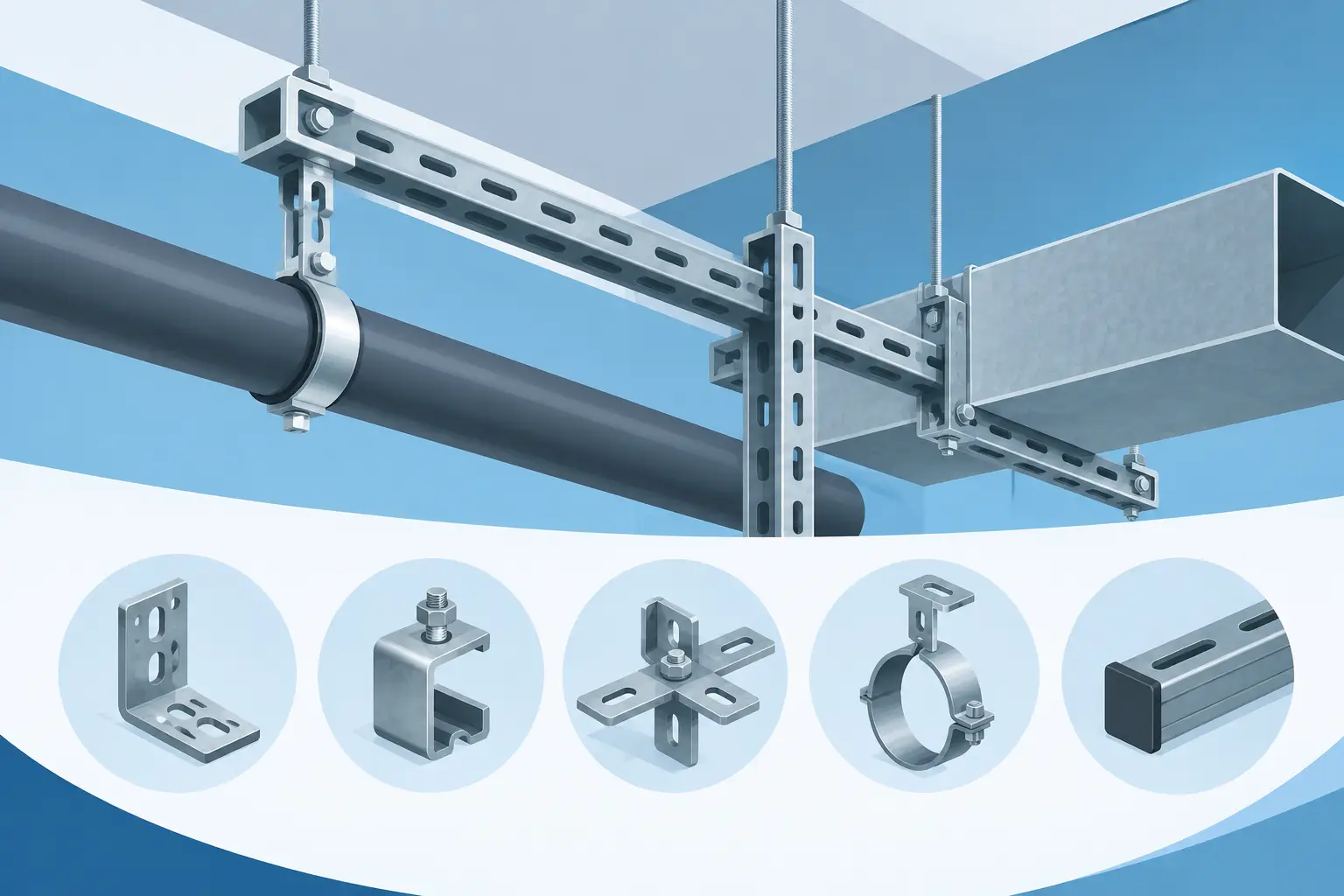
A strut channel is only as reliable as the hardware that connects it. Selecting the right strut fitting types affects load transfer, installation time, corrosion performance, adjustability, and the ability to modify a support system after installation. For contractors, OEMs, and procurement teams, the objective is not simply to source compatible parts. It is to specify a complete support assembly that performs consistently under the actual conditions of the project.
Strut systems are widely used to support conduit, cable tray, HVAC equipment, piping, machinery guards, solar mounting assemblies, and light structural frames. Their modular design makes them practical, but that flexibility also creates choices. Channel size, slot pattern, fitting geometry, material grade, finish, fastener size, and loading direction must work together.
How Strut Fitting Types Support a System
Strut fittings are formed or fabricated metal components that join channel sections, secure channel to a structure, or provide a mounting point for equipment and services. Most are designed for use with standard strut channel profiles, including common 1-5/8-inch channel systems. However, nominal compatibility is not enough. Channel depth, lip dimensions, slot spacing, gauge, and hardware thread size should be verified before release to production or purchase.
The fitting selected determines how forces move through the assembly. A simple angle fitting may be suitable for a lightly loaded cable support, while a cantilever arm carrying pipe requires consideration of bending moment, deflection, anchor capacity, and the strength of the supporting structure. Using a heavier fitting than necessary can add cost and installation weight. Using an underspecified fitting can create movement, misalignment, premature corrosion, or a safety concern.
For industrial buyers, the practical approach is to begin with the connection function: join, support, suspend, brace, mount, or anchor. From there, the required geometry and material can be defined.
Common Strut Fitting Types
Angle Fittings and Corner Brackets
Angle fittings create 90-degree connections between two strut channels or between a channel and a supporting surface. They are commonly used for equipment frames, wall-mounted supports, rack structures, and light-duty bracing. Available configurations include short angle brackets, wide-angle plates, inside corners, outside corners, and multi-hole structural angles.
The number and position of holes matter. A two-hole fitting may provide adequate alignment for a simple connection, while a longer fitting with multiple holes distributes load across a greater length of channel. Slotted holes provide field adjustment, but they can also reduce resistance to movement if the assembly is not tightened correctly. For repeatable OEM assemblies, fixed-hole patterns may offer better positional consistency.
Flat Plates, Splice Plates, and Joining Plates
Flat fittings are used to connect channels in a straight line, reinforce a joint, or create custom mounting surfaces. Splice plates are especially useful when channel lengths must be extended or when a structural transition occurs between channel sections. They may be installed internally, externally, or on both sides of a channel, depending on the required load capacity and access for installation.
A splice connection should not be treated as automatically equivalent to an unbroken channel. Its performance depends on fitting thickness, fastener count, channel gauge, joint location, and applied load. If the channel carries a concentrated load near the splice, engineering review is advisable. Longer splice plates generally improve load distribution, but the right choice still depends on the application.
U-Fittings, Z-Fittings, and Offset Brackets
U-shaped fittings connect parallel channel members and are commonly used in trapeze supports, cross members, and framed structures. Their shape provides a controlled offset and can create a rigid connection where two channel faces need to be held at a consistent distance.
Z-fittings and offset brackets serve a different but equally useful purpose. They allow installers to move a support plane away from a wall, beam, or channel face without fabricating a custom spacer assembly. This is valuable when clearing insulation, avoiding obstructions, or setting conduit and cable tray at a specified elevation. The offset dimension should be reviewed carefully because it can increase leverage on the connection and anchors.
T-Fittings and Multi-Channel Connectors
T-fittings create perpendicular branch connections, while four-hole, six-hole, and multi-channel plates support more complex framing arrangements. These fittings are frequently used in modular equipment bases, pipe support racks, and custom industrial assemblies where several channels intersect.
The advantage of multi-channel connectors is assembly flexibility. The trade-off is that the load path can become less obvious as frames become more complex. Connections should be designed so the primary load is carried through the channel and fitting faces rather than relying on fasteners in a way they were not intended to perform. Clear drawings and consistent hole orientation reduce installation errors on site.
Post Bases, Beam Clamps, and Structural Attachments
Not every strut fitting joins one channel to another. Many fittings attach the system to concrete, structural steel, wood framing, or finished building surfaces. Post bases secure vertical channel sections to a floor or foundation. Wall brackets and stand-off brackets support channels at controlled distances from a wall. Beam clamps attach channel assemblies to structural steel without drilling, where permitted by the project specification.
Attachment hardware requires particular attention because the supporting substrate often governs the allowable load. A heavy strut fitting cannot compensate for an undersized concrete anchor or a thin steel member. Anchor type, edge distance, embedment depth, base material strength, and overhead installation conditions should be confirmed as part of the complete support design.
Pipe Clamps, Conduit Clamps, and Service Supports
Strut channel systems are often selected because they allow services to be mounted with adjustable clamps. Pipe clamps, conduit clamps, cushioned clamps, cable support brackets, and hanger components connect the supported item to the channel framework.
The clamp must match both the outside diameter of the service and the operating environment. Stainless steel pipe may require a compatible clamp material to reduce corrosion risk. Insulated copper tubing may need a cushioned or lined clamp to prevent damage and vibration wear. HVAC, plumbing, and electrical installations can also have code-specific spacing and support requirements that influence fitting selection.
Channel Nuts, Spring Nuts, and Fastening Hardware
Channel nuts are small components with a major role in strut assembly. A standard channel nut engages the inward-facing lips of the strut channel, allowing fittings to be secured without drilling. Spring channel nuts hold their position during installation, which can improve efficiency for overhead work or single-person assembly.
Thread size must match the bolt or threaded rod specification, and the nut must suit the channel profile. Serrated or toothed channel nuts can help resist slipping under load, but tightening torque remains critical. Over-tightening can damage threads or deform lighter-gauge channel. Under-tightening can allow fittings to shift, particularly in systems exposed to vibration.
Material and Finish Selection
Material selection should reflect both mechanical requirements and service conditions. Mild steel fittings are widely used for interior dry applications and can be supplied with finishes such as pre-galvanized, electro-galvanized, or zinc-coated protection. Hot-dip galvanized fittings are commonly specified for outdoor, damp, and corrosive environments where a heavier protective coating is required.
Stainless steel fittings offer strong corrosion resistance for food processing, marine, chemical, coastal, and washdown applications. Aluminum may be appropriate where weight reduction is a priority, although galvanic compatibility must be evaluated when aluminum interfaces with other metals. The lowest initial-cost material is not always the lowest lifecycle-cost choice, especially where maintenance access is limited.
A consistent finish across channel, fittings, nuts, bolts, and clamps is generally preferable. Mixed materials can be necessary in some assemblies, but they should be selected deliberately rather than by availability.
What to Specify Before Ordering
A reliable strut hardware order starts with more than a part description. Procurement documentation should identify the channel series and dimensions, fitting part geometry, material, finish, thickness, hole pattern, thread size, and required quantity. If the fitting is load-bearing, include the load direction, support spacing, installation orientation, and applicable project standards.
For custom parts, a drawing should clearly show critical dimensions, tolerances, bend locations, hole sizes, weld requirements, and finishing specifications. This is particularly important for brackets that must align with existing equipment or interface with nonstandard framing. A supplier with cutting, punching, bending, welding, and finishing capability can consolidate these requirements into a controlled production process rather than leaving the buyer to coordinate several vendors.
Metallix Exports supports standard unistrut-compatible fittings as well as custom fabricated strut hardware for project-specific requirements. Production control, material traceability where required, and export-ready packaging help procurement teams maintain consistency across domestic and international deliveries.
The best fitting is the one that matches the channel, the load, the environment, and the installation method without adding unnecessary complexity. When those details are defined early, a strut support system becomes easier to install, easier to inspect, and more dependable throughout its service life.


