
 E-mail :
 Call Us :
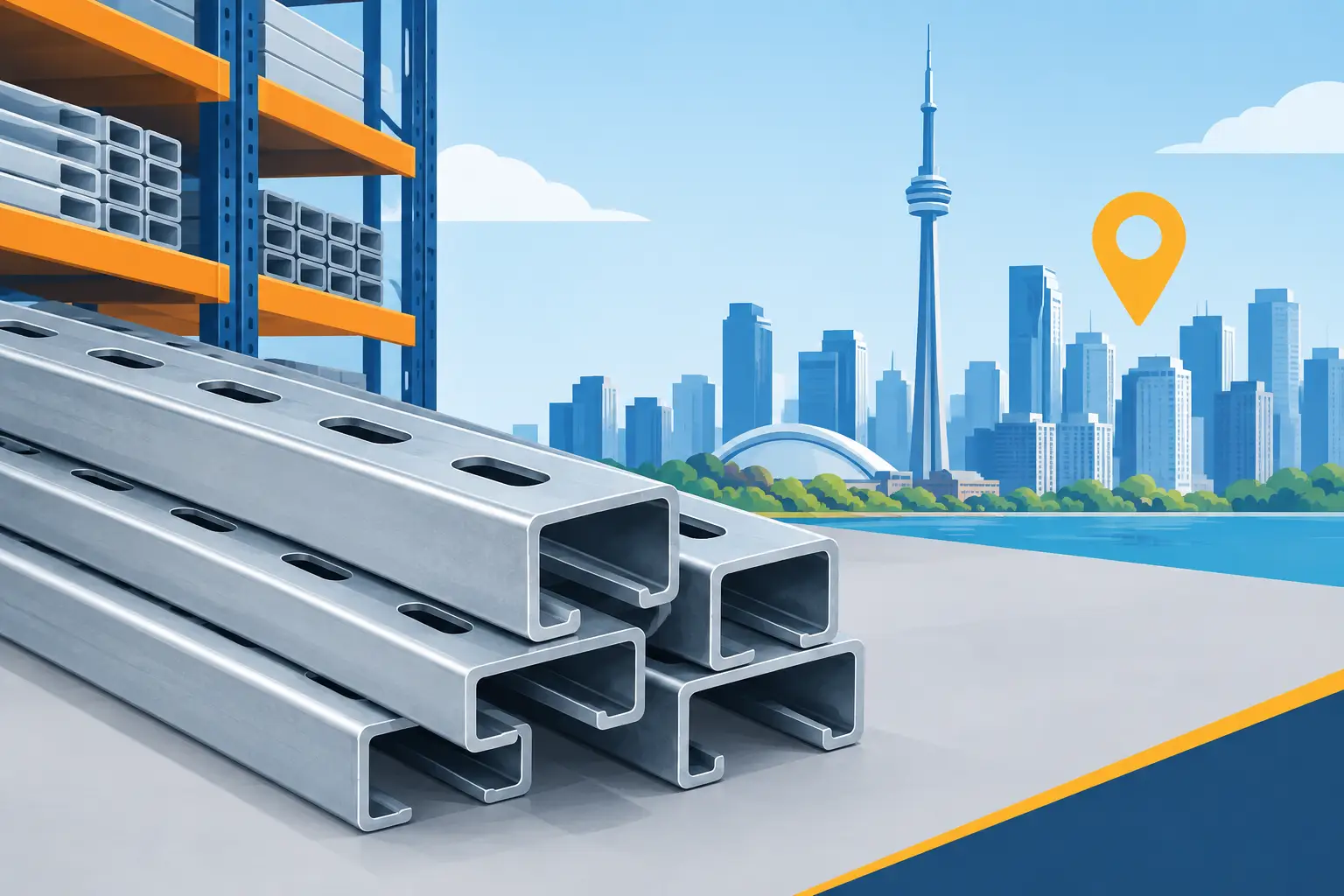
A search for a strut channels supplier near me in Vaughan usually starts when a project cannot wait for mismatched parts, uncertain stock, or a shipment that arrives without the fittings needed to install it. For contractors, OEMs, electrical teams, HVAC fabricators, and industrial buyers, strut channel is not simply a length of formed steel. It is a load-support component that must work predictably with brackets, spring nuts, clamps, threaded rod, and site-specific installation conditions.
The right supplier brings more than available channel sizes. They provide dimensional consistency, compatible hardware, material options, fabrication capability, and dependable fulfillment. That combination reduces sourcing friction and helps keep installation crews, production schedules, and project budgets under control.
What to Expect From a Strut Channels Supplier Near Me in Vaughan
Local access matters when a project requires quick communication, shorter domestic transit, or the ability to clarify specifications before production begins. However, proximity alone should not determine the purchase decision. A nearby distributor may have common sizes on hand, while a manufacturing-focused supplier can provide the custom lengths, hole patterns, finishes, and assemblies that a standard catalog cannot cover.
For most commercial and industrial applications, buyers should expect a supplier to support both standard strut channel and the complete framing system around it. That includes plain or slotted channel, solid and slotted profiles, channel nuts, brackets, clamps, post bases, angle fittings, fasteners, and related structural hardware. Purchasing these items through one capable source helps prevent compatibility issues that can appear when channels and accessories come from unrelated product lines.
Metallix Exports supports this approach with unistrut-compatible support systems and custom sheet metal manufacturing for buyers who need standard hardware alongside application-specific components. For projects serving Vaughan, the GTA, or wider North American supply chains, the value lies in receiving clear technical support and manufacturing discipline without managing multiple vendors for every supporting part.
Start With the Application, Not the Channel Size
A 1-5/8 inch channel is widely used, but it is not automatically the right answer for every installation. The intended load, span, support spacing, orientation, material environment, and connection method all influence the appropriate channel profile and gauge. A light cable support run has very different requirements from a rooftop mechanical frame, pipe rack, solar support structure, or machinery enclosure.
Before requesting a quote, define whether the system will carry static equipment, dynamic loads, vibration, suspended services, or outdoor exposure. Consider whether the channel will be mounted vertically, horizontally, overhead, or in a cantilever arrangement. These details affect the channel selection and, just as importantly, the brackets and anchors required to transfer load safely to the supporting structure.
Galvanized steel is a common choice for general construction and indoor utility framing because it provides practical corrosion resistance at a competitive cost. Stainless steel may be appropriate for food processing, marine, chemical, or high-moisture environments. Aluminum can reduce weight and may suit applications where corrosion resistance is needed, though its structural behavior and connection requirements differ from steel. Material selection should be based on the environment and engineering requirements, not on initial component cost alone.
Channel Profile and Slot Configuration
Plain channel provides flexibility when field drilling or specific connection placement is required. Slotted channel can speed installation by allowing fittings and channel nuts to be positioned without drilling every connection point. The trade-off is that slot patterns must align with the planned hardware and load design.
Single-channel profiles are suitable for many standard support installations. Back-to-back or deeper channel sections provide greater capacity and stiffness where the span or load demands it. A qualified supplier can help buyers compare profile options, but final load validation should follow the project engineer's requirements and applicable codes.
Accessories Are Part of the System
The channel itself is only one part of the assembly. An otherwise suitable channel can become a weak point if the wrong spring nut, clamp, bracket, threaded rod, or anchor is selected. Hardware must fit the channel profile correctly and meet the strength and corrosion requirements of the installation.
This is especially relevant when replacing an existing support system. Compatibility should be confirmed by dimensions and performance requirements, rather than assumed from a familiar product name. “Compatible” should mean the fitting engages correctly, installs as intended, and supports the designed load - not merely that it appears similar in a product image.
Specifications That Improve Quote Accuracy
Clear requirements lead to faster, more reliable quotes. When a buyer sends only a channel length and quantity, the supplier may need several follow-up conversations before confirming the correct material, finish, slot pattern, and accessories. Sharing the full requirement early reduces delays and avoids receiving parts that are technically correct on paper but unsuitable in the field.
For a meaningful quote, provide these details when available:
- Channel profile, width, depth, gauge, and whether the channel is plain, slotted, or continuously slotted
- Material requirement, including mild steel, galvanized steel, stainless steel, or aluminum
- Finish specification, such as pre-galvanized, hot-dip galvanized, powder coated, or unfinished
- Required lengths, cut tolerances, quantity breaks, and packaging preferences
- Hole locations, slot dimensions, punched patterns, bends, welded additions, or assembly requirements
- Related fittings, hardware, clamps, brackets, and any requested compatibility standard
Drawings, photographs of an existing installation, and bill-of-materials information are equally useful. For custom work, a dimensioned drawing is preferable because it establishes the production baseline and reduces ambiguity around hole centers, radii, weld locations, and orientation.
Standard Stock Versus Custom Fabrication
Standard channel products are the right choice when the application follows common dimensions and the buyer needs repeatable, readily available components. They are generally the most economical route for straightforward installations, particularly when standard lengths can be used with minimal cutting.
Custom fabrication becomes valuable when field modification would add labor, create inconsistent results, or compromise coating protection. Pre-cut channel, punched mounting holes, welded brackets, formed tabs, special end plates, and assembled framing kits can all reduce work at the jobsite. This can be particularly effective for repeat installations across multiple facilities, equipment skids, electrical enclosures, or OEM assemblies.
Custom does not always mean expensive. It depends on volume, design complexity, and the labor being removed from installation. A single highly specialized piece may carry higher setup costs, while a repeat production run of pre-fabricated supports can lower total installed cost by reducing cutting, measuring, drilling, and rework.
A capable manufacturer should be able to explain the production route clearly. Cutting, punching, bending, welding, forming, assembly, and finishing should be coordinated to preserve dimensional accuracy and deliver parts ready for use. For projects with stringent tolerances, request confirmation of the critical dimensions rather than relying on general descriptions of capability.
Evaluate Quality Beyond the Product Catalog
A broad catalog is useful, but procurement teams should also assess how consistently the supplier controls production and order fulfillment. In strut systems, minor variations can create major installation problems. Incorrect slot placement can prevent fitting alignment. Poorly formed channel edges can affect hardware engagement. Inconsistent finish coverage can shorten service life in demanding environments.
Ask how material is identified, how dimensions are checked, and how orders are packed for transport. If a project needs multiple parts that must work together, ask whether the supplier verifies the kit against the bill of materials before shipment. These operational details often determine whether the product arrives ready for installation or creates an avoidable receiving issue.
Lead time should also be discussed in practical terms. Standard stock may be available quickly, but custom items require time for engineering review, tooling considerations, fabrication, finishing, inspection, and packing. Reliable suppliers distinguish between production time and transit time, communicate constraints early, and do not treat an aggressive delivery request as a reason to bypass quality checks.
Local Service With Scalable Supply Support
For Vaughan-area buyers, a nearby supplier can simplify coordination for construction schedules, urgent replenishment, and technical discussions. Yet many B2B customers also need the supplier to support projects outside the GTA, whether those projects are in other Canadian provinces, the United States, or international markets.
That is where export-ready capability becomes relevant. Proper packing, commercial documentation, consistent product identification, and coordinated shipping are essential when strut channel and fabricated hardware move across borders. A supplier that understands both local project needs and broader logistics can remain useful as a customer expands rather than becoming another vendor that must be replaced.
The best sourcing decision is rarely based on the lowest per-foot price. It is based on whether the supplier can deliver a channel system that fits, performs, arrives on time, and remains consistent through the next order. Start with the application details, confirm compatibility, and choose a manufacturing partner that treats each specification as part of the finished result.


