
 E-mail :
 Call Us :
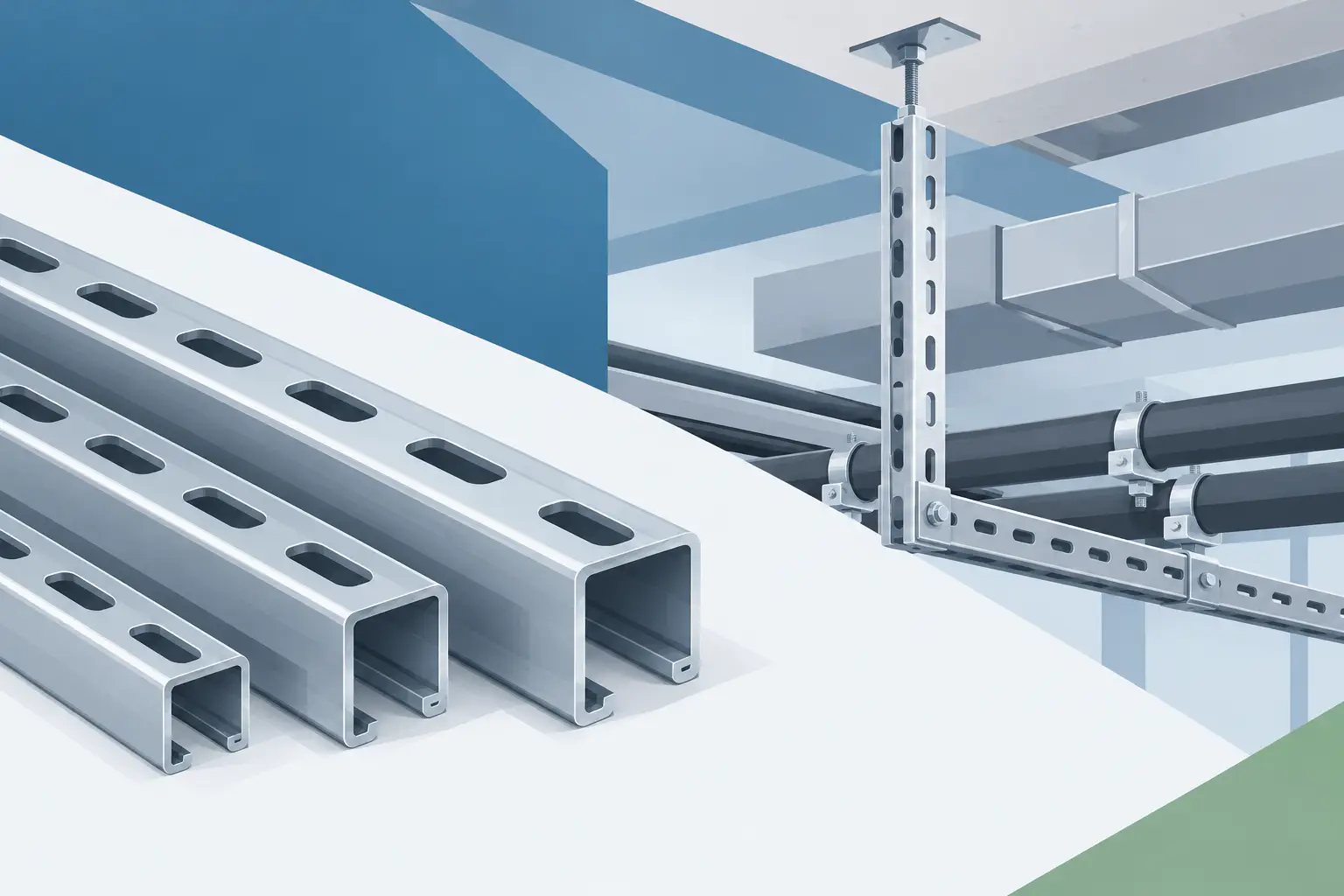
A support system is only as dependable as the channel carrying its load. Strut channels give contractors, OEMs, and facility teams a practical way to build adjustable supports for conduit, cable tray, piping, HVAC equipment, machinery, and secondary steel without field welding or extensive drilling. Their value is not simply the channel profile. It is the ability to create repeatable assemblies using compatible fittings, hardware, and specified material finishes.
For procurement teams, the challenge is rarely finding a channel-shaped product. The real requirement is sourcing components that fit together correctly, perform under the intended conditions, and arrive with consistent dimensions and finish quality. A well-specified strut system reduces installation uncertainty, simplifies future modifications, and helps prevent costly rework on site.
What Strut Channels Do in a Support System
Strut channel is a cold-formed metal framing profile with inward-facing lips that accept spring nuts, channel nuts, bolts, clamps, brackets, and other fittings. This arrangement allows installers to position hardware along the channel length, tighten it in place, and create a structural support assembly without welding.
The design is particularly useful where layouts may change. A pipe run can be adjusted, a cable tray support can be relocated, or additional brackets can be added without replacing the complete frame. That flexibility makes channel systems common in commercial construction, industrial plants, data facilities, mechanical rooms, manufacturing lines, and infrastructure projects.
A channel, however, should never be treated as a universal structural solution. Its suitability depends on span, point loads, load direction, connection design, anchorage, environmental exposure, and the combined behavior of every component in the assembly. The channel may be adequately sized while the bracket, fastener, weld, anchor, or supporting substrate is not.
Selecting the Right Strut Channel Profile
Profile dimensions and wall thickness determine much of a channel's performance. Shallow profiles may suit light-duty electrical support or compact framing. Standard-depth channels are widely used for general mechanical and electrical support. Back-to-back or double-channel configurations provide greater section strength for longer spans, concentrated loads, and more demanding frames.
Slotting is another specification decision. Slotted channels can speed installation and make it easier to attach components at fixed intervals. Solid channels may be preferred where a continuous section is needed, where corrosion protection around openings is a concern, or where the design requires mounting locations to be drilled or punched to a specific pattern.
Channel length also deserves attention during sourcing. Standard stock lengths work for many installations, but they can create unnecessary waste, handling difficulty, or extra joints on large projects. Custom cut lengths, punched holes, end treatments, and bundled kits can reduce site labor and improve installation consistency. For OEM production, repeatable cut and hole patterns can also support faster assembly and more controlled quality.
Load Direction Changes the Decision
Catalog load values are useful starting points, but they are not interchangeable across every arrangement. A channel used as a horizontal beam responds differently from one used as a vertical post, cantilever arm, trapeze member, or braced frame. The location of the load, the span between supports, and whether the channel is oriented open-side up, down, or sideways all affect performance.
Deflection can be as relevant as ultimate capacity. A support may remain structurally intact yet allow excessive movement that affects pipe slope, equipment alignment, cable management, or finished appearance. Projects with vibration, dynamic loading, seismic requirements, thermal movement, or suspended equipment need a more detailed engineering review.
Material and Finish Must Match the Environment
Material selection is a lifecycle decision, not just a line-item cost decision. Mild steel strut channel is widely used indoors in controlled environments and offers an economical foundation for many support applications. Galvanized steel adds corrosion resistance and is often selected for general construction, utility areas, and locations with intermittent moisture exposure.
Pre-galvanized and hot-dip galvanized products do not perform identically. Pre-galvanized material is produced from coated steel and may be suitable for many interior and moderate-exposure uses. Hot-dip galvanizing is typically selected where heavier coating protection is needed after fabrication, particularly for exterior structures and more corrosive environments. Cut edges, punched areas, welds, and fabricated assemblies should be considered when specifying the coating approach.
Stainless steel channels are appropriate where moisture, chemicals, washdown conditions, marine exposure, food processing requirements, or appearance call for higher corrosion resistance. The stainless grade matters. Type 304 suits many general corrosion-resistant applications, while Type 316 is often a better choice where chlorides, coastal conditions, or more aggressive chemical exposure are present.
Aluminum can reduce weight and offers good corrosion resistance in suitable settings, but it has different strength, stiffness, and galvanic compatibility characteristics than steel. When dissimilar metals are present, designers should consider isolation methods and fastener selection to limit galvanic corrosion. Copper and specialty alloys may also be required for specific electrical, architectural, or process applications.
Compatible Hardware Makes the Channel Usable
A channel system performs as an assembly. Spring nuts, channel nuts, square washers, threaded rods, angle fittings, post bases, beam clamps, pipe clamps, and concrete anchors all need to suit the chosen profile and application. A mismatch between channel lip dimensions and channel nut geometry can create poor engagement even when individual parts appear similar.
For this reason, procurement should define compatibility rather than relying on a product description alone. If a project requires components compatible with established Unistrut-style systems, the channel dimensions, slot pattern, fitting geometry, and hardware engagement should be confirmed against the required standard or approved sample.
Fastener grade and coating also affect system reliability. Zinc-plated hardware may be acceptable for dry indoor conditions, while galvanized or stainless fasteners may be required for exposed or corrosive locations. Mixing a corrosion-resistant channel with unsuitable hardware can weaken the assembly's long-term performance.
Fabrication Options That Reduce Field Work
Standard channels are effective for common layouts, but many industrial and construction projects benefit from fabricated channel components. Precision punching can create repeatable mounting patterns for panels, equipment, clamps, or proprietary assemblies. Cutting, bending, welding, and forming can turn channels into purpose-built frames, cantilever brackets, equipment skids, solar supports, dock hardware, or machine guarding structures.
Custom fabrication is especially valuable when a buyer wants to reduce vendor fragmentation. Instead of sourcing channel, brackets, plates, fasteners, and welded subassemblies separately, a manufacturing partner can produce coordinated components to a controlled drawing package. This approach can simplify receiving, improve fit-up, and reduce the variability that comes from assembling parts from unrelated sources.
The specification package should clearly state material grade, thickness, profile dimensions, tolerances, hole diameter and position, weld requirements, finish, packaging, marking, and inspection criteria. For export programs, carton configuration, palletization, corrosion protection during transit, and part identification should be addressed before production begins rather than after goods are ready to ship.
Questions Procurement Teams Should Ask
Before placing an order, buyers should verify more than nominal channel size. Four questions often expose issues early:
- Is the channel profile compatible with the required nuts, fittings, clamps, and legacy installed systems?
- Does the specified material and finish suit the actual indoor, outdoor, chemical, marine, or washdown environment?
- Have load path, span, deflection, anchors, and connection details been reviewed for the completed assembly?
- Can the supplier provide the required lengths, punching, fabrication, packaging, documentation, and delivery schedule consistently?
These questions help distinguish an available product from a supply solution that supports the full project requirement. They also create a clearer basis for comparing quotations, since lower initial pricing can conceal added cutting, coating, installation, or replacement costs later.
Building a More Reliable Supply Program
For recurring OEM and construction demand, consistency matters as much as individual part quality. Lot-to-lot dimensional control supports predictable fitting engagement. Accurate punching supports faster assembly. Controlled welding and surface finishing help fabricated frames arrive ready for installation. Quality checks should reflect the features that affect field performance, including profile dimensions, hole locations, burr control, coating condition, weld integrity, and packaging protection.
Metallix Exports supports standard and custom strut support requirements through precision sheet metal fabrication, structural hardware production, welding, finishing, and export-ready fulfillment. That combination is useful when a project needs catalog-compatible components alongside application-specific brackets or fabricated assemblies.
The best time to resolve channel compatibility, finish selection, and fabrication details is before material is cut. A clear drawing, defined load case, and representative sample can turn a routine strut channel purchase into a support system that installs cleanly and performs with confidence.