
 E-mail :
 Call Us :
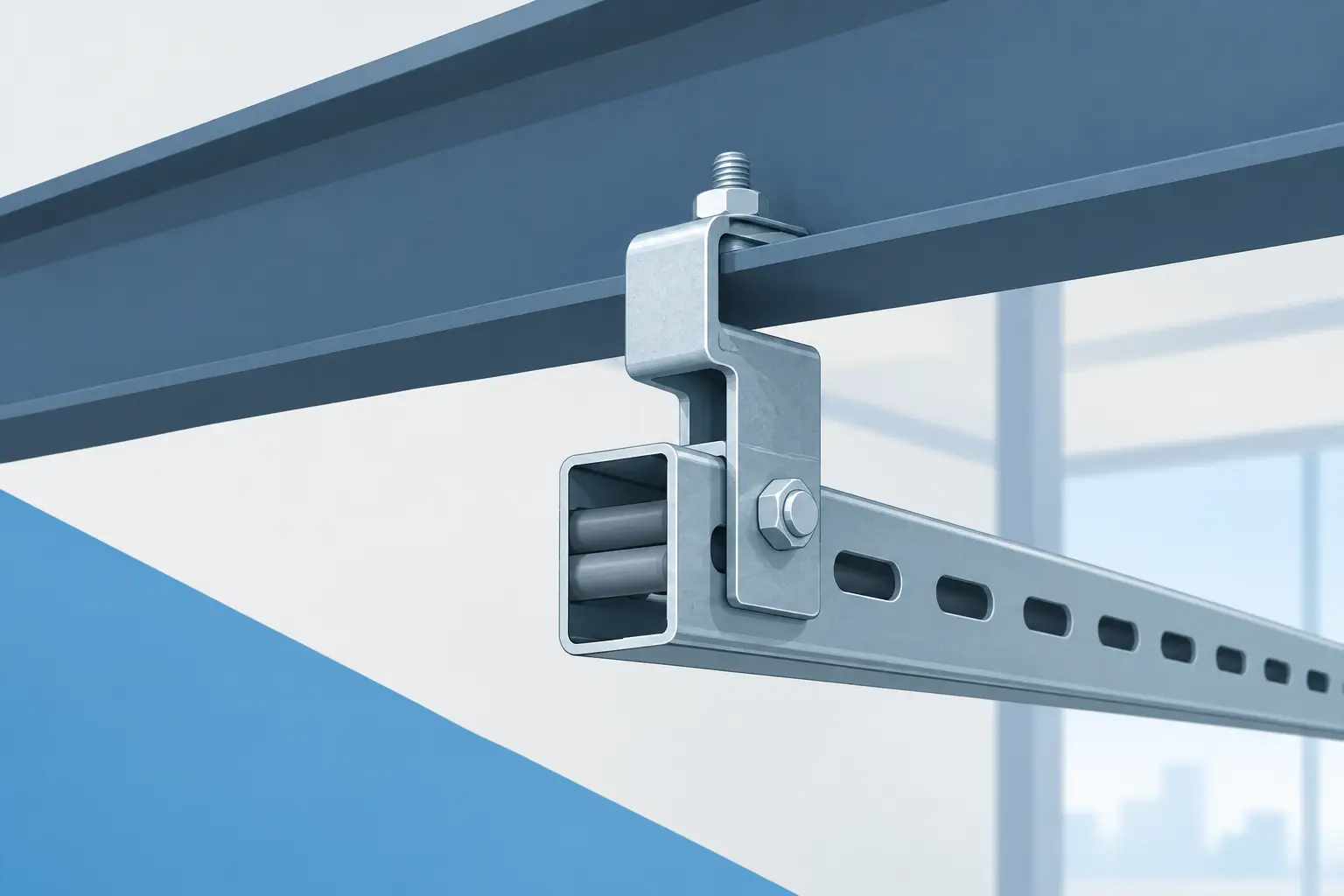
A support system is only as dependable as the connection carrying its load. Strut channels beam clamps provide a practical way to attach channel framing to existing steel without drilling, welding, or interrupting the structure. For contractors, OEMs, and procurement teams, the value is clear: faster installation, adjustable positioning, and a cleaner path to supporting conduit, cable tray, pipe, HVAC equipment, and secondary steelwork.
The right clamp, however, is not simply the one that fits over a beam flange. Its geometry, rated capacity, material, finish, and compatibility with the selected channel determine whether the assembly performs as intended. A sound specification begins with the load path and ends with a connection that can be installed consistently in the field.
What Strut Channels Beam Clamps Do
Beam clamps connect a strut channel or threaded rod assembly to the flange of a structural steel beam. Depending on the design, the clamp may grip the beam with a set screw, a locking jaw, or a bolted arrangement. The channel then becomes an adjustable framework for equipment supports and building-services installations.
This approach is especially useful where structural steel is already in place and permanent modification is undesirable. It can reduce field fabrication, eliminate hot-work requirements, and allow installers to adjust the support position as routing changes. Those benefits matter on fast-moving commercial, industrial, and infrastructure projects where coordination changes are common.
A typical assembly includes the beam clamp, a strut channel, channel nuts and bolts, and often threaded rod or a hanger fitting. Each part must be considered as part of one system. A high-capacity clamp does not automatically make an assembly high capacity if the channel wall, hardware, rod, or supported member is the limiting component.
Start With the Load Path, Not the Catalog Page
The first engineering question is simple: what load reaches the clamp, and how does it reach it? Weight from pipe, cable tray, ductwork, or equipment passes through the channel and fastening hardware to the beam clamp, then into the structural member. Eccentric loading, vibration, and installation geometry can change that path significantly.
A centered vertical load is generally easier to manage than a load applied away from the beam flange or at the end of a cantilevered channel. When a channel projects outward, it creates bending and prying forces that may exceed what a clamp is designed to resist. In these applications, a wider channel arrangement, a second support point, a braced frame, or a purpose-designed bracket may be required.
Rated working loads should be used only under the manufacturer’s stated conditions. These conditions can include beam-flange thickness, clamp orientation, fastener torque, channel profile, and load direction. Do not assume a published vertical-load rating applies to side loading, uplift, seismic restraint, or dynamic machinery loads. Where the support is safety-critical or carries substantial equipment, the final arrangement should be reviewed by the responsible structural engineer.
Fit Details That Prevent Field Delays
Beam flange thickness and width are the first fit checks. A clamp must match the flange range it is intended to grip, with sufficient engagement after installation. An oversized opening or insufficient jaw contact can reduce stability, while an incompatible clamp may not seat properly around the beam profile.
Channel dimensions matter just as much. Standard strut channels, deep channels, back-to-back channel assemblies, and slotted configurations do not all accept the same hardware in the same way. Unistrut-compatible dimensions can simplify replacement and procurement, but compatibility should be verified by measurement and specification rather than assumed from a product description.
Fasteners also need attention. Thread size, thread pitch, nut type, bolt length, and washer selection affect assembly strength and installation speed. A bolt that is too short may not achieve full engagement; one that is unnecessarily long can interfere with adjacent services or create a snag point. For repeated product programs, standardizing these details reduces purchasing errors and makes field installation more predictable.
Material and Finish Should Match the Environment
Mild steel beam clamps are often suitable for dry, controlled indoor environments when protected with an appropriate coating. Zinc-plated finishes can provide economical corrosion resistance for many interior uses. For more demanding settings, hot-dip galvanized steel is commonly selected for improved protection in outdoor, humid, or industrial environments.
Stainless steel may be the better choice where moisture, washdown, chemicals, salt exposure, or long service life create a higher corrosion risk. It comes at a higher material cost, so the decision should reflect the actual exposure rather than a blanket preference. In marine-adjacent work, food processing, wastewater facilities, and similar environments, finish selection can affect maintenance requirements as much as initial appearance.
Mixed-metal assemblies deserve careful review. Contact between dissimilar metals in a wet or corrosive environment can contribute to galvanic corrosion. Isolation methods, compatible fasteners, and a properly matched coating system may be necessary. The channel, clamp, hardware, and supported equipment should be evaluated together instead of treated as separate purchasing items.
Installation Quality Is Part of the Design
Beam clamps are often chosen because they make installation faster, but speed should not replace procedure. The beam surface should be inspected for heavy scale, coatings, damage, or geometry that prevents full clamp contact. The clamp must seat squarely on the flange, and the specified tightening method should be followed.
Set-screw designs require particular discipline. Torque affects grip, and overtightening can damage threads, distort the contact area, or create an unreliable connection. Under-tightening can permit movement under load or vibration. Where vibration is present, the support design may need locking hardware, restraint components, or an alternative connection method.
Installers should also confirm that the clamp is positioned on a suitable portion of the supporting beam. A connection may be physically possible near an edge, taper, coping, or obstruction while still being unsuitable for the intended loading. Clear installation drawings and defined hardware schedules help prevent this kind of field decision from becoming a costly correction.
When Standard Hardware Is Not Enough
Standard beam clamps and strut channels cover many common support applications, but not every project has standard geometry. OEM frames, process equipment, dock structures, retrofit work, and high-volume fabricated assemblies often need modified hole patterns, custom channel lengths, welded tabs, reinforced brackets, or application-specific finishes.
Custom fabrication can reduce unnecessary field cutting and eliminate adapter stacks that complicate installation. It also gives sourcing teams a way to consolidate channel components, clamps, brackets, fasteners, and welded subassemblies through one manufacturing partner. The result is fewer part interfaces to manage and a more controlled fit at assembly.
Metallix Exports supports both standardized strut-system hardware and custom sheet metal fabrication for buyers who need precise dimensions, repeatable production, and export-ready fulfillment. For custom requirements, useful inputs include drawings, material grade, finish specification, channel profile, expected load direction, critical tolerances, and projected order volume. The earlier these details are defined, the more effectively the component can be designed for manufacturing and installation.
Questions Procurement Teams Should Ask
Before approving strut channels beam clamps, procurement teams should confirm more than unit price. They should establish whether the supplier can provide consistent material traceability, dimensional control, coating quality, and packaging suited to the shipping method. For international programs, labeling, corrosion protection during transit, and reliable carton or pallet configuration can prevent avoidable receiving issues.
It is also useful to ask whether the supplier can maintain the same specification across standard and custom parts. A project may start with common clamps and channels, then require a bracket or fabricated support as site conditions change. Working with a manufacturer that understands both catalog hardware and custom metal production helps protect continuity when that change occurs.
The lowest-cost component can become the most expensive option when tolerances vary, finishes fail early, or replacement parts do not fit the installed system. A specification-led purchasing decision creates a more reliable balance between cost, lead time, and long-term performance.
Build the Connection Around the Application
Strut channels beam clamps are effective because they turn existing structural steel into an adaptable support point. Their performance depends on disciplined selection: verify the beam, follow the load path, match materials to the environment, and treat the clamp, channel, and fasteners as one assembly.
For a routine indoor support, a standard compatible system may be the efficient answer. For corrosive exposure, unusual loading, or custom equipment geometry, a more specific design is justified. The practical next step is to define the application clearly enough that every component can be manufactured, supplied, and installed with confidence.


