
 E-mail :
 Call Us :
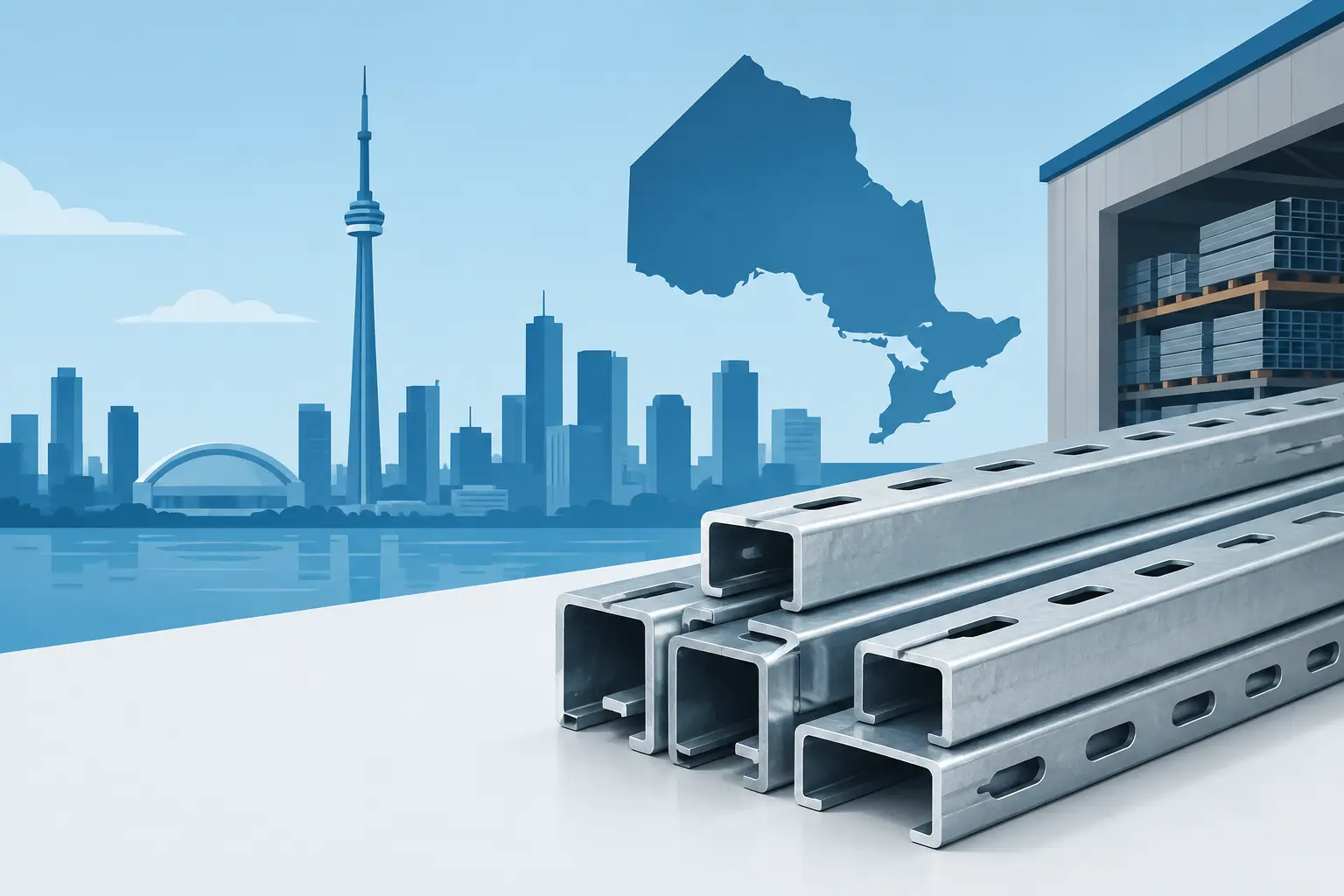
A strut channel order can look simple on a purchase order: channel lengths, fittings, nuts, and a finish requirement. In the field, small specification gaps quickly become installation delays. Buyers evaluating strut channel suppliers Ontario need more than available stock. They need compatible profiles, consistent dimensions, appropriate corrosion protection, dependable hardware, and a supplier that can respond when a standard item no longer fits the application.
For electrical, HVAC, industrial, utility, and construction work, strut support systems carry real coordination responsibility. They support conduit, cable tray, pipe, equipment, and secondary steel assemblies. The right supplier helps a procurement team avoid fragmented sourcing and gives installers components that fit together as intended.
What Separates Capable Strut Channel Suppliers in Ontario
The strongest suppliers understand that channel is part of a system, not an isolated length of formed steel. A buyer may require slotted or solid channel, single or back-to-back profiles, spring nuts, beam clamps, angle brackets, post bases, pipe clamps, and custom connection hardware. When these parts come from unrelated sources, dimensional assumptions can create costly problems during assembly.
Profile compatibility is the first technical checkpoint. Many projects use systems designed around common unistrut-compatible dimensions, but compatibility should never be assumed from a product description alone. Confirm channel width, height, material thickness, slot size and spacing, inside lip geometry, and the hardware interface. A nut that appears similar may not seat or turn correctly in a different channel profile.
Material selection also depends on the environment and load requirement. Pre-galvanized steel can be practical for interior support work where exposure is controlled. Hot-dip galvanized channel and fittings are often specified for outdoor, damp, or corrosive environments. Stainless steel may be the better choice in food processing, marine, chemical, or high-moisture applications, though it changes both cost and lead-time expectations. Aluminum offers weight and corrosion advantages in certain installations, but its load behavior and connection details must be reviewed separately.
A dependable supplier will ask the questions that protect the project: What is being supported? What span and load apply? Is the assembly indoors, outdoors, coastal, or chemical-exposed? Does the project require a standard compatible profile, or does it need a fabricated bracket or welded frame? Those questions are not sales friction. They are part of controlled procurement.
Start With the Channel Specification
Before comparing quotes, define the product clearly enough that each supplier is pricing the same requirement. “Strut channel” alone is not a complete specification. It may describe several gauges, slot configurations, materials, and finishes with materially different performance and price.
For each channel item, identify the profile dimensions, wall thickness or gauge, standard length, slot pattern, material grade where applicable, finish, and quantity by size. If cut lengths are required, state the cut tolerance and whether deburring is necessary. For projects with structural responsibility, provide the required load data and engineering criteria rather than relying on a generic catalog rating.
The same discipline applies to fittings. A 90-degree angle fitting may be a light-duty stamped component, a heavier formed bracket, or a custom welded connection plate. Hole diameter, hole center distance, thickness, finish, and orientation all affect fit-up. If the fitting must connect to another manufacturer’s channel system, submit drawings or physical samples during qualification when possible.
This level of detail helps procurement compare total value rather than unit price alone. A low-price channel that arrives with inconsistent slot spacing or mismatched fittings can create labor costs that overwhelm the initial savings.
Standard Components Versus Custom Fabrication
Standardized strut hardware is usually the fastest route for repeatable installations. Common channel profiles, spring nuts, washers, clamps, brackets, and connectors allow contractors to assemble supports quickly with familiar methods. For recurring OEM assemblies, standard parts also simplify inventory planning.
Custom fabrication becomes valuable when the support must solve a specific spatial, loading, or installation constraint. Examples include nonstandard equipment bases, offset brackets, welded frames, special hole patterns, heavier-gauge support members, and assemblies designed around a machine enclosure or dock structure. The trade-off is that custom parts require a clear drawing package, prototype review where needed, and realistic production lead times.
A manufacturer with both catalog capability and fabrication capacity can be particularly useful here. Rather than forcing an application into a standard fitting or sending custom work to a separate vendor, the buyer can coordinate a compatible system through one production source.
Evaluate Quality Beyond a Product Photo
Industrial buyers should look for evidence that a supplier controls the manufacturing details that affect installation and service life. For roll-formed or formed channel, this includes dimensional consistency, clean slotting, controlled burrs, straightness, and repeatable profile geometry. For brackets and fittings, it includes accurate punching, bend consistency, weld quality where welding is required, and finish coverage.
Surface finish deserves close attention. Galvanized products are not interchangeable simply because they share the same general label. The base material, coating method, post-fabrication treatment, and handling practices all influence corrosion performance. Cut edges, welded areas, and field modifications should be considered in relation to the environment. A supplier should be able to identify the finish offered and confirm whether it aligns with the project specification.
Documentation needs vary by project. A straightforward commercial installation may only require clear part identification and packing accuracy. An infrastructure, OEM, or export program may require inspection records, material information, dimensional reports, traceability, or packaging standards. Establish these requirements before production, not after shipment is ready.
Lead Time Is a Production Question, Not a Promise
A supplier’s stated lead time has value only when it reflects material availability, tooling capacity, fabrication workload, finishing schedules, quality checks, and freight planning. Standard in-stock channel may move quickly, while custom brackets with special coating requirements follow a different timeline.
Ask suppliers to separate stocked items from made-to-order items. For fabricated components, request clarity on drawing approval, first-article review if applicable, production time, finishing time, and shipment readiness. This makes it easier to plan around critical-path materials and avoids treating every line item as though it has the same supply profile.
Ontario buyers may also need to consider cross-border logistics when supporting U.S. projects or sourcing from export-oriented manufacturers. Packaging, labeling, shipment consolidation, and documentation can influence both delivery reliability and receiving efficiency. For high-volume programs, scheduled releases and blanket-order arrangements may reduce uncertainty more effectively than repeated spot purchases.
Ask How the Supplier Handles Change
Construction and OEM requirements change. A conduit route shifts, a piece of equipment gets heavier, an engineer revises a hole pattern, or a corrosion requirement changes after site review. The useful supplier is not merely the one that says yes to every revision. It is the one that identifies the effect on compatibility, cost, tooling, finish, and schedule before proceeding.
This is especially important for custom support hardware. A seemingly minor dimension change can alter bend allowances, material yield, fixture requirements, or weld access. A disciplined manufacturer will issue a revised drawing or confirmation, control the revision in production, and make sure the shipped part matches the approved requirement.
Metallix Exports supports this type of sourcing need with unistrut-compatible support components and custom sheet metal fabrication for buyers who require standard hardware alongside application-specific parts. That combination can reduce vendor coordination while maintaining focus on exact dimensions, material selection, and production consistency.
A Practical Supplier Review for Procurement Teams
When comparing suppliers, assess the full supply equation: product compatibility, manufacturing capability, quality controls, finish options, responsiveness, and delivery discipline. Price remains important, but it should be reviewed against the cost of field rework, expedited freight, missing hardware, and procurement time spent resolving mismatched components.
For a repeat program, start with a controlled sample or first production batch. Verify channel dimensions, fitting engagement, hardware operation, finish appearance, labeling, packaging, and installation fit before releasing larger quantities. For project work, align the purchase order with approved drawings and clearly identify any substitutions that require written acceptance.
The best strut channel supplier is not always the one with the broadest catalog or the lowest initial quotation. It is the supplier that can consistently deliver the specified system, communicate production realities early, and provide a reliable path when standard channel hardware needs to become a project-specific solution.


