
 E-mail :
 Call Us :
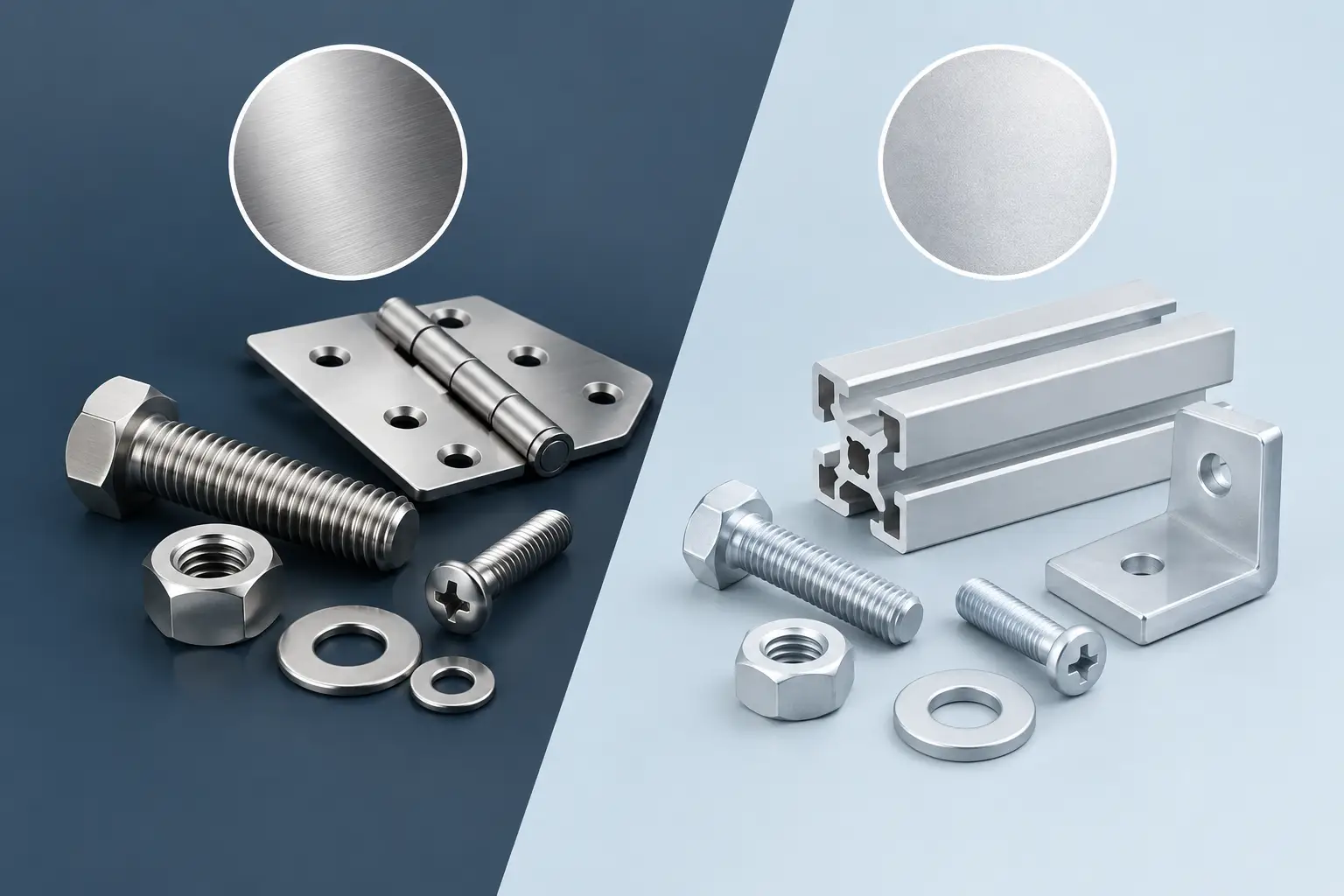
A bracket that performs well in a dry equipment room can fail prematurely on a coastal dock, rooftop HVAC installation, or mobile machine. The decision between stainless versus aluminum hardware affects more than material cost. It influences load capacity, corrosion performance, installation methods, finish requirements, maintenance expectations, and the long-term reliability of the assembled system.
For procurement teams and engineers, there is no universal winner. Stainless steel is generally selected where strength, wear resistance, and corrosion protection are critical. Aluminum is often the preferred choice when reducing weight, simplifying handling, or managing material costs matters most. A sound specification considers the full operating environment and the interaction between the hardware, connected materials, and installation method.
Stainless Versus Aluminum Hardware: The Core Differences
Stainless steel hardware is an iron-based material alloyed with chromium, which creates a protective surface layer that helps resist corrosion. Common grades such as 304 stainless steel perform well in many industrial and commercial environments. Grade 316 stainless steel offers improved resistance in chloride-rich conditions, making it a frequent choice for marine, coastal, food processing, and chemical-adjacent applications.
Aluminum hardware is valued for its low density. It weighs roughly one-third as much as steel, which can reduce shipping weight, simplify field installation, and lower the load imposed on supporting structures. Aluminum alloys also form a natural oxide layer that provides useful corrosion resistance in many environments. However, that oxide layer is not a substitute for choosing the right alloy, finish, and isolation strategy in harsh service conditions.
The comparison becomes more application-specific when the component is a structural bracket, clamp, channel accessory, mounting plate, post base, enclosure part, or custom fabricated assembly. The hardware must be evaluated as part of a working system, not as an isolated piece of metal.
Start With Load, Deflection, and Wear Requirements
Stainless steel typically provides higher strength and stiffness than aluminum at comparable component dimensions. For load-bearing brackets, anchors, clamps, framing hardware, and connection plates, this can allow a smaller stainless component to carry a given load with less deflection. It also performs well where threads, bearing surfaces, or repeated mechanical contact may be exposed to wear.
Aluminum can meet demanding structural requirements when the alloy, temper, thickness, and formed geometry are engineered correctly. A fabricated aluminum bracket may need thicker material, wider flanges, ribs, gussets, or additional bends to achieve the same rigidity as a stainless equivalent. That does not make aluminum the wrong choice. It means the design needs to account for its different mechanical behavior from the start.
When stainless steel is usually the stronger fit
Stainless is often specified for heavily loaded supports, high-cycle clamping points, security-sensitive connections, and hardware exposed to impact or abrasion. It is also well suited to applications where compact part geometry is necessary but strength cannot be compromised.
For threaded hardware, stainless offers reliable durability, but installation practices matter. Stainless fasteners can gall, particularly when dry threads are tightened at speed or under high load. Appropriate lubrication, compatible nuts, controlled torque, and correctly specified thread fit help prevent seizing during assembly.
When aluminum is usually the more efficient fit
Aluminum is especially practical where weight reduction has an operational value. Transportation equipment, portable structures, floating dock components, access systems, enclosures, and large fabricated assemblies can benefit from reduced mass. Lighter hardware can also improve installation productivity when crews are handling parts overhead or in difficult-access locations.
The material can be cut, punched, bent, welded, machined, and finished effectively, provided the fabrication process is matched to the selected alloy and temper. Tight bend radii, welding heat input, and localized stresses require proper engineering attention because they can affect final strength and dimensional stability.
Corrosion Resistance Depends on the Environment
“Corrosion resistant” is not a complete material specification. Moisture, salt exposure, cleaning chemicals, airborne pollutants, temperature cycles, drainage, and contact with dissimilar metals all affect performance.
Stainless steel is a dependable choice for long-term exposure when the grade matches the environment. Grade 304 is commonly appropriate for indoor industrial use and many general outdoor applications. Where deicing salts, salt spray, frequent washdown, or chloride exposure are present, 316 stainless is often the better option. Even stainless can stain or develop localized corrosion if contaminants remain on the surface, drainage is poor, or the grade is underspecified for the environment.
Aluminum performs well in many atmospheric conditions, but it requires more caution in alkaline or highly acidic settings and in continuously wet assemblies. Anodizing, powder coating, or other suitable finishing methods can improve appearance and provide added protection, depending on the service conditions. Edges, cutouts, weld areas, and damaged coatings deserve attention because they are common starting points for deterioration.
Prevent galvanic corrosion in mixed-metal assemblies
One of the most overlooked issues in stainless versus aluminum hardware is galvanic corrosion. When stainless and aluminum are electrically connected in the presence of an electrolyte such as rainwater, condensation, or saltwater, the aluminum may corrode at an accelerated rate.
The risk can be managed through nonconductive washers, bushings, gaskets, coatings, sealants, and drainage-oriented joint design. Fastener selection should be reviewed alongside the base material. A stainless bolt installed directly through an aluminum plate may be acceptable in a dry interior, while the same connection in a coastal or marine application may require deliberate isolation and sealing.
Fabrication and Finishing Affect the Final Result
Material selection should align with the planned manufacturing route. Stainless steel generally requires greater cutting and forming force than aluminum, and its work-hardening characteristics need to be considered during punching, bending, and machining. However, it delivers a durable finished part and can be brushed, polished, passivated, or left with an appropriate mill or fabricated finish where appearance is not the primary concern.
Aluminum is easier to machine and lighter to handle, which can support efficient production for complex fabricated parts. Its surface is also well suited to anodizing and powder coating. Welded aluminum assemblies require capable process control, as welding can change the properties around the heat-affected zone. When specifying a custom component, the drawing should identify material grade or alloy, temper where applicable, thickness, finish, tolerances, weld requirements, and critical inspection points.
For both materials, tolerances should be realistic for the part geometry and process. A precision-punched flat bracket, a deep-formed clamp, and a welded structural assembly do not carry the same dimensional risks. Early review between the design team and manufacturer helps avoid late changes that affect cost or delivery.
Compare Total Cost, Not Just Piece Price
Aluminum may offer a lower installed cost where reduced weight decreases freight, handling, lifting equipment, or labor requirements. Its value can be particularly clear in large-volume assemblies and applications where every pound affects transportation efficiency.
Stainless steel often has a higher upfront material cost, especially in 316 grade, but it may reduce maintenance, replacement, and downtime over a long service life. In corrosive environments, selecting a lower-cost material without appropriate protection can create a much larger expense after installation.
The right comparison includes fabrication complexity, finishing, fasteners, protective isolation, expected service life, replacement access, and the consequence of failure. A low-cost bracket is not economical if replacing it requires shutdown time, access equipment, or disruption to a critical facility.
A Practical Specification Process
Before releasing hardware for production, define the operating environment and the component’s job within the assembly. Confirm design loads, expected cycles, allowable deflection, temperature range, exposure to chemicals or salt, finish expectations, and the materials it will contact. Then evaluate whether the part needs the strength and durability of stainless or the weight advantage and fabrication flexibility of aluminum.
For recurring programs, prototype evaluation is valuable. Fit checks can confirm hole alignment, bend clearances, fastener access, and mating-part compatibility. Environmental testing or field trials may be appropriate for marine, infrastructure, food processing, and outdoor equipment applications where corrosion exposure is difficult to predict from drawings alone.
Metallix Exports supports industrial buyers with precision fabrication across stainless steel and aluminum, helping convert application requirements into production-ready brackets, structural hardware, clamps, channels, mounting components, and custom assemblies. Consistent materials, controlled processes, and clear inspection requirements are essential when hardware must perform across repeated orders and international shipments.
The best material choice is the one that protects the finished system, not simply the one that looks strongest or costs least on a quotation. A well-defined drawing and an honest review of service conditions give the manufacturer the information needed to produce hardware that fits correctly, installs efficiently, and remains dependable in the field.


