
 E-mail :
 Call Us :
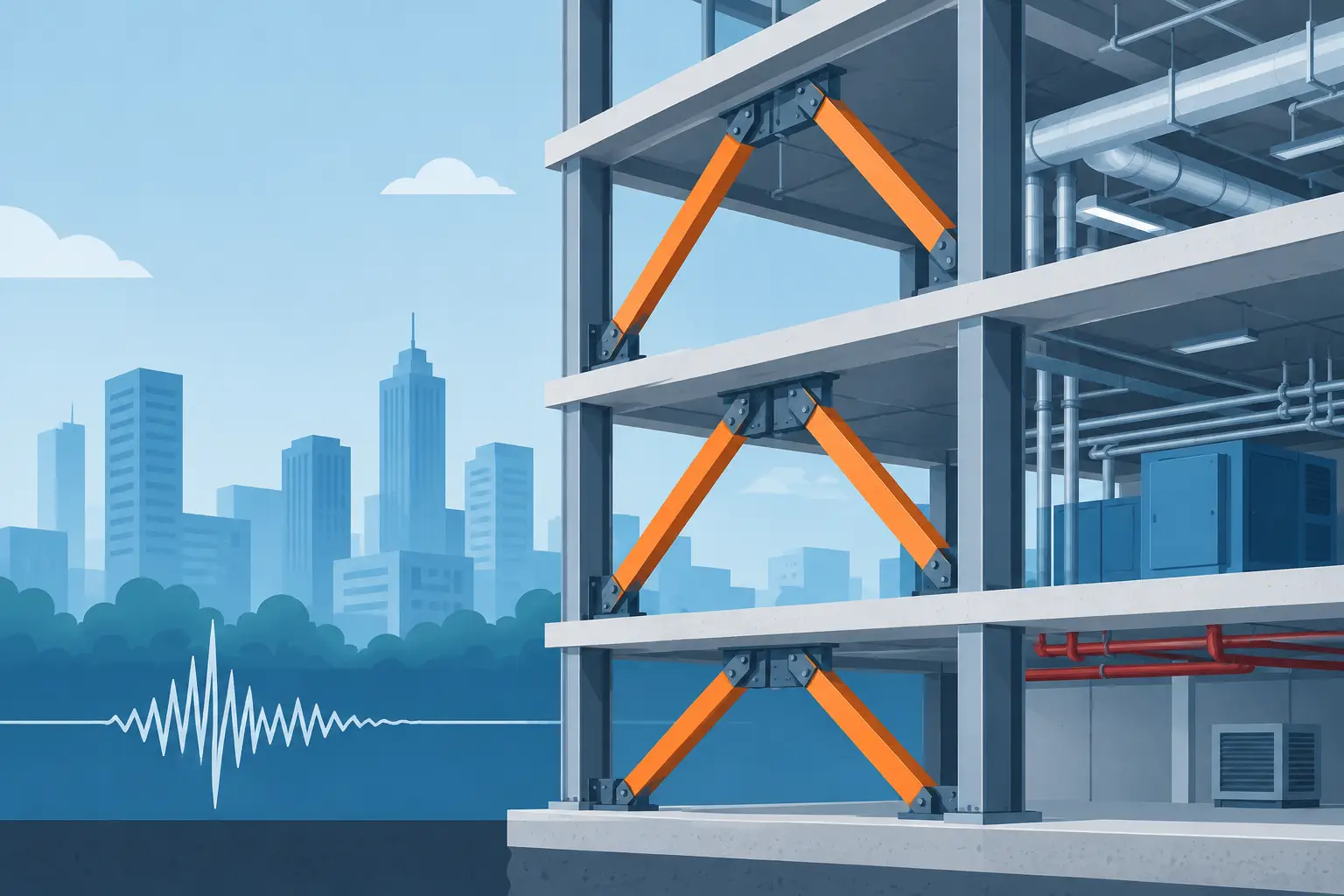
A suspended pipe, cable tray, duct run, or equipment frame can become a major project risk when an earthquake shifts the building around it. Seismic bracing controls that movement by creating a deliberate load path from nonstructural systems to the building structure. For contractors, engineers, OEMs, and procurement teams, success depends on more than ordering brackets and strut channel. It requires correctly engineered attachment points, compatible components, dependable fabrication, and installation discipline.
What Seismic Bracing Is Designed to Do
Seismic bracing is a system of restraint components that limits excessive lateral and vertical movement during seismic activity. While gravity supports carry the normal operating weight of pipes, ducts, conduit, cable tray, and mechanical equipment, seismic restraints address forces generated when those systems accelerate, sway, or shift.
The objective is not to make every component completely motionless. Buildings move during an earthquake, and supported systems must be able to move within the limits anticipated by the design. The goal is to prevent damaging displacement, falling objects, broken utility connections, equipment instability, and damage to structural or life-safety systems.
A properly specified system transfers seismic forces through a continuous path: from the supported service or equipment, through clamps, braces, fittings, and fasteners, into an approved structural attachment. A weak connection at any point can compromise the entire assembly. That is why seismic support hardware should be evaluated as a coordinated system rather than a collection of individual metal parts.
Where Seismic Bracing Is Commonly Required
Seismic requirements vary by project location, occupancy, building type, component weight, and the critical role of the system being supported. Design criteria are typically established through the applicable building code, project specifications, and the engineer of record. In the United States, this often involves code provisions based on the International Building Code and ASCE 7, along with trade-specific requirements for fire protection, mechanical, electrical, and plumbing systems.
Seismic bracing is commonly used for HVAC ductwork, process piping, fire sprinkler piping, electrical conduit, cable tray, suspended ceilings, industrial machinery, rooftop equipment, and equipment installed on frames or platforms. Hospitals, data centers, manufacturing facilities, distribution centers, schools, public infrastructure, and high-occupancy commercial buildings may have particularly demanding requirements.
Not every hanger or support requires the same restraint configuration. A lightweight conduit installation may use a different approach than a large-diameter pipe rack or a heavy air-handling unit. The correct arrangement depends on calculated loads, spacing, elevation, geometry, and the structural conditions available for attachment.
The Components That Create a Reliable Load Path
A seismic restraint assembly may look straightforward in the field, but each component has a defined role. Strut channels and framing members provide adaptable support geometry. Brackets, gusseted fittings, clamps, beam attachments, channel nuts, threaded rods, anchors, and fasteners connect the system together. Diagonal brace members resist lateral forces, while rigid posts or vertical restraints may address uplift and vertical movement where required.
Material selection should match the environment and expected service life. Mild steel is commonly used for general indoor applications where properly finished. Galvanized steel provides added protection in many commercial and industrial locations. Stainless steel or aluminum may be appropriate where corrosion resistance, weight reduction, or compatibility with surrounding materials is a priority. The best choice depends on the application, exposure conditions, load requirements, and project specifications.
Compatibility matters just as much as material strength. A channel, fitting, clamp, and nut should fit together as intended, with proper engagement and predictable load transfer. Unistrut-compatible components can be valuable for projects that need flexibility in assembly and access to standardized framing dimensions. However, dimensional compatibility alone does not establish seismic suitability. The full assembly still must be selected and approved for the specified loading and installation conditions.
Structural Attachments Deserve Close Attention
The attachment to the building structure is often the most critical point in a seismic bracing system. A brace connected to an unapproved deck profile, weak concrete area, nonstructural member, or improperly installed anchor may not perform as designed.
Project teams should confirm the substrate, attachment method, edge distances, embedment requirements, fastener type, and applicable installation instructions before work begins. Concrete anchors, beam clamps, welded attachments, and through-bolted connections each have different limits and verification needs. Field substitutions should not be made simply because a component appears similar or is easier to obtain.
Design Coordination Prevents Expensive Field Changes
Many seismic support problems begin before fabrication or installation. Mechanical, electrical, plumbing, structural, and architectural layouts can compete for the same overhead space. If braces are not coordinated early, installers may face blocked attachment points, conflicts with ductwork, inaccessible fasteners, or brace angles that no longer meet the intended design.
The most effective approach is to review restraint locations alongside coordinated drawings or models before releasing material. This allows the team to identify where standard assemblies will work and where custom brackets, offset fittings, welded frames, or purpose-built connection plates are needed.
Custom fabrication is especially useful when standard catalog hardware cannot accommodate site geometry. A fabricated bracket may need a specific hole pattern, offset, material thickness, reinforcement detail, or finish. For industrial projects, support frames may also require integration with equipment bases, access platforms, cable management, or existing structural steel. These details should be defined from approved engineering information, not improvised in the field.
Manufacturing Quality Has a Direct Effect on Installation
For procurement teams, seismic hardware should be sourced with the same attention applied to other safety-sensitive construction components. Consistent dimensions, clean punched holes, accurate bends, controlled welds, and reliable coatings all affect whether assemblies install correctly and perform as specified.
A manufacturing partner should be able to produce both standard support components and project-specific fabricated parts under controlled processes. Cutting, punching, bending, forming, welding, assembly, and surface finishing need to align with the material grade, thickness, tolerance, and functional requirement of each part.
Several production details deserve review before a large order is placed:
- Material grade, thickness, and corrosion-protection requirements
- Hole diameter, slot orientation, and center-to-center spacing
- Bend radii, bracket angles, and fit-up tolerances
- Welding requirements, reinforcement details, and finishing quality
- Packaging, part identification, and shipment sequencing for the jobsite
These details influence more than appearance. Misaligned holes can slow installation. Poorly controlled bends can prevent proper brace angles. Inadequate finishing can shorten service life in humid, coastal, chemical, or exterior environments. Clear drawings, approved samples where appropriate, and inspection procedures reduce these risks before material reaches the site.
Procurement Questions That Improve Project Outcomes
The lowest unit price does not always represent the lowest installed cost. A buyer may save on a bracket only to lose time resolving fitment issues, replacing inconsistent parts, or waiting for urgent remanufacture. For seismic bracing packages, reliable delivery and documentation are part of the product value.
Before selecting a supplier, ask whether the supplier can support required quantities, repeatable tolerances, custom modifications, export packaging, and staged deliveries. Confirm whether part numbers and labeling will match the bill of materials and whether standard and custom hardware can be consolidated into a practical shipment.
It is also useful to distinguish between engineered design responsibility and manufacturing responsibility. Manufacturers can build to approved drawings and specifications, but seismic system design, load calculations, code interpretation, and final approval should remain with qualified project professionals. Clear responsibility boundaries help avoid assumptions that create compliance issues later.
For international sourcing, shipment planning should account for lead time, coating protection, packing method, container utilization, customs documentation, and site receiving capability. A well-made part loses value if it arrives damaged, unidentifiable, or out of sequence.
Installation Is Where the Design Is Proven
Even accurately manufactured hardware can fail to deliver its intended performance if installed incorrectly. Common issues include missing fasteners, improper torque, incorrect brace angles, unauthorized substitutions, attachments made to unsuitable members, and field-cut components that alter the approved assembly.
Installers should work from current approved drawings and manufacturer instructions, with inspection points established for critical connections. The field team should verify that braces are attached to the intended structural element, that hardware is fully engaged, and that modifications are reviewed before they are made.
For large or complex facilities, a phased inspection process can prevent small defects from becoming widespread. Reviewing a representative installation area early allows the project team to confirm materials, methods, clearances, and workmanship before the full package is installed.
Metallix Exports supports industrial and construction buyers with precision-fabricated structural hardware, strut-compatible components, brackets, clamps, welded fabrications, and custom sheet metal parts produced to project requirements. The practical advantage is the ability to source standard support hardware and application-specific fabricated components through one manufacturing partner.
The right seismic bracing strategy begins with a clear engineering requirement and ends with hardware that fits, arrives on time, and installs as intended. When design coordination, fabrication control, and field verification are treated as one process, project teams can protect critical building systems with greater confidence.


