
 E-mail :
 Call Us :
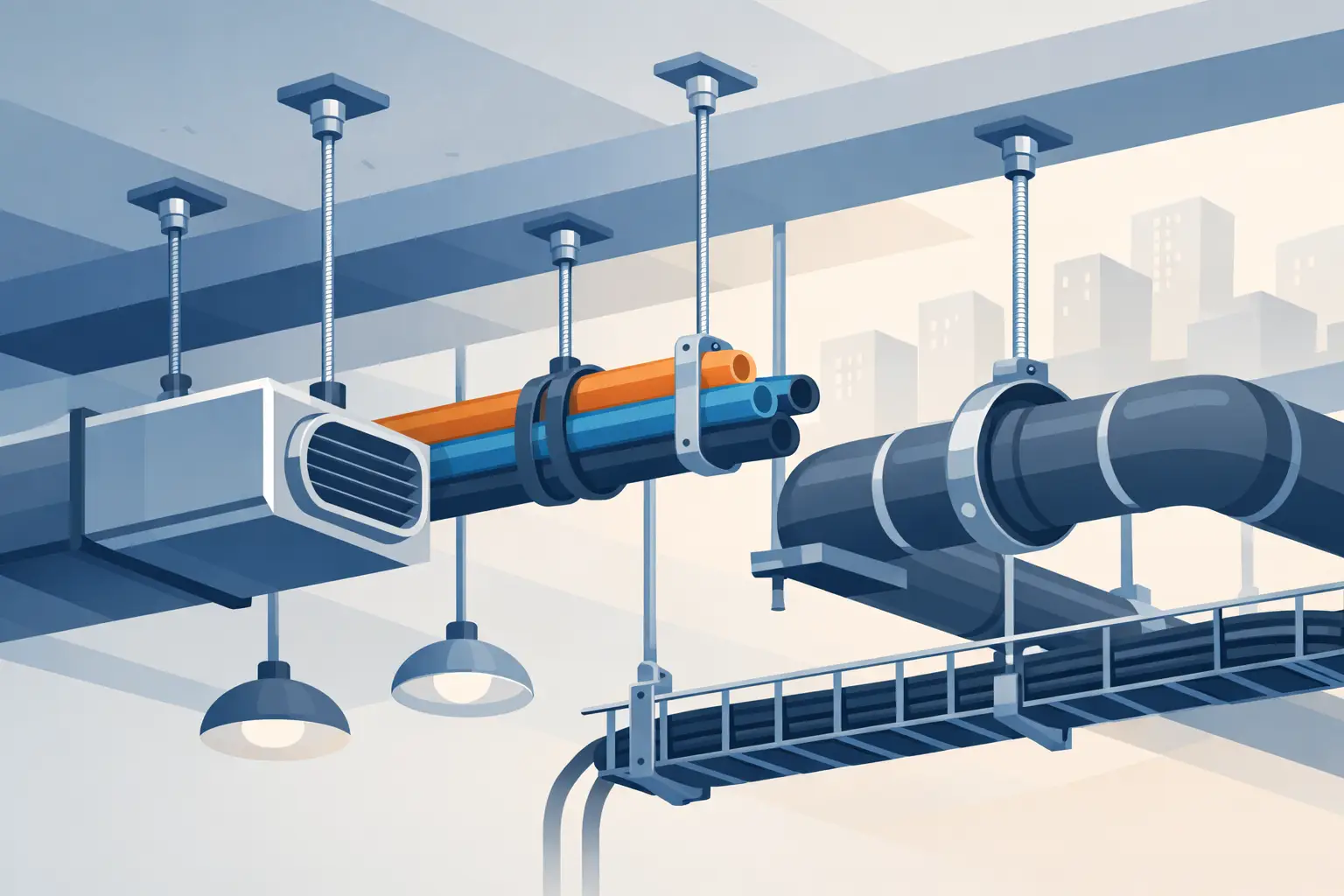
A threaded rod may be one of the smallest items on a material takeoff, yet the rods to hang ductwork, pipe, cable tray, and mechanical equipment carry a direct responsibility for system safety, alignment, and serviceability. A mismatched diameter, unsuitable finish, or poorly defined connection can slow installation and create costly field corrections. For contractors, OEMs, and procurement teams, selecting hanging rods is a specification decision, not a commodity purchase.
What rods to hang are designed to support
In commercial and industrial construction, hanging rods are most often fully threaded steel rods used with channel, beam clamps, rod couplers, washers, nuts, trapeze supports, and other structural hardware. They transfer the weight of a suspended service to a building structure or approved support point.
Their applications vary substantially. HVAC contractors use rods to suspend rectangular and round ductwork. Plumbing and process-piping installations use them with clevis hangers, split-ring hangers, and trapeze frames. Electrical contractors support cable tray, conduit racks, and junction-box assemblies. Industrial facilities may require rods for equipment platforms, utility supports, machinery guards, or custom fabricated frames.
The rod itself is only one element in the load path. The complete assembly includes the supported service, hanger or channel, nuts and washers, rod connections, anchorage or beam attachment, and the supporting structure. A rod with sufficient tensile capacity does not make an assembly adequate if the clamp, anchor, channel, weldment, or base material is undersized. This is why specification review must consider the entire support system.
Start with the actual load and support layout
The first question is not simply, “What rod diameter is normally used?” It is, “What load will this support point carry under the installed conditions?” That calculation should include the weight of pipe, duct, tray, insulation, contents, fittings, valves, accessories, and any equipment loads transferred through the support.
For piping, the operating weight can be very different from the empty weight. Water-filled lines, fire protection pipe, process media, and insulation all add load. Thermal movement can also introduce forces that a standard vertical hanger was not designed to restrain. For ductwork, large sections may create concentrated loads at joints, transitions, dampers, and equipment connections. Cable tray loading depends on present cable fill as well as planned expansion capacity.
Hanger spacing determines how much of that total load reaches each rod. Wider spacing can reduce the number of supports, but it increases the load carried at each support point and may allow excessive deflection. Tighter spacing adds hardware and installation labor but can improve control, alignment, and access. Applicable codes, project specifications, manufacturer requirements, and the responsible design professional should govern spacing and load criteria.
Where a trapeze support carries multiple pipes or tray runs, calculate the combined load rather than evaluating each service in isolation. Also account for eccentric loading. A heavy pipe positioned toward one side of a cross member can place unequal demand on the two rods and introduce bending into the support frame.
Select diameter, thread, and material deliberately
Rod diameter is a principal factor in tensile capacity, stiffness, connection compatibility, and availability. Common threaded rod sizes are widely used in support systems, but common does not mean interchangeable. The selected size must match the specified load requirement, hanger component, channel fitting, and installation method.
Thread form and pitch matter when rods must connect to couplers, nuts, hanger devices, or equipment inserts. Mixing incompatible thread standards can appear acceptable during dry assembly and then fail in the field when engagement is limited or components bind. Procurement documents should clearly identify diameter, thread designation, unit system, length, and required accessories.
Material selection depends on the environment and the engineering demand. Mild steel threaded rod is widely used for general indoor applications where corrosion exposure is controlled. Galvanized rod offers added protection for many exterior, humid, and moderately corrosive environments. Stainless steel can be appropriate for aggressive corrosion conditions, food-related environments, marine applications, and installations where long-term appearance and corrosion resistance are critical.
Aluminum, copper, and other material choices may be needed for specialized assemblies, but they require careful consideration of strength, thread performance, and galvanic compatibility. When dissimilar metals are in contact, moisture and environmental conditions can accelerate corrosion. Isolation methods or compatible material combinations may be needed.
Finish is a service-life requirement
Finish should be specified according to exposure, not selected only by price. A plain steel rod may be suitable inside a dry, conditioned building, while the same rod can deteriorate rapidly in a parking structure, washdown area, coastal zone, or exterior utility installation.
Zinc-plated finishes are frequently used for indoor hardware, but they are not a substitute for a corrosion strategy in severe conditions. Hot-dip galvanized rod and compatible hardware provide a more substantial coating for many outdoor and industrial applications. Stainless steel may offer the best long-term option in highly corrosive settings, although it carries a higher initial cost and should be paired with compatible nuts, washers, clamps, and anchors.
The finish must be consistent across the assembly where practical. Installing a corrosion-resistant rod with untreated nuts, clamps, or fabricated support members can leave the system vulnerable at its connections. Buyers should request clear finish requirements for all supplied components, including cut ends and any custom welded assemblies.
Define connection details before fabrication
A hanging rod is effective only when it has reliable engagement at both ends. At the top, attachment may be through a beam clamp, channel nut, concrete insert, expansion anchor, wedge anchor, welded tab, structural bracket, or another approved method. At the bottom, the rod may connect to a clevis hanger, channel trapeze, angle frame, equipment bracket, or custom support.
Each connection has different limitations. Concrete anchors require consideration of concrete condition, edge distance, embedment, spacing, and installation torque. Beam clamps must suit the flange geometry and loading direction. Channel-based systems need correctly matched channel nuts, fittings, and thread sizes. Welding can be useful for custom fabrications, but the design must account for weld quality, coating repair, distortion, and inspection requirements.
Thread engagement deserves specific attention. Nuts and couplers need adequate engagement length, and extended rod ends should not interfere with insulation, access panels, or equipment maintenance. Where rods are cut in the field, clean cuts and properly installed hardware reduce the chance of damaged threads and difficult adjustments.
Plan for installation tolerance and adjustment
The best hanging support systems allow installers to level, align, and adjust services without improvisation. Fully threaded rods provide flexibility because nuts can be repositioned to set elevation. This is especially valuable where overhead structure varies, multiple utility systems share a corridor, or final routing changes during coordination.
That flexibility has limits. Very long unsupported rod drops can be susceptible to sway, vibration, and visual misalignment. Mechanical rooms, seismic zones, vibrating equipment, and areas exposed to wind or moving loads may require bracing, lateral restraint, spring isolation, or engineered support details beyond a simple vertical rod arrangement.
For large-scale work, standardizing rod sizes and accessory combinations can reduce installation errors and simplify replenishment. However, standardization should not override application requirements. A facility with corrosive process areas, heavy piping, or custom equipment supports may need several rod materials, finishes, and support configurations within the same project.
Procurement details that prevent site delays
Clear purchasing information prevents the familiar problem of receiving usable-looking hardware that does not fit the installation. A complete request should define rod material, diameter, thread, length or cut-length requirement, finish, quantity, tolerances, and packaging expectations. It should also identify whether nuts, washers, couplers, clamps, channel components, or fabricated brackets are required as part of the supply package.
For export projects, packaging and labeling matter as much as the part specification. Rods should be protected from transit damage, bundled for safe handling, and labeled so receiving teams can separate sizes and finishes quickly. Long lengths require packaging that controls bending and thread damage during shipping and storage.
A capable metal manufacturing partner can add value when standard rod supply must integrate with custom sheet metal brackets, channel supports, welded frames, post bases, or project-specific hardware. Metallix Exports supports this approach through precision fabrication across cutting, punching, bending, welding, forming, finishing, and assembly, helping buyers consolidate compatible support components under a controlled specification.
Inspect the installed support, not just the delivered rod
Receiving inspection should confirm size, thread condition, finish, quantity, and visible damage. Installation inspection should go further. Check that each rod is vertical where required, nuts are properly seated, locking methods follow the project detail, attachments are fully engaged, and supports are not carrying unintended side loads.
Look for signs that the field team has compensated for coordination issues with unapproved extensions, bent rod, partial thread engagement, or mixed hardware. These shortcuts may be hidden above ceilings or behind equipment, but they can affect reliability and future maintenance. Documenting approved support details before installation gives supervisors a practical standard for quality control.
When rods are specified as part of a complete support path rather than purchased as isolated pieces, installations move faster and perform more predictably. Define the load, environment, connection, adjustment needs, and compatible accessories early, then source hardware that is built to those requirements. That discipline turns a small component into dependable infrastructure.


