
 E-mail :
 Call Us :
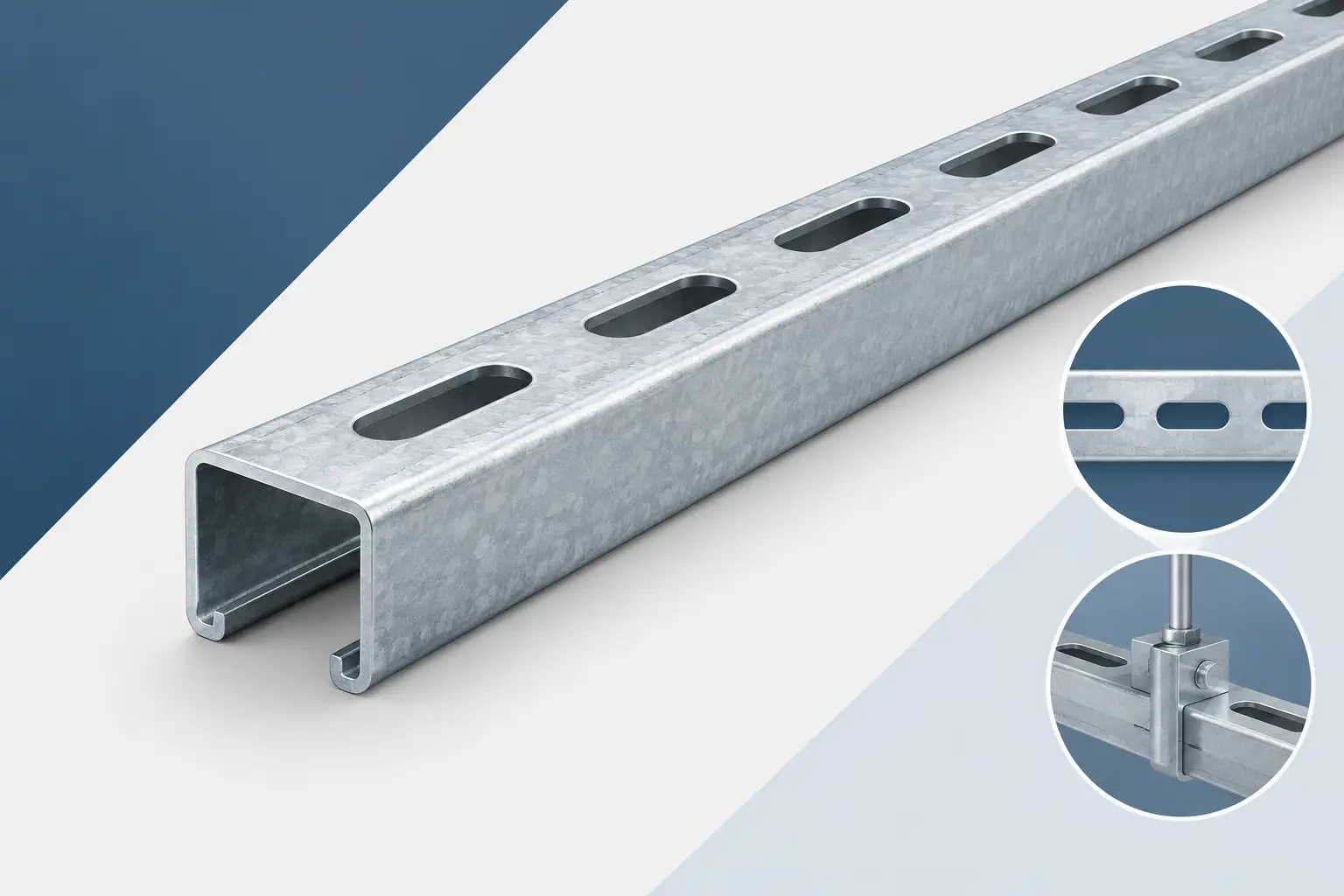
A strut channel specification can look routine until the material reaches the jobsite and the fittings, hole pattern, coating, or wall thickness do not match the installation plan. Pre-galvanized slotted strut channels in the 1-5/8 x 1-5/8 x 12G x 10-foot configuration are widely used because they provide a practical balance of section strength, field adjustability, and handling efficiency for electrical, mechanical, HVAC, and industrial support systems.
For procurement teams and project engineers, the value is not simply in ordering a familiar channel size. It is in confirming the dimensional, coating, and compatibility details that allow the channel to perform consistently with the selected brackets, spring nuts, clamps, and threaded hardware.
What This 1-5/8 Slotted Strut Channel Specification Means
The 1-5/8 x 1-5/8 profile refers to the nominal outside dimensions of the channel. This square, deep-profile format is a common choice where installers need a versatile support member that can be mounted horizontally, vertically, or as part of a multi-channel frame. Its return lips accept compatible channel nuts and fittings, allowing components to be positioned without drilling the channel body in the field.
The 12-gauge designation identifies the nominal material thickness. Compared with lighter channel gauges, 12-gauge strut is selected for applications that require greater stiffness and higher load capacity, subject to the span, loading direction, connection design, and manufacturer data. Gauge alone should not be treated as a complete load rating. A channel supporting a concentrated pipe load behaves differently from one carrying uniformly distributed cable tray, and both must be evaluated with their actual support spacing and attachment conditions.
The 10-foot length is practical for stocking, shipping, and installation. It reduces the number of joints in longer runs while remaining manageable for many crews. Where freight limits, site access, or project layouts call for another length, channels can also be cut, punched, or fabricated to an approved project requirement.
Why Slots Change the Installation Process
Slotted strut channel includes elongated openings along the channel back. These slots provide adjustment for anchors, rod assemblies, brackets, and connected channels. They can shorten layout time when field dimensions vary slightly or when support locations must align with existing structural members.
The trade-off is that the slot pattern must be specified, not assumed. Slot length, width, center-to-center spacing, and end distance affect fit-up with bolts and accessory hardware. A buyer replacing an existing system should verify these details against the installed channel and fittings. A channel that appears visually similar may not align with the same hardware pattern.
Pre-Galvanized Finish: Where It Fits Best
Pre-galvanized channel is formed from steel sheet that has been zinc coated before roll forming. It offers corrosion protection suitable for many indoor and dry-service environments, including commercial interiors, utility rooms, warehouses, and protected mechanical spaces. The finish also supports a clean, consistent appearance for exposed support assemblies.
However, pre-galvanized material has a practical limitation: cut edges, punched areas, and forming locations may have less zinc coverage than surfaces coated after fabrication. In ordinary indoor service, this is often acceptable. In coastal locations, chemical processing facilities, wastewater environments, exterior installations, or continuously damp areas, the corrosion exposure should drive the finish decision.
Hot-dip galvanized after fabrication may be the better option where the channel will face sustained weathering or a more aggressive atmosphere. Stainless steel can be appropriate for demanding corrosion conditions, although it carries different cost, lead-time, and compatibility considerations. The correct choice depends on the environment, expected service life, local code requirements, and the materials used in connected hardware.
Using dissimilar metals also deserves attention. For example, an aluminum support component attached directly to galvanized steel may require an isolation strategy in wet conditions. The full assembly matters, not just the channel finish.
Engineering Details That Should Be Confirmed Before Purchase
A complete purchase description avoids the common problem of ordering channel that is close to the intended product but unsuitable for the system. For pre-galvanized slotted strut channels, confirm the nominal profile, gauge, stock length, slot pattern, and finish. Also establish whether the channel must be compatible with an existing unistrut-style system or a specified proprietary accessory range.
Load requirements should be communicated with more than a general statement such as “heavy duty.” A useful request identifies the span between supports, the type and location of the load, deflection expectations, support orientation, and any seismic or vibration requirements. This gives the engineering team a basis for selecting the appropriate channel configuration and related fittings.
For larger orders, material documentation and inspection expectations should be addressed early. Buyers may require dimensional checks, coating verification, material certificates, lot traceability, packaging requirements, or defined acceptance criteria. These requirements are easier to control when incorporated into production planning rather than introduced after fabrication is complete.
Compatibility Is a System Issue
Strut channel is rarely installed alone. It functions with channel nuts, bolts, beam clamps, angle brackets, post bases, pipe clamps, threaded rods, and concrete anchors. Each connection transfers load into the next component, which means the finished assembly is only as dependable as its least suitable element.
A 1-5/8 channel may be broadly described as compatible with common strut systems, but critical applications still require dimensional verification. Channel lip geometry, internal width, slot dimensions, and nut spring design can affect engagement and tightening performance. This is especially relevant when a project combines replacement parts from multiple suppliers.
It is also worth checking whether accessories need the same corrosion protection level as the channel. Installing plain steel fasteners on a pre-galvanized support assembly can create visible corrosion points long before the channel itself shows deterioration.
Fabrication and Supply Considerations for Project Buyers
Standard 10-foot channel works well for many projects, but a capable manufacturing partner can reduce site labor by providing material in project-ready configurations. Pre-cut lengths, custom slot patterns, end holes, welded assemblies, brackets, and specified finishes can reduce field modifications and help crews maintain consistent installation quality.
Custom work should be approached with clear tolerance requirements. If a channel assembly must connect to equipment frames, wall mounts, or modular support racks, hole placement and straightness can be as significant as the base channel dimensions. Providing drawings, mating-part information, and expected installation conditions allows the manufacturer to identify practical production controls before the first production run.
Packaging also influences delivered quality. Long channels can be vulnerable to distortion, edge damage, and finish abrasion during international transport if bundles are not properly secured. Export-ready packing should account for bundle weight, lifting methods, moisture exposure, container loading, and labeling needed for receiving teams. For distributors and OEM buyers, consistent labeling by part number, lot, and quantity helps keep warehouse handling efficient.
Sourcing Pre-Galvanized Slotted Strut Channels with Confidence
The lowest unit price does not always represent the lowest installed cost. Material that arrives with inconsistent slots, an incompatible profile, unclear gauge control, or poor packaging can create delays that outweigh a small purchase-price difference. A more dependable sourcing approach evaluates product conformity, manufacturing capability, communication speed, documentation, and delivery performance together.
Metallix Exports supports industrial and construction buyers with standard strut support components as well as custom fabricated channel assemblies. For projects that require more than a catalog part, the ability to coordinate punching, cutting, bending, welding, finishing, and export packaging through one manufacturing partner can reduce vendor complexity and improve control over the finished support system.
Before releasing a purchase order, compare the drawing or submittal requirements against the actual channel profile, gauge, slot schedule, coating, accessory compatibility, and packing plan. That short review creates a clearer path from specification to installation and helps ensure the channel delivered is the channel the project was designed to use.


