
 E-mail :
 Call Us :
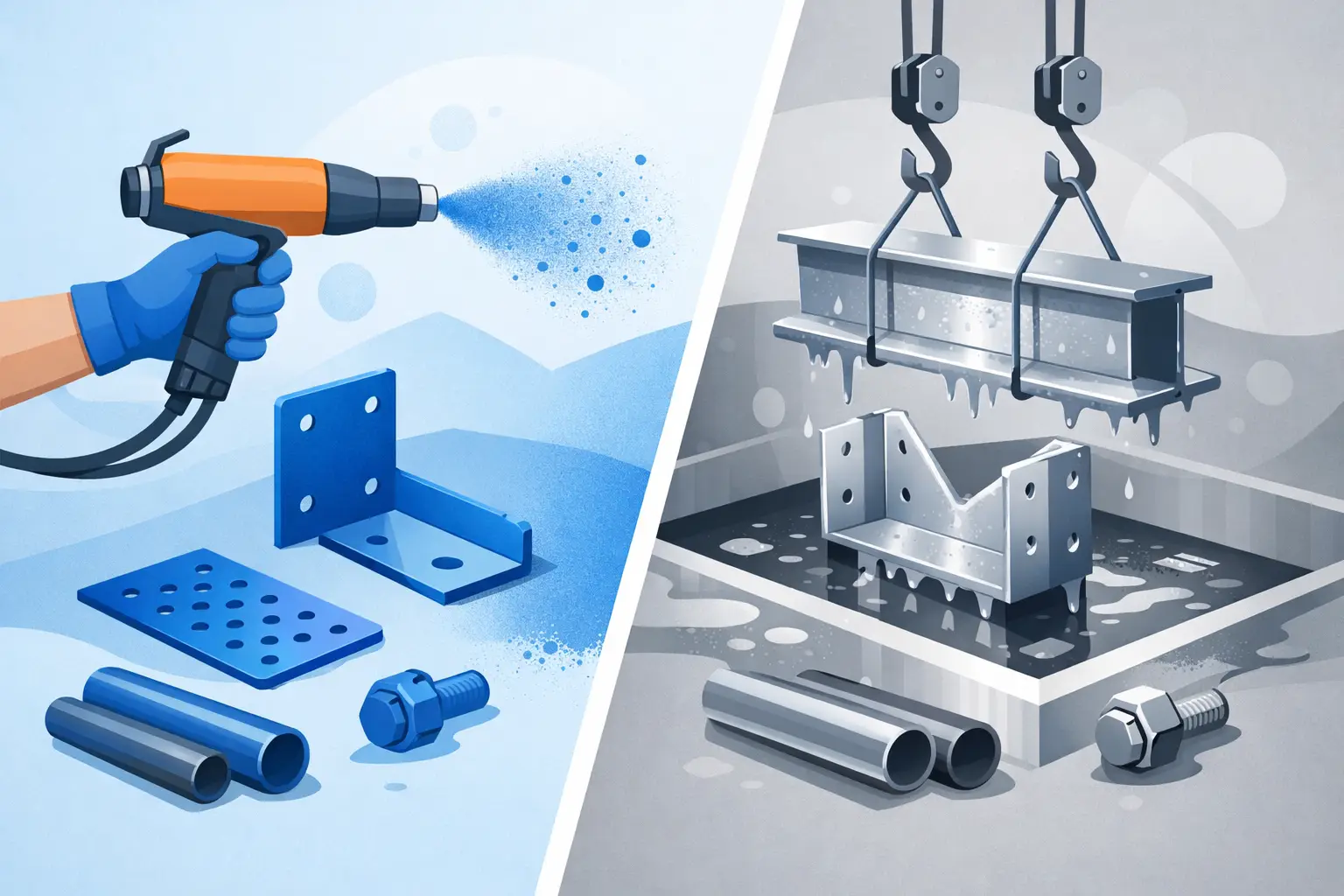
A structural bracket can meet every dimensional requirement and still fail the project if its finish is wrong. Premature red rust, chipped color, poor weld-area protection, or an unexpected coating cost can create installation delays and warranty concerns. In the decision between powder coating vs galvanizing, the right answer depends on the part’s environment, geometry, handling requirements, and expected service life.
For OEMs, contractors, and procurement teams, surface finishing should be specified as early as material thickness, hole pattern, and weld configuration. The coating process affects corrosion performance, visual consistency, fabrication sequence, packaging, and delivery planning.
Powder Coating vs Galvanizing: The Core Difference
Powder coating is an organic finish. Dry polymer powder is electrostatically applied to a properly prepared metal surface, then cured in an oven to form a continuous colored film. Common powder types include polyester, epoxy, epoxy-polyester hybrid, and polyurethane systems. For exterior steel components, polyester powder is frequently selected because it provides good weatherability and color retention.
Galvanizing protects steel with zinc. In hot-dip galvanizing, fabricated steel is cleaned, fluxed, and immersed in molten zinc. The zinc reacts with the steel to create bonded zinc-iron alloy layers topped by a zinc coating. This is not simply paint over metal. The coating becomes part of the steel surface and provides both barrier protection and sacrificial protection.
That distinction matters when damage occurs. A scratched powder-coated surface can expose bare steel, allowing corrosion to begin at the damaged area if the film is breached. Zinc surrounding a small scratch can provide cathodic protection to the exposed steel, sacrificing itself before the base metal corrodes. Powder coating, however, generally provides a smoother, more controlled appearance and a far broader color range.
When Powder Coating Is the Better Choice
Powder coating is usually the preferred finish where appearance, color consistency, and a clean finished surface are project priorities. It is well suited to visible brackets, electrical enclosures, equipment frames, furniture components, architectural hardware, HVAC supports in protected locations, and customer-facing fabricated assemblies.
A quality powder-coated finish can offer good resistance to chipping, abrasion, chemicals, and UV exposure when the powder chemistry and pretreatment match the application. It also allows customers to specify standard colors, custom colors, gloss levels, textures, and specialty finishes. This is valuable when fabricated hardware needs to align with an OEM’s product identity or a construction project’s visual requirements.
The process works best when the steel surface is thoroughly cleaned and pretreated. Oil, welding residue, mill scale, sharp edges, moisture, and poor surface preparation can reduce adhesion. In demanding applications, a phosphate or zirconium pretreatment may be used before coating. For aluminum and galvanized sheet, pretreatment is equally important because the surface chemistry differs from mild steel.
Powder coating is not automatically the strongest choice for every outdoor application. A high-quality exterior powder system can perform well, but a coating breach at a sharp edge, fastener hole, or high-impact area requires attention. Parts that will be dragged, struck, buried, continuously wet, or exposed to salts need a more careful corrosion review than a standard color specification provides.
When Galvanizing Is the Better Choice
Hot-dip galvanizing is often selected for fabricated steel used outdoors, in humid conditions, near road salts, around marine air, or in industrial environments where corrosion protection matters more than decorative appearance. It is commonly used for support channels, post bases, foundation hardware, guardrail components, structural brackets, dock hardware, utility supports, and heavy fabricated assemblies.
The greatest advantage is coverage. Because the steel is immersed in molten zinc, the process can protect exterior surfaces, edges, corners, and many internal areas that are difficult to reach with spray-applied coatings. This is especially useful for hollow sections, complex welded fabrications, and assemblies with crevices, provided the part is designed with suitable vent and drain holes.
Galvanized coatings are not visually uniform in the same way as powder coatings. Their appearance can range from bright silver to matte gray, with variations caused by steel chemistry, coating thickness, cooling conditions, and fabrication details. For industrial hardware, this variation is usually acceptable. For highly visible architectural or branded components, it may not be.
Part design also deserves close attention. Hot-dip galvanizing exposes the fabrication to elevated temperatures, which can create distortion risks in thin sheet, long flat sections, or unbalanced welded assemblies. Closed cavities require proper venting, and overlapping surfaces can trap cleaning solutions or zinc. An experienced manufacturer should review these details before fabrication, not after parts reach the galvanizing line.
Compare Corrosion Exposure Before Comparing Price
A lower initial finish cost does not always mean a lower project cost. The expected corrosion exposure should guide the decision.
For indoor parts in dry, conditioned facilities, powder coating may provide the appearance and protection required at a practical cost. For exterior components in ordinary weather conditions, either finish may be suitable depending on coating specification, maintenance expectations, and visual requirements. For coastal, marine, chemical, or high-salt environments, hot-dip galvanizing usually provides a more forgiving protection system for steel.
There is also a high-performance option for severe service: duplex coating. This means hot-dip galvanizing followed by powder coating or a liquid topcoat. The zinc protects the steel beneath, while the topcoat adds color and another barrier against moisture and contaminants. Duplex systems can significantly extend service life, but they require correct surface preparation and coordination between the galvanizer and coating operation. They also add process time and cost, so they should be specified where the exposure justifies the investment.
Fabrication Sequence Changes the Result
For most fabricated steel components, welding, drilling, punching, bending, and assembly steps should be completed before hot-dip galvanizing. Cutting or welding galvanized steel after the finish is applied removes zinc protection at the affected area and may require repair. The same principle applies to powder coating: fabrication after coating will damage the finish and compromise appearance.
Threaded hardware requires special planning. Galvanizing adds measurable zinc thickness, which can interfere with threads, mating parts, and tight-fit assemblies. Tapped holes may need to be oversized before galvanizing, while threaded studs or bolts may need to be cleaned or chased after coating. Powder coating can also build up on threads, bearing surfaces, and electrical grounding points, so masking may be necessary.
Welds deserve attention in either process. Powder coating requires weld spatter removal and smooth finishing for an acceptable cosmetic result. Galvanizing requires clean welds, sealed overlaps where appropriate, and fabrication details that allow processing solutions and molten zinc to flow freely. Poor weld cleanup can become highly visible after either finish is applied.
Appearance, Tolerance, and Handling Requirements
Powder coating generally gives procurement teams greater control over color and surface appearance. It is a strong option when the component will remain visible after installation or must match other equipment. Texture can also help hide minor substrate imperfections and reduce fingerprints on enclosures or handles.
Galvanizing is usually selected for durability rather than color precision. Zinc coatings can be thicker and less predictable in build than powder films, particularly at corners and edges. This matters for close-tolerance fits, sliding interfaces, narrow slots, and assemblies that rely on consistent clearance. Engineers should identify these functional surfaces early so the finish can be accommodated in the design.
Handling also affects the choice. Powder-coated parts should be protected from sharp impacts, abrasion during transit, and metal-to-metal contact. Galvanized steel is more tolerant of rough site handling, though it can still be scratched and should not be treated as indestructible. Packaging should match the finish, part geometry, and shipment method, particularly for export loads where components may move through multiple handling points.
Specify the Finish as a Manufacturing Requirement
A useful finish specification goes beyond stating “powder coat” or “galvanized.” It should identify the base material, intended environment, required color or zinc standard, coating thickness where applicable, cosmetic expectations, masked areas, threaded features, and any salt-spray, adhesion, or inspection requirements. For galvanized fabrications, drawings should also show venting and drainage expectations for hollow or enclosed sections.
At Metallix Exports, finish selection can be coordinated with cutting, forming, welding, assembly, and export packaging so that custom steel hardware arrives ready for its intended application. That coordination reduces the common problems caused when fabrication and finishing are sourced as disconnected steps.
The most reliable choice is the one that protects the actual part in its actual environment, while still meeting fit, appearance, and delivery requirements. Share the installation conditions and functional details at the quotation stage, and the finish can be engineered into the component rather than treated as a last-minute add-on.


