
 E-mail :
 Call Us :
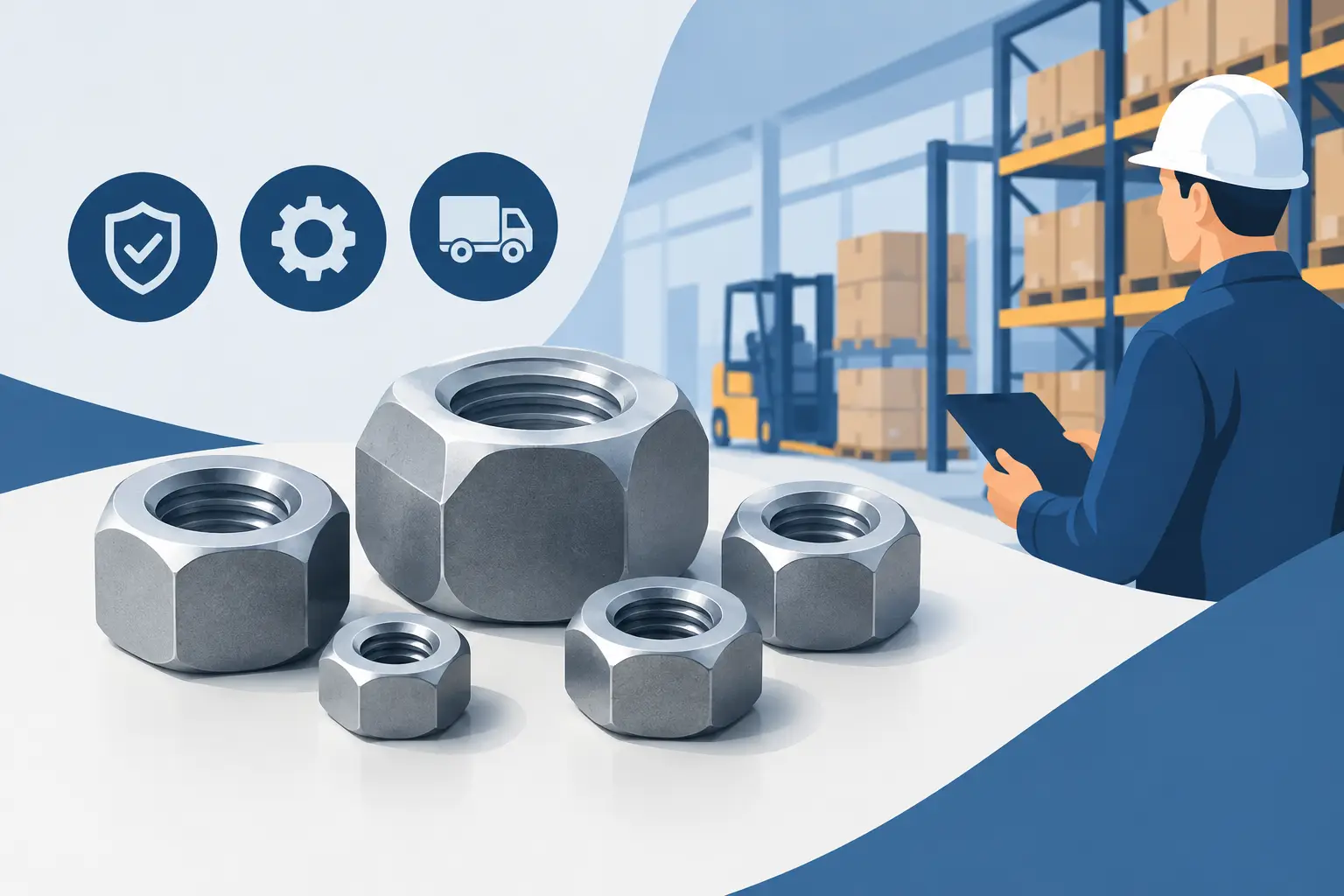
A nut that threads on easily but loses engagement under vibration, binds during installation, or corrodes before commissioning creates a costly problem out of a small component. For industrial buyers, specifying nuts UNC correctly means matching a widely used coarse-thread standard to the real loading, environment, mating hardware, and production requirements of the assembly.
UNC stands for Unified National Coarse, part of the Unified Thread Standard used throughout the United States and Canada. These threads are common in structural framing, machinery, equipment supports, electrical installations, transportation hardware, and fabricated assemblies. Their broad pitch makes them practical for general-purpose fastening, particularly where rapid assembly and field conditions matter.
What Are Nuts UNC?
Nuts UNC are internally threaded nuts designed to mate with bolts, studs, or threaded rods carrying Unified National Coarse external threads. A designation such as 1/2-13 UNC identifies a nominal 1/2-inch major diameter with 13 threads per inch. The diameter and pitch must match the mating fastener exactly.
The word "coarse" can be misleading. It does not mean a low-quality thread or a rough manufacturing standard. It refers to the number of threads per inch relative to a fine-thread alternative of the same diameter. For example, a 1/2-13 UNC thread has fewer, deeper thread forms than a 1/2-20 UNF thread.
That difference affects installation behavior and application suitability. Coarse threads are generally more tolerant of minor handling damage, contamination, and repeated field assembly. They also provide reliable engagement in many standard steel components and fabricated structures. Fine threads may be preferred where adjustment precision, higher tensile capability, or specialized design requirements apply, but they are not interchangeable with UNC hardware.
Why UNC Thread Selection Matters in Production
Thread specification is not a catalog detail. It controls whether components fit, assemble efficiently, and perform as designed. Ordering a 3/8-16 UNC nut for a 3/8-24 UNF bolt, for example, will not produce a usable joint even though the nominal diameter is the same.
For procurement teams, a complete requirement should identify nominal size, thread series, material, finish, nut style, applicable standard, and quantity. When the part will be paired with a customer-supplied bolt or a preexisting assembly, confirming the mating thread before production prevents avoidable rework and shipment delays.
UNC hardware is often selected for applications that require practical installation on job sites or production lines. Its thread geometry supports quicker engagement than a fine thread and is familiar to installers working with standard inch-based fasteners. However, the correct choice still depends on the complete joint design, including clamp load, vibration exposure, accessibility, and environmental conditions.
Thread Fit and Class Matter
A correct nominal size alone is not enough. Thread class establishes the permitted tolerance range for mating parts. Standard commercial fasteners commonly use Class 2A external threads and Class 2B internal threads, providing a practical balance between fit, manufacturability, and assembly performance.
Tighter classes may be appropriate for controlled or specialized assemblies, but they can increase manufacturing complexity and make parts less forgiving of coating buildup or debris. For general industrial hardware, the most reliable approach is to specify the required thread class only when the application or drawing calls for it. Over-specification can add cost without improving field performance.
When a nut will receive zinc plating, galvanizing, or another protective coating, thread allowance requires particular attention. Coating thickness can reduce the effective internal thread clearance. The supplier should account for the specified finish during manufacturing and inspection so the finished nut accepts its intended mating fastener.
Selecting the Right Nut Style
The base shape of the nut should match installation space, load distribution, and service conditions. Hex nuts remain the standard choice for many assemblies because they are available across common UNC sizes and work with conventional hand and power tools. Heavy hex nuts offer larger wrench flats and increased bearing area, making them suitable for higher-demand structural and industrial work where the relevant standard requires them.
Flange nuts provide an integrated bearing surface that can distribute load over a larger area and reduce the need for a separate washer in some applications. Lock nuts, prevailing-torque nuts, and nylon-insert lock nuts help resist loosening where vibration is expected. Their suitability depends on temperature, chemical exposure, reusability requirements, and the joint design.
For strut channel, support frames, and adjustable mounting systems, spring nuts and channel nuts can simplify installation inside the channel. Their dimensions, spring configuration, and thread size must be compatible with the selected strut profile. A generic nut may be dimensionally correct yet fail to seat or rotate properly in the channel.
Material and Finish Are Part of the Specification
Carbon steel nuts are widely used for standard indoor construction, general fabrication, and machinery assemblies. Their mechanical properties should be selected to suit the strength grade of the mating bolt. Pairing a high-strength bolt with an unsuitable nut can compromise the joint even when the threads appear to fit correctly.
Stainless steel UNC nuts are often specified for moisture, chemical exposure, food-processing environments, marine-adjacent installations, and architectural applications. Stainless offers corrosion resistance, but grade selection matters. A material that performs well indoors may not be suitable for chloride-rich coastal conditions or prolonged saltwater exposure.
Galvanized and zinc-plated finishes are practical choices for many construction and outdoor applications. Zinc plating offers basic corrosion protection and a clean appearance, while hot-dip galvanizing generally provides a heavier protective coating for exposed steelwork. The trade-off is that thicker coatings demand proper thread clearances and compatible mating components.
Aluminum, brass, and copper-alloy nuts can also serve specialized electrical, lightweight, nonmagnetic, or corrosion-related requirements. These materials should be selected with awareness of galvanic compatibility. In mixed-metal assemblies, moisture can accelerate corrosion between dissimilar metals unless the connection is designed and protected appropriately.
Quality Checks That Protect the Assembly
Reliable nuts UNC require more than a visual inspection. Dimensional verification should confirm thread size, pitch, form, and engagement. Go/no-go gaging is commonly used to verify internal threads efficiently and consistently. Inspection should also check wrench dimensions, thickness, bearing face condition, coating coverage, and part markings where applicable.
For production orders, consistency across lots is as important as individual conformity. A project can be disrupted if hardware from one shipment installs smoothly while a later batch has coating-related fit issues or inconsistent thread quality. Clear inspection procedures, controlled raw material sourcing, and traceable production records reduce this risk.
Buyers should also consider packaging requirements. Bulk-packed nuts may suit automated production or high-volume site work, while labeled small packs can improve inventory control for distributors, maintenance teams, and installation kits. Export shipments require packaging that protects threads and finishes through handling, storage, and transit.
When Custom UNC Nuts Make Sense
Standard UNC nuts are efficient for common applications, but custom manufacturing becomes valuable when a drawing requires nonstandard dimensions, a special flange, a welded tab, a captive feature, unusual material thickness, or a specific coating system. Custom hardware can also reduce assembly time by combining functions that would otherwise require several separate components.
For OEMs and project-based buyers, providing the mating part, fastening load details, environmental conditions, and applicable drawing revision early in the sourcing process helps avoid specification gaps. A manufacturer can then assess manufacturability, recommend appropriate tolerances, and plan inspection around the requirements that affect performance.
Metallix Exports supports standard and custom industrial hardware requirements with precision fabrication, controlled finishing options, and export-ready fulfillment. For UNC-threaded nuts used alongside brackets, channels, clamps, fabricated frames, and structural hardware, sourcing related components through one manufacturing partner can simplify quality control and purchasing coordination.
The right nut is rarely the most visible part of an assembly, but it is often the part that determines whether installation stays on schedule. Define the UNC thread completely, match material and finish to the environment, and verify fit before volume production so every connection is ready to perform when it reaches the field.