
 E-mail :
 Call Us :
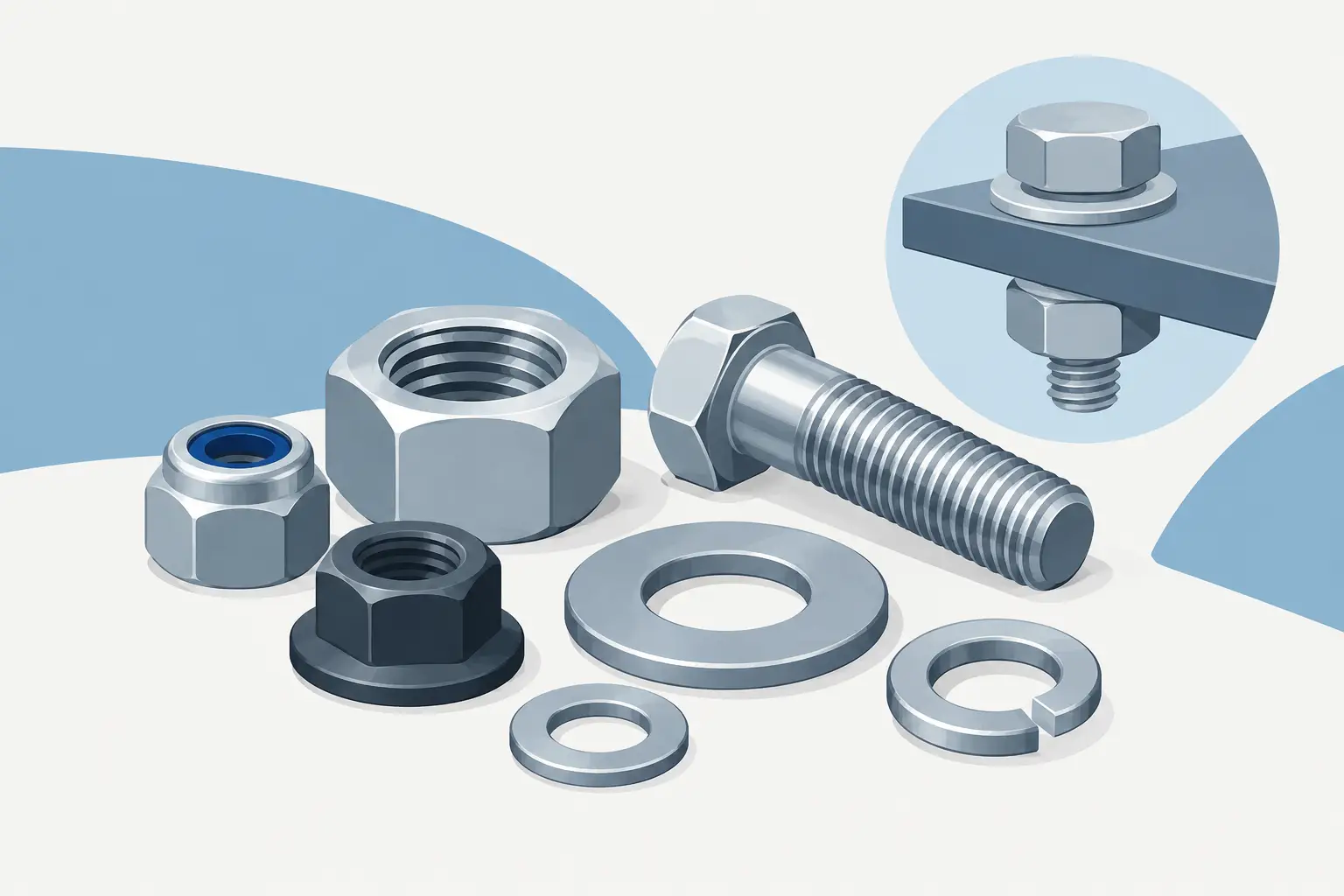
A fastening assembly rarely fails because a nut or washer was omitted from a bill of materials. It fails because the selected nuts and washer combination did not match the joint, load, environment, or installation method. For OEMs, contractors, and procurement teams, these small components directly affect clamp load, vibration resistance, corrosion performance, service life, and installation consistency.
The right hardware should support the performance of the entire fabricated assembly. That means looking beyond nominal diameter and unit price to confirm thread compatibility, material grade, washer function, coating requirements, and repeatable supply quality.
Nuts and Washer Selection Starts With the Joint
A nut provides the threaded engagement that creates clamp force. A washer distributes that force, protects the bearing surface, and can add locking, spacing, or sealing performance depending on its design. Together, they help a bolted connection remain stable when it is exposed to static loads, cyclic movement, vibration, temperature changes, or outdoor conditions.
The first question is not simply, “What size fastener is required?” It is, “What must this joint do?” A light-duty enclosure panel, a structural channel support, and a marine dock bracket may all use a similar diameter bolt, yet each calls for a different approach to materials, washers, and corrosion protection.
A well-specified assembly accounts for the bolt diameter and thread pitch, the thickness and hardness of the joined materials, anticipated load direction, access for tools, required torque, and the chance that the joint will need to be removed for maintenance. When these details are decided early, installation crews avoid field substitutions that can compromise a designed connection.
Choose the Nut Type for the Application
Standard hex nuts remain the most common choice because they are economical, widely compatible, and easy to install with conventional tools. They are suitable for many general construction, machinery, framing, and fabricated metal applications when the correct grade and finish are selected.
For high-vibration service, a prevailing-torque lock nut may be more appropriate. Nylon insert lock nuts are common in moderate-temperature applications, while all-metal lock nuts are generally better suited to elevated temperatures or industrial environments where nylon inserts may degrade. Locking hardware helps resist loosening, but it does not eliminate the need for correct torque or joint design.
Flange nuts integrate a broad bearing surface beneath the nut. This can reduce the number of individual components in an assembly and may remove the need for a separate flat washer in certain applications. However, a flange nut is not automatically a replacement for every washer. Where a washer is needed to bridge oversized holes, protect a finished surface, provide electrical isolation, or meet a specific structural detail, a separate washer remains necessary.
Other configurations serve more specialized purposes. Coupling nuts join threaded rods. Weld nuts provide permanent threaded points on sheet metal or fabricated structures. Cage nuts support mounting in racks and enclosed channels. T-slot and channel nuts are used in strut support systems where positioning and load transfer are critical. The correct form depends on the assembly method as much as on the load requirement.
Select the Washer by Function, Not Habit
A flat washer is often treated as a default component, but its dimensions and material matter. A properly sized flat washer spreads the compressive force of the nut or bolt head over a larger area. This is particularly useful with thinner sheet, aluminum, painted surfaces, slotted holes, and softer materials that may deform under concentrated load.
Fender washers offer a larger outside diameter and are useful where broader load distribution is required. Structural or hardened washers are designed for applications involving higher-strength fasteners and more demanding clamp loads. Using a soft washer under a high-strength connection can lead to embedment or deformation, reducing clamp force after installation.
Lock washers are intended to increase resistance to loosening, but their effectiveness depends on the joint design and operating conditions. In many critical assemblies, prevailing-torque nuts, thread-locking compounds, serrated flange hardware, or engineered locking systems may provide a more dependable solution. The selection should follow the application specification rather than a familiar shop practice.
Sealing washers are appropriate where moisture, dust, or fluid intrusion is a concern. Bonded sealing washers, for example, combine a metal backing with an elastomer sealing element. They can be useful in exterior enclosures, roofing details, HVAC equipment, and equipment housings, provided the sealing material is compatible with the operating temperature and chemical exposure.
Material Compatibility Prevents Expensive Failures
Material selection affects strength, corrosion resistance, appearance, and long-term serviceability. Zinc-plated steel hardware is widely used for indoor and controlled environments because it provides a practical balance of cost and protection. For exterior or moisture-prone applications, hot-dip galvanized hardware can offer more substantial corrosion resistance, especially when paired with galvanized structural components.
Stainless steel nuts and washers are often selected for marine, food-processing, architectural, and outdoor applications. They resist corrosion well, but stainless grades are not interchangeable. A fastener chosen for a coastal installation may need higher corrosion resistance than one used in a dry industrial plant. Stainless assemblies can also be prone to thread galling, particularly when installed at high speed or without appropriate lubrication and torque control.
Aluminum, copper, and dissimilar-metal assemblies need added attention. When dissimilar metals are exposed to moisture, galvanic corrosion can develop. A washer may help distribute load, but it will not always provide adequate electrical isolation. Depending on the environment, designers may need compatible material pairings, nonconductive isolators, protective coatings, or sealing methods to manage the risk.
The nut, washer, bolt, fabricated part, and protective finish should be considered as one system. Mixing finishes without reviewing compatibility can create weak points that shorten the life of an otherwise well-built assembly.
Thread Fit, Grade, and Torque Must Work Together
A correctly sized nut is not enough. Thread standard and pitch must match the mating bolt or threaded rod. Metric and imperial hardware should never be assumed to be interchangeable, even where dimensions appear close. Cross-threading, stripped threads, and inconsistent torque are common results of mismatched components.
Strength grade is equally significant. The nut must be rated to work with the selected bolt grade and required joint load. A high-strength bolt paired with an unsuitable nut can undermine the connection. For structural, machinery, and safety-related applications, procurement documentation should identify the relevant standards, grade requirements, mechanical properties, and traceability expectations.
Torque is the installation control that translates into clamp load. Too little torque can allow movement and loosening. Too much can stretch the bolt, damage threads, crush softer materials, or deform washers. The appropriate torque depends on fastener size, grade, coating, lubrication, and joint condition. A torque value used successfully on plain steel hardware may not produce the same result on stainless, galvanized, or lubricated threads.
For repeat production, documented torque procedures and calibrated tools improve consistency. This is especially valuable for OEM assemblies and field-installed support systems where hundreds or thousands of connections must perform the same way.
Specify Hardware for Manufacturing and Procurement Efficiency
The best hardware specification is clear enough for engineering, purchasing, production, and installation teams to use without interpretation. It should identify dimensions, thread type, material, grade, finish, washer style, quantity, and any required certifications or inspection criteria.
Standardizing common hardware across product lines can reduce inventory complexity and simplify field service. Still, standardization should not force one nut-and-washer assembly into applications with fundamentally different loads or environments. The cost of carrying an additional specification may be lower than the cost of corrosion, rework, loose joints, or warranty claims.
For custom fabricated products, hardware requirements should be reviewed alongside hole sizes, forming details, weld locations, coating thickness, assembly access, and packaging needs. A washer that fits before powder coating may become difficult to install after coating buildup. A weld nut may require masking or process sequencing to keep threads clean. These are production details that influence both quality and lead time.
Metallix Exports supports buyers who need standard hardware alongside precision sheet metal components, structural brackets, channel systems, and custom fabricated assemblies. Coordinating these requirements through one manufacturing partner can reduce vendor fragmentation and help maintain consistent specifications from prototype through production.
Build Reliability Into the Smallest Components
Nuts and washers may be small, but they are not minor decisions. The right combination protects surfaces, sustains clamp load, resists corrosion, and gives installers a connection they can assemble correctly and repeatedly.
Before releasing the next purchase order or fabrication drawing, review the joint as a complete system. A precise hardware specification gives the finished assembly a better chance of performing as designed long after it leaves the production floor.