
 E-mail :
 Call Us :
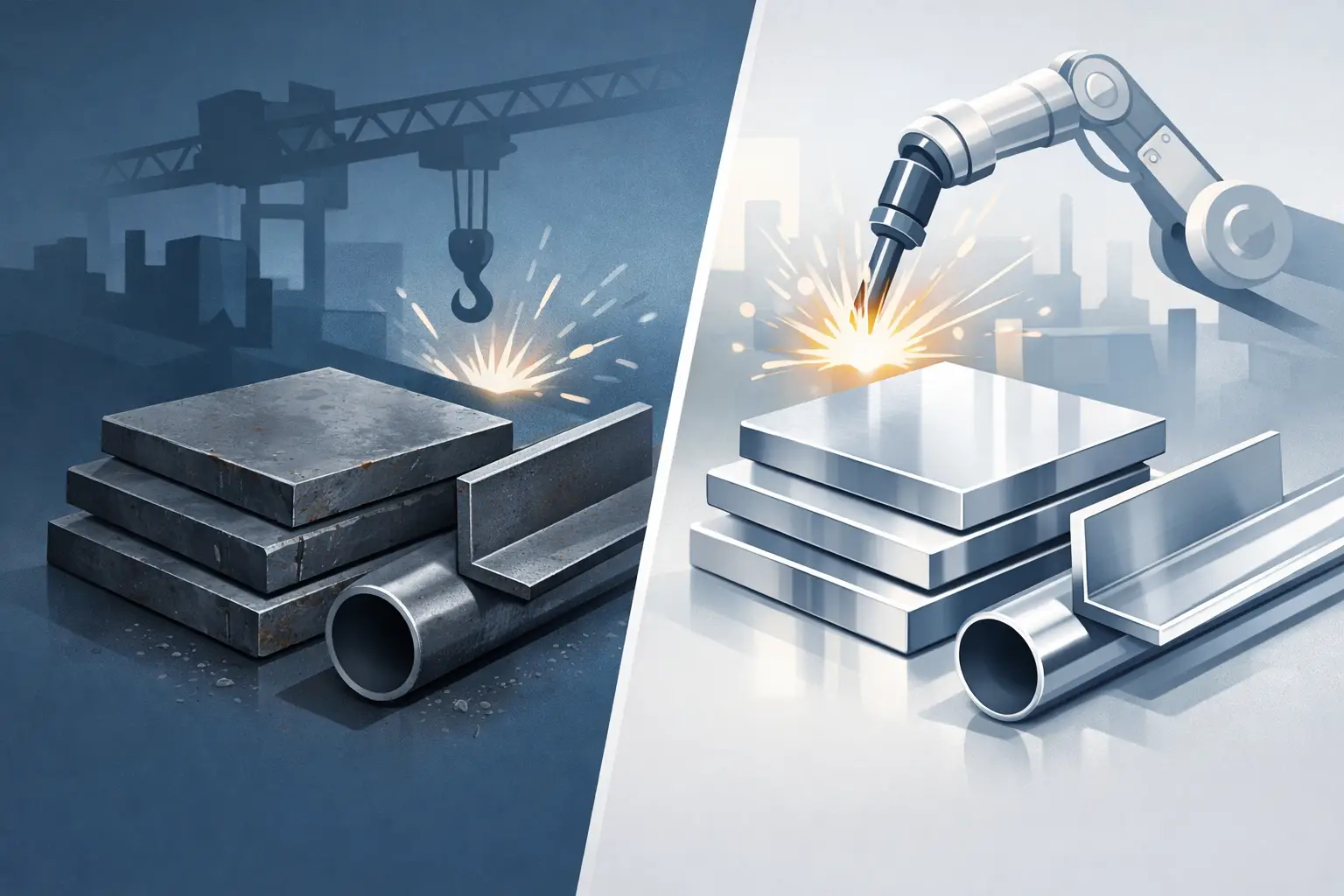
A bracket that performs well in a dry equipment room can fail early on a coastal dock, in a washdown facility, or beneath an exposed structure. That is why the mild steel vs stainless steel decision should begin with service conditions, not simply the initial material price. Both materials are widely used in fabricated components, structural hardware, supports, enclosures, clamps, channels, and custom assemblies, but they solve different engineering and commercial requirements.
For procurement teams, contractors, and OEM sourcing professionals, the correct choice affects fabrication method, finish specification, maintenance expectations, lead time, and total installed cost. Mild steel often provides the most economical path for strong, high-volume fabricated parts. Stainless steel can provide a longer service life where corrosion, moisture, chemicals, or appearance are central concerns. The right material is the one that meets the application requirement without adding unnecessary cost or manufacturing complexity.
Mild Steel vs Stainless Steel: Core Differences
Mild steel is a low-carbon steel valued for its strength, formability, weldability, and cost efficiency. It is commonly selected for structural brackets, frames, channels, support systems, machine guards, base plates, welded fabrications, and construction hardware. Its carbon content is generally low enough to support efficient cutting, punching, bending, drilling, and welding across a broad range of sheet and plate thicknesses.
Stainless steel is an alloy steel that contains chromium, typically at least 10.5 percent. Chromium forms a thin passive surface layer that helps resist rust and corrosion. Many stainless grades also contain nickel, molybdenum, or other alloying elements that improve corrosion resistance, strength, heat performance, or formability. For fabricated products, Type 304 and Type 316 are among the most common choices. Type 304 suits many general-purpose indoor and outdoor applications, while Type 316 is frequently specified where chlorides, saltwater, or more aggressive chemical exposure are present.
The practical distinction is straightforward: mild steel needs a protective finish when exposed to moisture or corrosive conditions, while stainless steel has corrosion resistance built into the material itself. That distinction has implications well beyond the purchase order price.
| Factor | Mild Steel | Stainless Steel | | --- | --- | --- | | Initial material cost | Lower in most applications | Higher due to alloy content | | Corrosion resistance | Requires coating or controlled environment | High, depending on grade and environment | | Fabrication | Excellent for cutting, bending, punching, and welding | Highly fabricable, but may require different tooling and process control | | Surface finish | Often painted, powder coated, plated, or galvanized | Can be mill finish, brushed, polished, or passivated | | Typical use | Structural, industrial, and cost-sensitive parts | Hygienic, marine, architectural, food, chemical, and exposed applications |
Cost Should Be Measured Over the Service Life
Mild steel is usually the more economical material at the point of manufacture. Its lower raw-material cost and predictable fabrication characteristics make it a strong choice for high-volume parts, large structural assemblies, and applications where a coating system can provide the required protection. For indoor machinery components, protected framing hardware, equipment bases, and dry-environment supports, mild steel can deliver dependable performance at a competitive cost.
However, the lowest purchase price is not always the lowest lifecycle cost. A mild steel component installed outdoors may require galvanizing, zinc plating, powder coating, or a multi-step paint system. Those finishing operations add cost and must be specified correctly. Damage to the coating during transport, installation, drilling, or field welding can create localized corrosion points that require repair.
Stainless steel commands a higher initial price, but it may eliminate or reduce the need for secondary protective coatings. In exposed or corrosive environments, this can simplify maintenance planning and reduce replacement risk. For an OEM building equipment intended for frequent washdown, for example, specifying stainless steel may protect product reliability and reduce warranty exposure. For a marine dock connection or coastal mounting assembly, the difference between Type 304 and Type 316 can be equally significant.
The commercial question is not whether stainless steel costs more. It does. The better question is whether the operating environment justifies its higher upfront cost over the expected service life of the finished product.
Corrosion Resistance Depends on the Actual Environment
Stainless steel is not a single material with identical performance in every setting. Grade selection matters. Type 304 stainless steel performs well in many industrial, architectural, food-service, and general outdoor applications. But it can experience staining or corrosion when repeatedly exposed to salt spray, deicing chemicals, chlorine-containing cleaners, or marine conditions.
Type 316 stainless steel includes molybdenum, which improves resistance to chloride-related corrosion. It is often the more suitable option for coastal construction, waterfront hardware, marine assemblies, chemical processing environments, and equipment exposed to aggressive washdown. Even then, design details matter. Crevices that trap water, poor drainage, contamination from carbon steel tools, and incompatible fasteners can compromise long-term performance.
Mild steel is highly vulnerable to corrosion when left bare in humid or outdoor conditions. That does not make it unsuitable. It means the corrosion-control strategy must be part of the engineering specification. Hot-dip galvanizing is commonly used for outdoor structural hardware and heavy fabricated assemblies. Powder coating can provide a clean, durable finish where appearance is important. Zinc plating may suit hardware and controlled environments, though its protection level is not equivalent to heavy galvanizing.
A reliable specification identifies the environment clearly: indoor or outdoor, dry or wet, sheltered or exposed, coastal or inland, occasional splash or continuous washdown. Generic phrases such as “corrosion resistant” leave too much room for inconsistent sourcing decisions.
Fabrication and Welding Considerations
Both mild steel and stainless steel can be cut, punched, bent, formed, welded, and assembled into precise fabricated products. Mild steel is generally more forgiving in conventional fabrication operations, particularly for structural parts requiring extensive welding and forming. It offers consistent results across common processes and is widely compatible with standard tooling.
Stainless steel requires disciplined process control. It can work-harden during forming, meaning it may become harder as it is bent or shaped. Tool selection, bend radii, press brake setup, and handling practices should reflect the grade and thickness being processed. Stainless surfaces also need protection from scratches, embedded iron particles, and cross-contamination from carbon steel operations.
Welding stainless steel demands proper filler selection and heat control to maintain corrosion resistance around the weld zone. Fabricators should also consider weld cleanup, pickling, passivation, or mechanical finishing where required by the application. These are not reasons to avoid stainless steel. They are reasons to work with a manufacturing partner that understands material-specific production controls and can maintain consistency from prototype through production quantities.
For mild steel assemblies, welding is efficient, but the finishing sequence must be planned early. If a part will be galvanized, venting and drainage provisions may be required for hollow sections. If it will be powder coated, weld spatter, sharp edges, and surface preparation need attention. Designing for fabrication and finishing together prevents avoidable delays and rework.
Strength, Appearance, and Specification Fit
Neither material should be selected on the assumption that one is automatically stronger. Mechanical properties vary by grade, thickness, temper, and product form. Mild steel is frequently well suited to load-bearing frames, brackets, channels, and structural supports because it combines practical strength with favorable cost. Stainless steel can offer excellent mechanical performance, but its primary value in many fabricated applications is corrosion resistance, cleanliness, and appearance rather than a simple strength advantage.
Appearance can be a valid specification driver. Stainless steel provides a clean, professional finish for visible architectural hardware, commercial equipment, medical-adjacent installations, food-processing components, and premium enclosures. It can be supplied with mill, brushed, or polished finishes depending on the visual and functional requirement.
Mild steel offers more finish flexibility when color matching is needed. Painted or powder-coated components can align with equipment branding, safety-color requirements, or architectural standards. Galvanized mild steel provides a practical industrial appearance and reliable protection for many outdoor uses. The key is to specify coating thickness, color, gloss level, and any testing requirement rather than relying on general finish descriptions.
How to Choose the Right Material for a Fabricated Part
Start with the installation environment and required service life. If the product will remain indoors and dry, mild steel with an appropriate finish is often the most cost-effective solution. If the component will face constant moisture, washdown, salt exposure, food-contact-adjacent conditions, or chemical cleaning, stainless steel deserves serious consideration.
Next, evaluate the part geometry and production method. Complex bends, deep forms, tight tolerances, welded joints, and cosmetic surfaces all influence the optimum grade, thickness, and finish. Also consider the full assembly. A stainless bracket paired with ordinary carbon steel fasteners can still create corrosion concerns. Material compatibility should be reviewed across fasteners, weldments, inserts, and connected structures.
Finally, document the requirement in terms a manufacturer can quote and produce consistently. Include material grade, thickness, finish, coating standard where applicable, dimensional tolerances, weld requirements, and expected operating environment. This gives sourcing teams comparable quotations and helps prevent costly substitutions after production begins.
At Metallix Exports, material selection is considered alongside fabrication process, tolerances, finishing, assembly, and export packaging requirements. That approach supports buyers who need more than a material quote - they need components manufactured for the conditions they will actually face.
The best choice is rarely the most expensive material or the cheapest one. It is the material, grade, finish, and fabrication plan that will keep the part performing as specified for the life of the project.


