
 E-mail :
 Call Us :
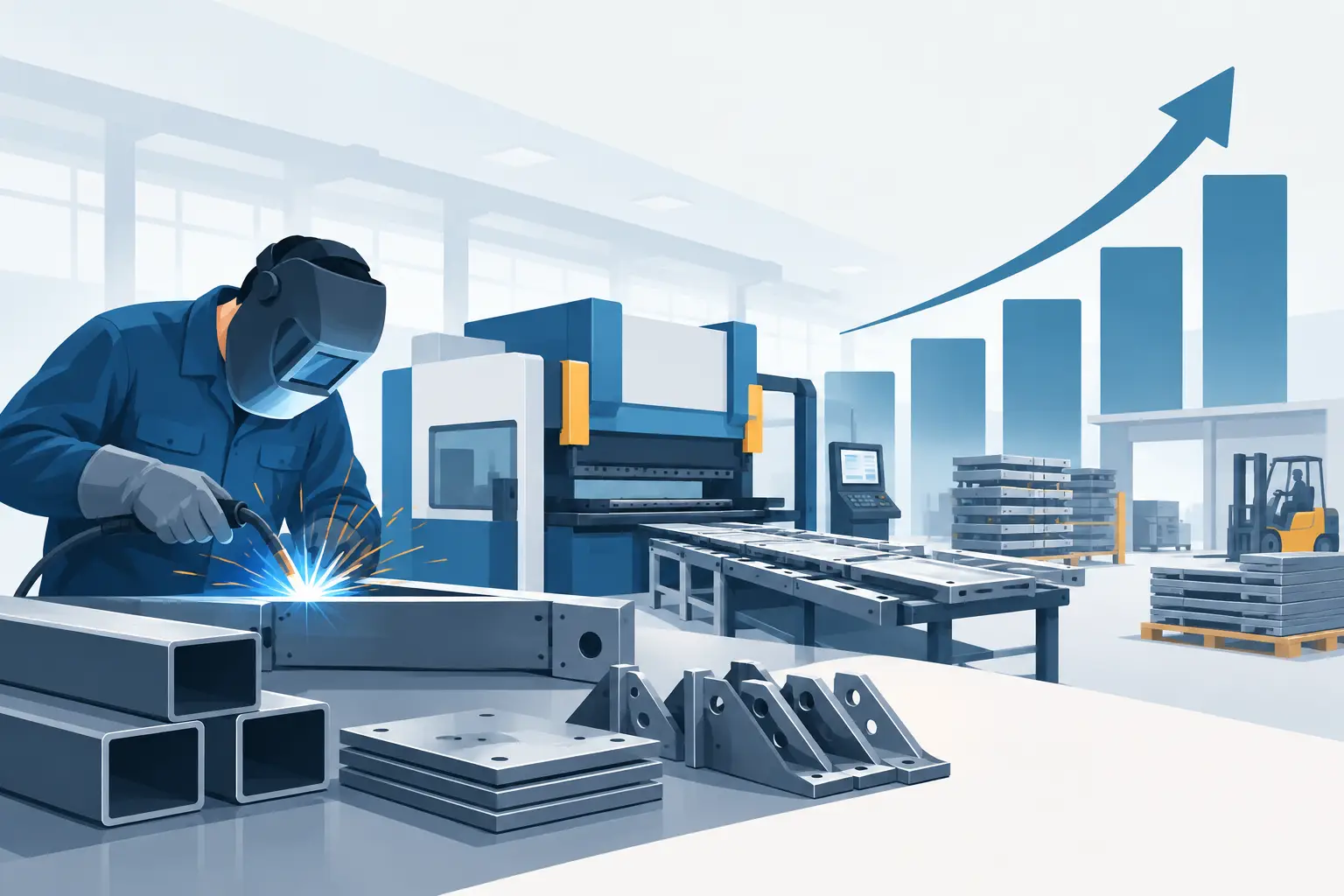
A component that fits perfectly in a first-article inspection but arrives late, varies between lots, or creates assembly problems is not a production-ready component. Metal fabrication for OEMs has to support more than a drawing. It has to support repeatable manufacturing, reliable procurement, and the production schedule behind the finished product.
For OEM sourcing teams, the right fabrication partner reduces friction across the supply chain. That means clear technical communication, controlled processes, dependable lead times, and the ability to produce standard hardware alongside application-specific parts. Whether the requirement is a formed electrical enclosure bracket, a welded machinery frame, a galvanized strut component, or marine dock hardware, the production method must match the product's functional demands.
What Metal Fabrication for OEMs Must Deliver
OEM production depends on consistency. A fabricator may be able to cut and bend a prototype successfully, but recurring production introduces different demands: material traceability, repeatable tooling, documented inspection, controlled welding, finish quality, packing discipline, and shipment coordination.
The real measure of capability is whether every approved lot performs like the last one. Small deviations in hole location, bend angle, thread engagement, weld distortion, coating thickness, or flatness can slow downstream assembly. Those problems are especially costly when a component is one part of a larger bill of materials and the final product cannot ship without it.
A capable supplier therefore works from the complete requirement, not just the visible geometry. Drawings, material specifications, tolerances, load requirements, finish expectations, assembly interfaces, annual volumes, and packaging needs all affect the production plan. When these inputs are addressed early, buyers can avoid avoidable rework, late engineering changes, and expensive expedited freight.
Start With Manufacturing-Ready Engineering
The strongest production outcomes begin before the first sheet is cut. Design for manufacturability review identifies details that are technically possible but unnecessarily difficult, slow, or inconsistent to produce at volume. It can also reveal opportunities to simplify a design without compromising function.
For sheet metal parts, common review points include bend radius, bend relief, flange length, hole-to-bend distance, access for welding, material thickness, and the relationship between forming and finishing. A tight tolerance may be necessary on a mounting face but not on a noncritical edge. Specifying precision only where it affects performance protects both cost and lead time.
Material choice requires the same practical approach. Mild steel is often economical and well suited to structural applications, particularly when a protective finish is appropriate. Stainless steel provides corrosion resistance in demanding environments, but grades, surface condition, and welding requirements need to be considered carefully. Aluminum can reduce weight and resist corrosion, although its forming behavior and joining methods differ from steel. Galvanized sheet is useful for many construction and support applications, but fabricators must account for coating condition around cut edges and welded areas.
The best answer depends on the application. An indoor industrial bracket, an exterior support system, a food-processing enclosure, and floating dock hardware may look similar on a drawing, yet require very different material and finish decisions.
Prototype Parts Are Not Production Parts
Prototype quantities are valuable for checking fit, function, and installation. They do not always prove that a component is ready for economical, repeatable production. A prototype can be made using flexible methods that are too slow for a release order of thousands of pieces.
Before moving to production, OEMs should confirm the planned routing, fixture requirements, tooling strategy, inspection points, and target cycle time. For recurring programs, purpose-built jigs, welding fixtures, or forming tools can improve repeatability and reduce labor variation. The initial investment may not make sense for a low-volume service part, but it can be justified when demand is stable and quality requirements are strict.
Build Process Control Into Every Operation
Metal fabrication is a sequence of dependent operations. An error at cutting can affect bending. A bending variation can complicate welding. Welding heat can alter dimensions or surface condition before finishing. Effective process control recognizes these connections rather than treating each operation as isolated.
Cutting, punching, laser processing, bending, forming, welding, assembly, and finishing should be planned as one manufacturing route. For example, hole features that locate a part during assembly need to be held to a tolerance that supports the final assembly, not merely the cutting process. Weld sequencing may need to be designed to limit distortion on long channels, frames, or brackets. Components requiring a clean exterior finish may need welds dressed before coating or polishing.
Inspection also needs to reflect the actual use of the part. Dimensional checks are essential, but they are not the whole quality plan. A useful inspection process may include material verification, first-piece approval, in-process checks, final dimensional inspection, visual weld evaluation, thread checks, coating review, and packaging verification. The level of control should be based on the component's risk and function.
For a simple noncritical clip, a practical sampling plan may be appropriate. For a load-bearing post base, helical pier component, machinery support, or safety-related structural hardware, more rigorous documentation and verification may be required. Over-inspection adds cost, but under-inspection can expose an OEM to field failures and costly corrective action.
Finishing and Packaging Are Part of the Specification
A fabricated part is not complete when it leaves the press brake or welding station. Surface finishing directly affects corrosion performance, appearance, handling safety, and compatibility with the finished assembly. Powder coating, zinc plating, galvanizing, passivation, painting, polishing, and other treatments each have different advantages and limitations.
Finish selection should account for the operating environment, expected wear, cosmetic requirements, electrical grounding needs, and mating components. Coating buildup, for example, can influence threaded features, close-fitting slots, and tight assembly interfaces. If a component will be exposed to salt, moisture, chemicals, ultraviolet light, or abrasive use, that needs to be addressed before production begins rather than after the first field issue.
Packaging matters just as much for export-ready fulfillment. Sharp edges must be protected. Finished surfaces may require separators or film. Hardware sets must remain complete. Heavy fabricated components need packaging that supports safe handling and limits movement in transit. Clear labeling, part identification, and lot control help receiving teams verify incoming material quickly and prevent mix-ups on the production floor.
Choose a Supplier That Reduces Vendor Complexity
Fragmented sourcing creates hidden costs. When cutting comes from one supplier, welding from another, finishing from a third, and standard support hardware from a fourth, the OEM carries more coordination risk. Lead times become harder to manage, and accountability becomes unclear when quality problems arise.
A broader manufacturing partner can simplify that model by combining custom fabricated components with standard product categories such as channels, brackets, clamps, framing hardware, structural fittings, and related fasteners. This is particularly useful for construction equipment, HVAC systems, electrical support applications, industrial machinery, marine projects, and infrastructure-related assemblies.
When evaluating a supplier, procurement teams should look beyond quoted unit price. Four questions often reveal whether the partner can support a program over time:
- Can the supplier manufacture to the required tolerances and verify them consistently?
- Can it manage the full process, including forming, welding, finishing, assembly, and export packaging?
- Does it communicate early when drawings, materials, or schedules create production risk?
- Can it scale from qualification orders to ongoing production without changing the quality level?
The answers should be supported by manufacturing evidence, not broad capability claims. Sample parts, inspection records, process discussions, clear quote assumptions, and realistic production schedules provide a much better basis for supplier approval.
Plan Capacity Around the Actual Demand Pattern
Capacity is not simply a question of how many parts a facility can make in a month. OEM demand often includes new-product introductions, seasonal peaks, blanket orders, replacement parts, and project-specific releases. The right supply model depends on how predictable those requirements are.
For steady, high-volume demand, scheduled releases and planned inventory can improve responsiveness and stabilize production. For variable programs, a supplier may need to reserve material, maintain approved tooling, and provide practical lead-time visibility rather than holding finished stock that may never be used. Long-lead materials and specialized finishes should be identified early because they can become the real constraint, even when fabrication capacity is available.
Communication is critical here. A reliable fabrication partner does not wait until a shipment is at risk to raise a concern. It provides clear production status, flags material issues promptly, and works with the buyer on alternatives when timing or specifications need adjustment.
For OEMs that need precision components, structural hardware, and export-ready supply from a single manufacturing partner, Metallix Exports brings together fabrication breadth and production discipline. The most useful next step is to review the part as it will actually be sourced, assembled, shipped, and used. That is where a drawing becomes a dependable production program.


