
 E-mail :
 Call Us :
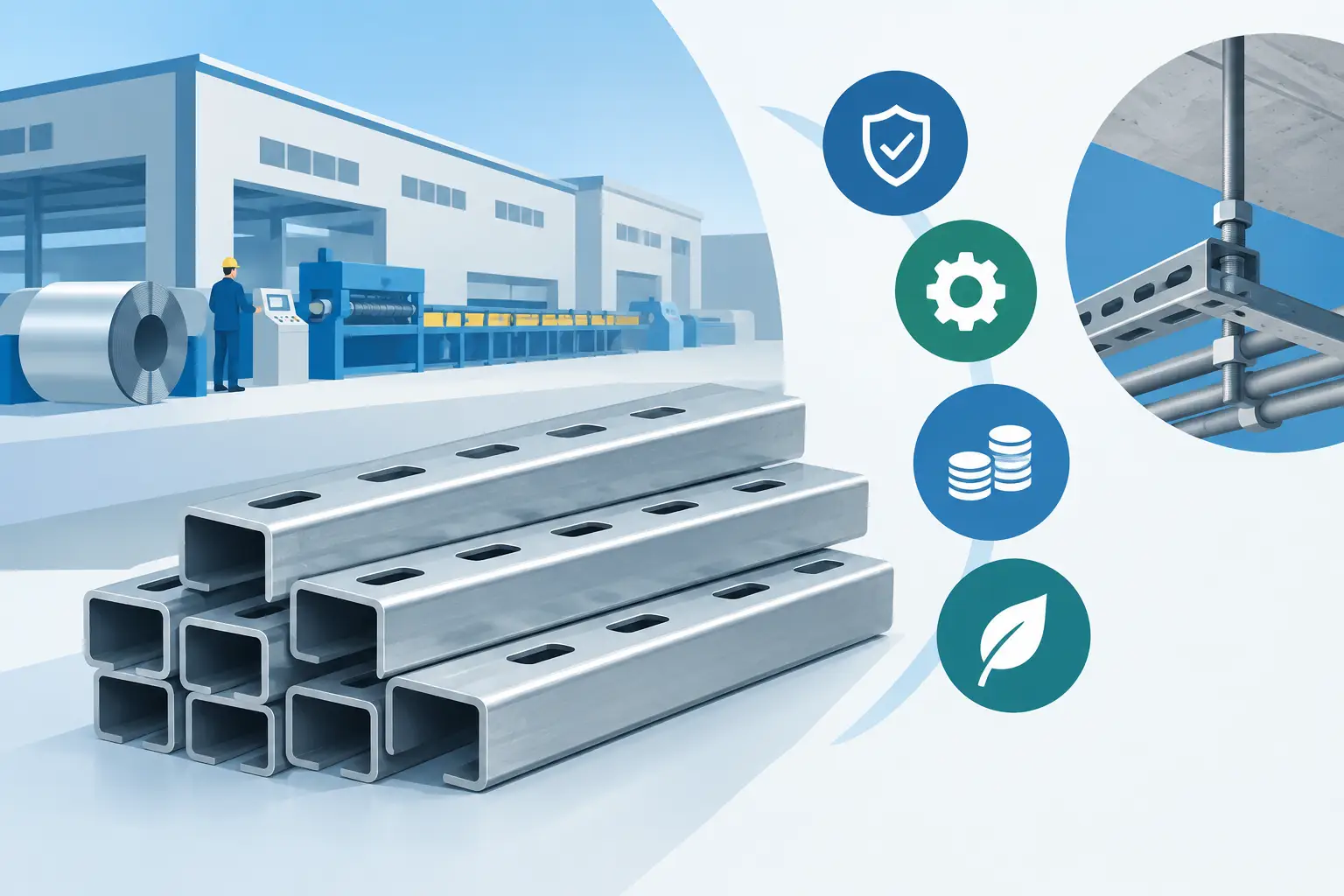
A strut channel may look like a simple formed steel section, but its performance is determined long before it reaches a jobsite. Slot geometry, material thickness, spring nut fit, corrosion protection, load requirements, and dimensional consistency all affect installation speed and system reliability. For procurement teams, contractors, and OEM buyers, selecting manufacturers of strut channels is therefore a sourcing decision with direct consequences for labor, inventory, safety, and project schedules.
The best supplier is not necessarily the one offering the lowest per-piece quote. It is the manufacturer that can produce compatible, repeatable channels and matching hardware at the required specification, while maintaining dependable lead times as demand changes.
What Separates Capable Strut Channel Manufacturers
Strut channels support cable tray, conduit, pipework, HVAC equipment, solar mounting assemblies, machinery guards, and custom structural frames. Because the channel often serves as the backbone of a modular support system, small inconsistencies can create expensive field problems. A slot that varies from specification, a channel lip that does not retain spring nuts correctly, or a coating that fails prematurely can slow installation across an entire project.
Capable manufacturers control the full production sequence. This begins with material selection and coil or sheet inspection, then continues through cutting, punching, roll forming or press forming, deburring, finishing, packing, and final inspection. The goal is not simply to make a U-shaped profile. It is to deliver components that assemble predictably with the hardware specified by the engineer or installer.
For standard systems, compatibility with widely used Unistrut-style channel dimensions is often essential. For custom applications, the manufacturer must be able to modify slot patterns, section dimensions, material grades, wall thicknesses, and lengths without sacrificing consistency. Buyers should look for a supplier that understands both requirements rather than treating every channel as a commodity item.
Material Choice Starts With the Environment
Material selection should be based on service conditions, loading, fabrication needs, and total project cost. Mild steel is commonly selected for indoor, dry applications where strength and cost efficiency are priorities. Pre-galvanized steel may suit many general construction uses, while hot-dip galvanized steel offers stronger corrosion protection for outdoor, wet, and industrial environments.
Stainless steel is a practical choice where corrosion resistance, washdown conditions, chemical exposure, or long-term appearance matter. Food processing, marine, wastewater, pharmaceutical, and coastal installations may justify its higher initial cost. Aluminum can reduce weight and offers good corrosion performance, although its structural characteristics and compatibility with connected metals need careful review.
Finishing must be specified as carefully as the base material. Zinc electroplating, pre-galvanized finishes, hot-dip galvanizing, powder coating, and specialized coatings each have different strengths. A finish suitable for a climate-controlled mechanical room may not be appropriate for an exterior rooftop support system or a marine dock installation. A manufacturer should be able to identify these trade-offs early, rather than applying one default finish to every order.
Precision Matters in a Modular System
Strut systems are valued because they reduce field welding and permit adjustment during installation. That advantage depends on reliable dimensional control. Channel width, return lip dimensions, slot placement, slot length, straightness, cut length, and edge condition all influence how easily hardware fits and how accurately assemblies can be positioned.
For an OEM, repeatability is often more valuable than a single prototype that looks correct. If channels are incorporated into an equipment frame or packaged support kit, every batch must install in the same way. Procurement teams should ask how dimensional checks are performed, what tolerances can be maintained, and whether first-article samples are available for custom parts.
The same attention applies to accessory hardware. Channel nuts, spring nuts, brackets, clamps, post bases, angle fittings, and welded assemblies should be evaluated as a coordinated system. Buying channels from one source and accessories from several others can appear economical, but it increases the risk of fitment issues, mixed finishes, fragmented quality accountability, and delayed replenishment.
Capacity Is More Than Production Volume
When comparing manufacturers of strut channels, annual output alone does not tell the full story. A supplier may have high-volume capacity for one standard profile but limited flexibility for short runs, special lengths, custom punching, or mixed hardware kits. Buyers should assess whether the manufacturer can support the actual purchasing pattern of the business.
For project buyers, that may mean dependable batch production aligned with phased construction schedules. For distributors, it may mean consistent stock-oriented production across several channel sizes and accessory categories. For OEMs, it may mean a controlled release program that supports recurring demand without excessive inventory exposure.
Manufacturing breadth also matters when a project requires more than channel. A supplier with in-house capabilities for laser or sheet cutting, punching, bending, welding, forming, assembly, and surface finishing can simplify sourcing. Instead of managing separate vendors for channels, brackets, supports, clamps, and fabricated frames, the buyer can work with one accountable manufacturing partner.
Questions That Clarify Supplier Capability
A serious sourcing discussion should move beyond catalog dimensions and unit prices. Buyers benefit from asking specific production and quality questions early in the process:
- Which material grades, thicknesses, and finishes are available for the required environment?
- Are standard profiles compatible with the channel hardware and installation system already in use?
- Can the supplier produce custom slot layouts, lengths, brackets, or welded support assemblies?
- What inspection points are used to verify profile dimensions, slot accuracy, straightness, and coating quality?
- How are parts packed to prevent damage, finish abrasion, and mixed-item shipments?
- Can the manufacturer support export documentation, consolidated shipping, and repeat international orders?
Clear answers to these questions reveal whether the supplier has an engineered production process or is simply reselling standard material. They also give purchasing teams a better basis for comparing quotations that may initially appear similar.
Custom Fabrication Can Reduce Installation Cost
Standard channel is useful because it offers flexibility, but custom fabrication can reduce labor and simplify field work when requirements are known. Pre-punched mounting locations, cut-to-length sections, formed brackets, welded frames, and packed installation kits can eliminate measuring, drilling, and part sorting on the jobsite.
The trade-off is that custom components require more up-front coordination. Engineering drawings, critical dimensions, load conditions, finish requirements, and hardware compatibility should be confirmed before production. This investment is generally worthwhile for repeat orders, standardized equipment, multi-site rollouts, and projects where field labor is costly or tightly scheduled.
Metallix Exports supports this approach by manufacturing standard strut support components alongside custom sheet metal and fabricated hardware. For buyers managing industrial, construction, marine, electrical, or equipment-support applications, the ability to source compatible channels and purpose-built components from one production partner can improve control over both quality and delivery.
Export Readiness Protects the Schedule
International procurement introduces risks that domestic shipments may not: transit handling, customs documentation, labeling requirements, package durability, and communication across time zones. A strut channel supplier serving global customers should understand how to protect long lengths, finished surfaces, and mixed hardware orders during shipment.
Export-ready packing is especially relevant for galvanized, powder-coated, and stainless components, where surface damage can affect both appearance and corrosion performance. Proper bundling, separators, labeling, carton selection, and palletization make receiving and site distribution easier. For container shipments, efficient packing can also influence freight cost per unit.
Delivery reliability depends on visibility as much as production speed. A supplier should be able to confirm manufacturing status, inspection timing, packing completion, and shipment readiness before a delay affects the project plan. This is particularly important when channels and accessories must arrive together for installation crews to begin work.
Build the Specification Before Requesting Quotes
The strongest purchasing outcomes begin with a complete requirement, not a generic request for channel pricing. Include the profile type, dimensions, material, thickness, finish, lengths, slot details, quantity by item, accessory requirements, applicable drawings, and delivery destination. If loading or environmental exposure is critical, state that as well.
A detailed specification allows qualified manufacturers to quote accurately and recommend practical alternatives when needed. It also prevents the common problem of comparing prices for products that are not truly equivalent. The right strut channel partner should make the next step easier: confirm the details, produce to specification, and deliver parts that fit the work the first time.


