
 E-mail :
 Call Us :
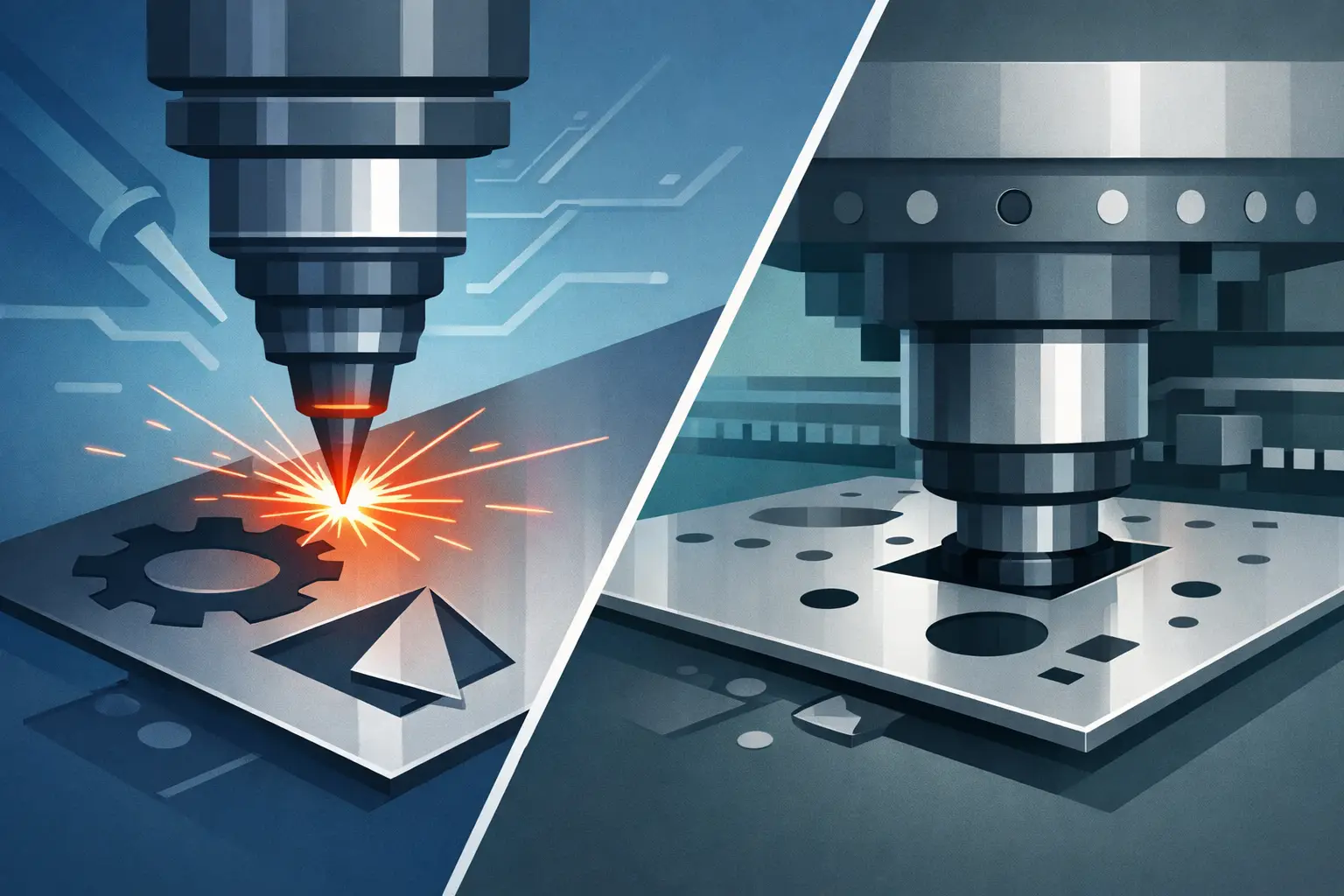
A flat bracket with a few holes may look simple on a drawing, but the cutting method can determine whether it is economical to prototype, practical to produce at scale, or ready for installation without a secondary operation. In laser cutting versus turret punching, the right choice depends less on which machine is generally better and more on the part geometry, material, order quantity, tolerance requirements, and delivery schedule.
For OEMs, contractors, and procurement teams, this is a production decision with direct effects on unit cost, lead time, repeatability, and supplier coordination. A capable sheet metal manufacturer will evaluate the entire part, not just the outside profile, before selecting a process.
How Laser Cutting and Turret Punching Work
Laser cutting uses a focused beam to melt or vaporize material along a programmed path. It is a flexible, non-contact process that can produce complex profiles, internal cutouts, slots, and varying shapes without dedicated punch tooling for each feature. Modern fiber lasers are especially effective for many mild steel, stainless steel, aluminum, and galvanized sheet applications.
Turret punching forms or cuts features by driving matched punches and dies through sheet metal. A turret machine holds multiple tooling stations and can rapidly produce repeated holes, louvers, knockouts, tabs, embossed features, and formed details. Because the tool contacts the material, each feature must be compatible with available or purpose-made tooling.
Both processes are proven manufacturing methods. The distinction is not quality versus quality. It is process fit.
Laser Cutting Versus Turret Punching for Part Geometry
Laser cutting is usually the stronger option when a part contains intricate contours, irregular openings, fine slots, or frequent design changes. The program can be updated without manufacturing a new punch and die set. This makes laser cutting well suited to prototypes, pilot runs, custom brackets, architectural hardware, enclosure panels, foundation components, and contract-manufactured parts with application-specific geometry.
It also provides design freedom when parts include multiple profile shapes in the same production batch. A laser can move from one programmed shape to another with minimal setup, which helps buyers consolidate low- and medium-volume custom components with one manufacturing partner.
Turret punching excels when the design relies on repeated standard features. Circular holes, square holes, rectangular cutouts, perforation patterns, and common electrical enclosure features can be produced at high speed. More significantly, a turret can create certain formed details in the same machine cycle. Louvers, dimples, countersinks, offsets, and extruded holes may eliminate separate forming operations when the material and part design allow.
A laser creates the outline of a louver or a countersunk opening, but it does not form that feature. If a part needs several formed elements, punching may reduce handling and total process time. If it needs complex cut geometry with limited forming requirements, laser cutting may be more efficient.
The hidden design question: Can the feature be punched?
Not every hole or shape is a good punching candidate. Feature dimensions, spacing from bends, proximity to an edge, sheet thickness, and material behavior all influence tool selection and the risk of distortion. Tight clusters of holes can cause sheet deformation or tool wear in some applications.
Laser cutting avoids punch-tool limitations but introduces its own considerations. Heat can leave a small heat-affected zone, particularly on thicker materials or certain alloys. Cut-edge condition, burr allowance, and finish requirements should be reviewed before production. For parts that will be powder coated, plated, welded, or exposed to corrosion, the complete downstream process matters as much as the initial cut.
Volume, Tooling, and Total Cost
For short runs, prototypes, and changing designs, laser cutting often offers a lower entry cost. There is no need to purchase custom punch tooling for every unique feature. Setup is primarily digital, allowing faster transition from approved drawing to first article production.
That advantage can narrow as order volumes increase. When a component has repeated geometry and stable annual demand, turret punching can achieve a lower per-part cost through rapid cycle times. Once the appropriate tooling is in place, each stroke is highly efficient. This is particularly relevant for standardized brackets, channels, support hardware, panel components, and other parts with recurring hole patterns.
However, tooling cost should not be reviewed in isolation. Buyers should consider the total cost of ownership for the part: programming, setup, tool amortization, machine cycle time, secondary forming, deburring, material utilization, inspection, packing, and freight readiness. A process that appears less expensive by piece price can become more costly if it requires several extra operations or creates avoidable scrap.
For mixed orders, a combined approach can be the most commercial solution. A turret can punch standard holes and formed features quickly, while a laser completes complex contours or low-volume variations. Process planning should follow the part requirement rather than forcing every component through one machine.
Speed and Lead Time Are Not the Same
Turret punching is often faster for high quantities of parts with common, repeated features. A purpose-matched tool can produce a hole in one fast stroke, while a laser must trace the perimeter of that hole. The difference becomes meaningful across thousands of identical parts.
Yet lead time includes more than machine time. A laser can move quickly from drawing approval to production because it avoids tooling procurement and setup associated with a new punch design. For urgent replacement parts, custom samples, or projects where dimensions may still be revised, this flexibility can shorten the path to shipment.
Procurement teams should therefore ask two separate questions: How quickly can the part run once production starts, and how quickly can a supplier release the part into production? The best answer may differ by project phase.
Tolerances, Edge Quality, and Material Considerations
Both methods can produce accurate parts when supported by controlled programming, maintained equipment, suitable tooling, and inspection procedures. The required tolerance should be identified on the drawing rather than assumed. Critical hole-to-hole locations, bend references, mating interfaces, and assembly datums deserve specific attention.
Laser cutting generally delivers strong positional accuracy for complex profiles and avoids the mechanical stress of a punching operation. It is often preferred for detailed components where profile accuracy is central to fit-up. Edge quality depends on laser type, sheet thickness, material grade, assist gas, and cutting parameters. Some applications may require deburring or edge finishing before assembly.
Turret punching can produce clean, consistent holes and repeatable features, especially with sharp, correctly maintained tooling. It may leave a shear edge and a small burr, which must be acceptable for the application or addressed through finishing. Tool wear also affects quality over time, making preventive maintenance and in-process inspection essential for production consistency.
Material selection can shift the decision. Stainless steel and aluminum may be ideal for laser-cut profiles, while certain repetitive mild steel patterns are highly efficient to punch. Copper, galvanized sheet, and pre-finished materials require process-specific evaluation to protect surface condition and avoid unnecessary rework.
Choosing the Right Method for Your Sheet Metal Program
A practical selection starts with the production facts: annual volume, batch size, material type and thickness, required formed features, drawing stability, finish requirements, and delivery expectations. It should also account for whether the part belongs to a broader assembly. A bracket that costs slightly more to cut may save time during bending, welding, installation, or field adjustment.
Laser cutting is generally the better fit for custom profiles, frequent revisions, short to medium runs, and parts with complex contours. Turret punching is generally the better fit for stable, high-volume parts with repeated holes or integrated formed features. Neither rule is absolute. A high-volume complex profile may still favor laser cutting, while a low-volume panel with several louvers may justify punching because it avoids separate forming.
For export programs, consistency matters beyond the machine. Parts should be checked against approved drawings, packed to prevent transit damage, labeled for receiving efficiency, and scheduled around project delivery commitments. Metallix Exports evaluates cutting, punching, bending, welding, finishing, and assembly as connected manufacturing steps so buyers can source complete, specification-ready components rather than manage fragmented operations.
The most useful question is not whether laser cutting or turret punching wins in general. Ask which process produces the required part with dependable quality, efficient total cost, and a lead time your project can rely on. That is where a well-engineered manufacturing decision begins.


