
 E-mail :
 Call Us :
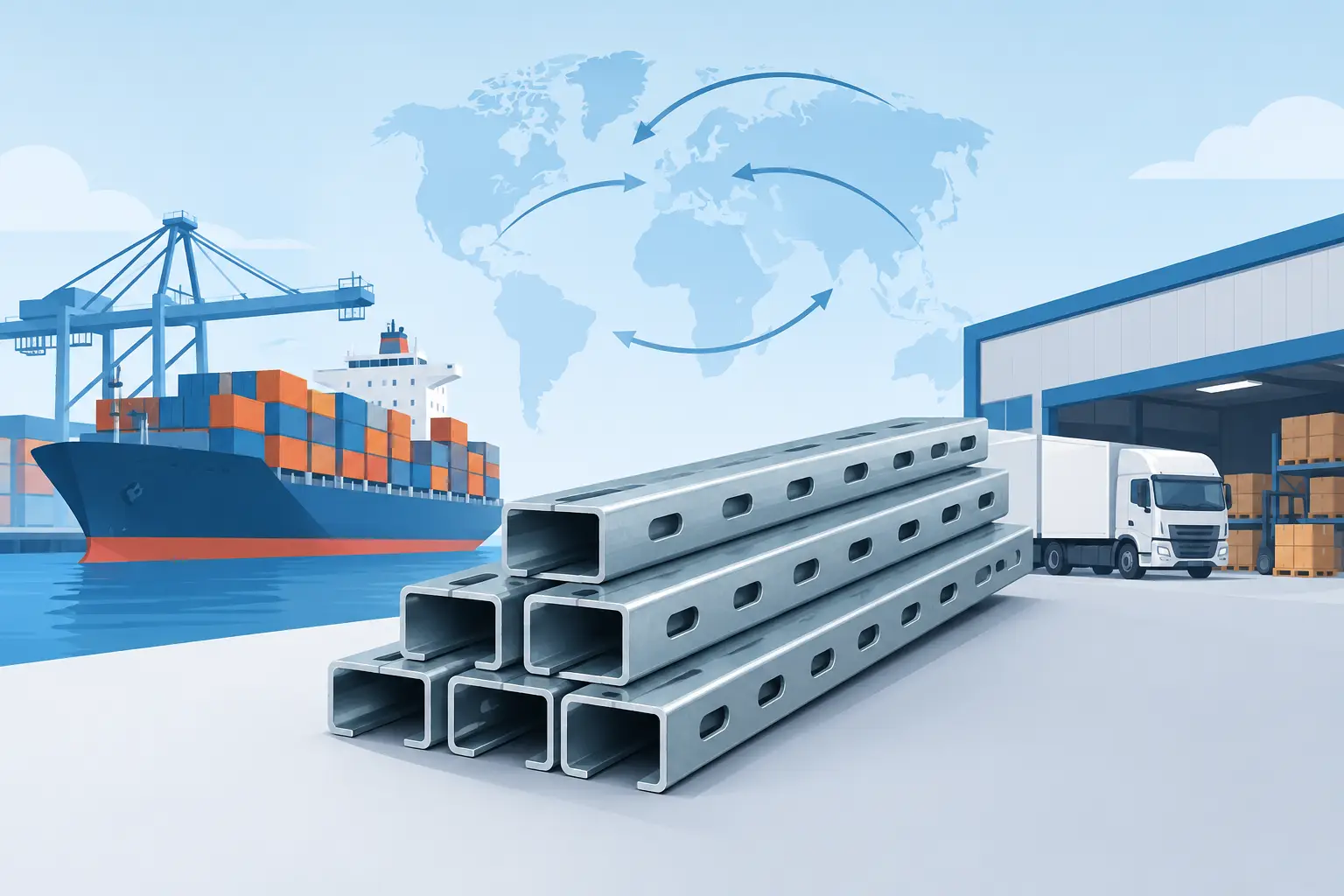
A strut channel may look like a simple formed steel section, but procurement errors are rarely simple. A channel with an inconsistent slot pattern, an incompatible nut, or inadequate corrosion protection can delay an electrical, HVAC, solar, or industrial support installation long after the material has reached the site. For importers and distributors of strut channels, the commercial opportunity lies in supplying a system buyers can specify, install, and replenish with confidence.
Strut channel demand is driven by a practical requirement: contractors and manufacturers need adaptable structural support without cutting, welding, or drilling at every installation point. The product is familiar, but buyer expectations are high. They expect dimensional consistency, compatible fittings, dependable stock availability, and clear documentation across every order.
What Buyers Expect From Strut Channel Suppliers
Distributors are not simply moving lengths of channel. They are expected to provide a support-system solution. That means the channel, spring nuts, bolts, clamps, brackets, post bases, beam clamps, and custom fittings must work together in the field.
For most purchasing teams, interchangeability is a central concern. Many projects use established strut profiles and require unistrut-compatible systems to avoid redesigning supports or replacing related hardware. Compatibility should be verified against the actual profile dimensions, slot configuration, wall thickness, and fitting geometry, rather than assumed from a general product description.
Consistency also protects the distributor's reputation. If a shipment contains channels with uneven bends, sharp edges, distorted slots, or variable coating coverage, the distributor absorbs the consequences through returns, jobsite complaints, and lost repeat business. A reliable manufacturing source reduces those risks before products enter the supply chain.
The Specifications That Should Not Be Treated as Secondary
Channel size alone does not define fit for purpose. Buyers should be able to obtain clear information on section depth and width, material grade, gauge or wall thickness, hole or slot pattern, length tolerance, and finish. These details influence load behavior, assembly speed, corrosion performance, and compatibility with existing support hardware.
Material selection depends on the environment and application. Pre-galvanized steel can be appropriate for many indoor commercial installations. Hot-dip galvanized channel is often selected for outdoor exposure and more demanding moisture conditions. Stainless steel may be necessary where corrosion resistance, washdown conditions, or chemical exposure justify the higher material cost. Aluminum can reduce weight in selected applications, but its load requirements and galvanic interaction with adjacent materials must be considered.
The right finish is not automatically the most expensive one. It is the finish that matches the service environment, expected life cycle, project specification, and maintenance plan. A distributor who helps customers make that distinction becomes more valuable than one who only quotes a price per length.
How Importers and Distributors of Strut Channels Build Reliable Supply
The most effective sourcing model starts with a clear product standard. Before placing a production order, importers should define approved drawings, acceptable tolerances, material requirements, coating specifications, marking requirements, packaging method, and inspection criteria. This gives the manufacturer a measurable production target and gives the distributor a basis for incoming quality checks.
A sample approval process is useful, especially when sourcing a new profile or introducing a private-label range. The approved sample should reflect the commercial product, not a hand-finished prototype. Review channel geometry, slot placement, burr control, finish appearance, accessory engagement, labeling, and carton strength. If the system includes spring nuts or brackets, test the assembled connection rather than evaluating each part in isolation.
Packaging deserves more attention than it often receives. Long formed channels can shift, scratch, or bend during international transit if bundles are poorly secured. Small hardware can become mixed, damaged, or difficult to identify when packed without clear labels. Export-ready packaging should protect products through container loading, inland transport, warehouse handling, and final delivery. Bundle counts, product codes, finish identification, and lot traceability make receiving faster and reduce picking errors.
Lead time should also be assessed as a process, not as a single promise. Buyers need to understand the timing for raw material procurement, tooling or setup, forming, punching, finishing, inspection, packing, and shipment. A supplier with transparent production planning can help distributors set realistic stocking levels and avoid committing inventory before it is actually available.
Standard Inventory and Custom Production Work Best Together
A broad standard range supports fast-moving demand. Common channel profiles, standard lengths, slotted options, channel nuts, pipe clamps, angle brackets, and fastening hardware give distributors a practical foundation for daily orders. These products are especially valuable for electrical contractors, HVAC installers, warehouse projects, and general construction work where speed of availability matters.
Custom manufacturing addresses the business that standard stock cannot capture. An OEM may need a specific channel length, nonstandard punching pattern, heavier gauge, special bracket, proprietary assembly, or application-specific finish. A marine installation may require corrosion-conscious hardware and fabricated connection plates. A solar or industrial project may need repeatable supports produced to a controlled drawing.
There is a trade-off. Highly customized products can increase setup requirements, minimum order quantities, and planning time. They are most effective when the application volume, margin, or strategic customer relationship supports that investment. Standard items remain the better choice when immediate availability and broad interchangeability are the priorities.
For distributors, the strongest portfolio usually combines both approaches: stocked products for repeat demand and a qualified manufacturing partner for engineered or project-specific requirements. This reduces the need to manage separate suppliers for channel, brackets, clamps, fabricated supports, and specialty hardware.
Quality Control Must Follow the Product Through Production
A channel that appears acceptable from a distance may still create installation problems. Quality control should begin with incoming material verification and continue through cutting, punching, roll forming or press forming, welding where required, surface finishing, packing, and final inspection.
Dimensional inspection is particularly important because small variations can affect system assembly. Check channel opening dimensions, internal lip geometry, wall thickness, straightness, slot position, and cut length. Hardware should be checked for thread quality, fit, coating integrity, and proper engagement with the channel profile.
For galvanized or coated components, visual appearance is only one part of the evaluation. Buyers should establish the required coating type and performance expectations based on the application. Areas exposed during cutting, punching, or welding may require special consideration. The supplier should be able to explain how the finish is applied and how it is protected during packing and shipment.
Documentation can make quality easier to manage across repeat orders. Depending on the product and customer requirement, this may include inspection records, material certificates, finish information, packing lists, and part identification. The goal is not paperwork for its own sake. It is traceability when a project team needs to confirm what was supplied.
Questions That Improve Supplier Selection
Price matters, but it should be evaluated alongside the costs created by inconsistency. A lower unit cost can quickly lose its advantage when deliveries require sorting, rework, replacement shipments, or additional field labor. Procurement teams should compare suppliers on total supply performance.
A capable manufacturer should be able to answer practical questions: Can it hold the stated profile tolerance across production runs? Can it produce both standard and custom lengths? Does it have the equipment for punching, bending, welding, assembly, and finishing? How are first articles and production lots inspected? Can it package mixed hardware kits or private-label products? What is its approach to export documentation and shipment coordination?
Manufacturing breadth matters because strut systems rarely stop at channel. When a supplier can produce related brackets, clamps, bases, nuts, welded fabrications, and custom assemblies, the distributor gains better control over compatibility and fewer vendor handoffs. That can be particularly valuable for project orders with fixed delivery windows.
Metallix Exports supports this model through precision sheet metal fabrication and export-ready supply of strut support systems, structural hardware, and custom metal components. For buyers, the value is straightforward: one manufacturing partner can support catalog products as well as drawing-based requirements without compromising production discipline.
Make the Channel System Easy to Buy Again
The most dependable distribution programs make repeat ordering simple. Maintain stable product codes, clear dimensional descriptions, finish designations, and compatible hardware references. Keep records of approved specifications so a repeat purchase does not become a fresh engineering exercise. Where demand supports it, plan inventory around high-velocity profiles and accessories rather than treating every item as a special order.
When project requirements move beyond standard channel, engage the manufacturer early with drawings, load context, environmental conditions, expected quantities, and installation details. Early clarification prevents late changes and gives the production team time to recommend practical forming, punching, finishing, and packing methods.
A well-supplied strut system does more than fill warehouse space. It helps contractors install faster, helps OEMs standardize assemblies, and helps distributors protect the trust they have earned with every order.


