
 E-mail :
 Call Us :
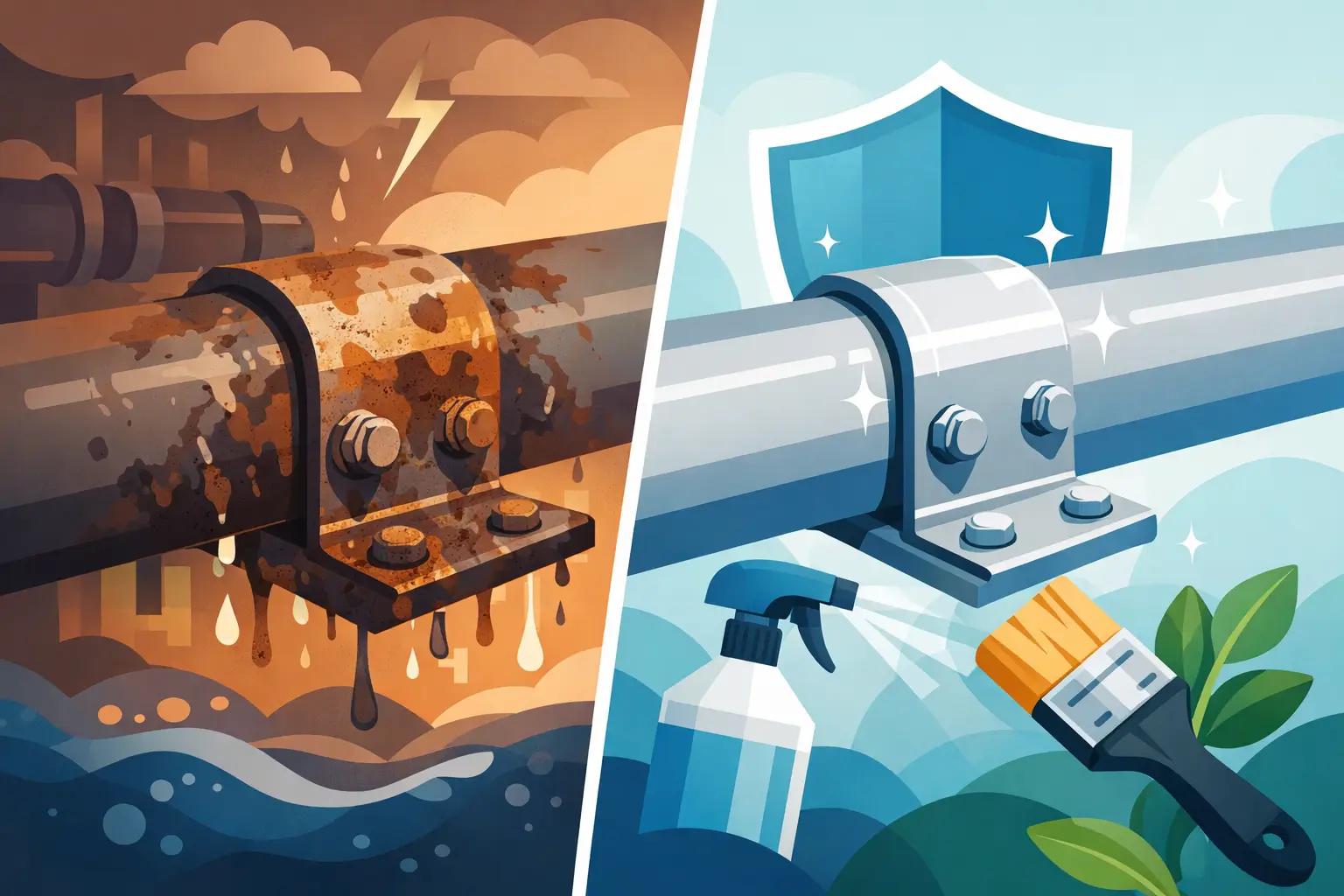
A bracket can meet every dimensional requirement and still fail early when its material, finish, and installation environment are not specified as one system. Understanding how to prevent bracket corrosion starts before fabrication: at the point where load conditions, moisture exposure, dissimilar metals, and expected service life are defined.
For OEMs, contractors, and procurement teams, corrosion control is not an added cosmetic step. It protects structural integrity, prevents seized hardware, reduces replacement cycles, and helps maintain a consistent appearance in visible installations. The right solution depends on the application, but the underlying principles remain the same.
How to Prevent Bracket Corrosion Through Better Specification
The most reliable corrosion strategy begins with accurate application data. A light-duty indoor support bracket requires a different approach than a marine dock fitting, rooftop HVAC support, exterior framing connector, or bracket installed in a chemical-processing environment.
Specify the exposure conditions clearly. Consider whether the bracket will encounter standing water, condensation, salt spray, road deicing chemicals, industrial pollutants, cleaning agents, high humidity, soil contact, or repeated temperature changes. Also identify whether the bracket is concealed or accessible for inspection and maintenance. These details determine whether a standard plated finish is adequate or whether a higher-performance material and coating system is necessary.
Service life should be part of the specification as well. If a bracket is difficult to access after installation, choosing a more durable material or finish at the outset is often less costly than planning for replacement. Lowest unit cost and lowest lifecycle cost are not always the same decision.
Select the Right Base Material
Material selection provides the first line of defense. Mild steel is strong, economical, and highly adaptable for cutting, punching, bending, welding, and custom fabrication. However, uncoated mild steel is susceptible to rust when exposed to moisture and oxygen. It should be paired with an appropriate protective finish for most industrial and construction uses.
Galvanized steel offers practical protection for many outdoor and general-purpose applications. The zinc coating acts as a barrier and provides sacrificial protection to exposed steel at minor scratches or cut edges. Pre-galvanized sheet can be an efficient option for formed components, while hot-dip galvanizing after fabrication generally delivers more complete coverage for heavy-duty exterior brackets and welded assemblies. The trade-off is that post-fabrication galvanizing can affect dimensional tolerances, thread fit, and surface appearance, so those requirements should be addressed during design.
Stainless steel is often the stronger choice for wet, hygienic, coastal, food-processing, chemical, and marine applications. Grade selection matters. Type 304 stainless steel performs well in many environments, while Type 316 provides improved resistance where chlorides and salt exposure are present. Stainless steel is not immune to corrosion, particularly where contamination, stagnant deposits, or poor drainage are present, but it can provide a long service life when properly specified.
Aluminum brackets provide low weight and natural corrosion resistance, making them useful in transportation, electronics, architectural, and certain marine applications. Their use requires attention to contact with steel, copper, and other dissimilar metals. Copper components can also develop protective surface patinas, but they require application-specific consideration because of cost, conductivity requirements, and galvanic interaction.
Match the Finish to the Environment
A coating only performs as well as the preparation beneath it. Oil, weld scale, sharp edges, surface contaminants, and inadequate pretreatment can reduce adhesion and create early points of failure. Manufacturing control is therefore as important as the finish selected.
For indoor brackets in controlled conditions, zinc electroplating with a suitable passivation system may provide economical protection. It is not the preferred solution for constant outdoor wetting, coastal exposure, or aggressive industrial conditions. In those settings, hot-dip galvanizing, zinc-rich systems, powder coating over properly prepared steel, or duplex protection may be more appropriate.
A duplex system combines galvanizing with a paint or powder coating. The galvanized layer protects the steel beneath, while the topcoat provides an additional barrier and can meet color or visibility requirements. This approach can extend service life substantially, particularly where coating damage and weather exposure are expected. It also requires disciplined process control, because trapped moisture, poor coating coverage, or damage during handling can undermine the result.
Powder coating offers a durable, uniform finish for many brackets and structural hardware components. It is especially useful where appearance, color consistency, and moderate corrosion resistance are required. For exterior use, specify a coating system designed for UV exposure and ensure that surface preparation, film thickness, and cure conditions are verified. A decorative coating should not be assumed to provide heavy-duty corrosion protection without the correct pretreatment and substrate.
Protect Welds, Edges, and Fabrication Features
Corrosion often begins at the areas that receive the least attention: weld zones, sharp corners, punched holes, cut edges, threads, and joints. These features can hold moisture, experience coating thinning, or become damaged during assembly.
Design brackets with reasonable bend radii and avoid unnecessarily sharp edges. After welding, remove weld spatter and surface residues before finishing. If the component will be galvanized, provide proper venting and drainage holes in hollow or enclosed sections to support safe, complete processing. Where threaded holes or close-fitting features are involved, account for the coating thickness during design rather than attempting to correct the fit after finishing.
For fabricated assemblies, coating continuity should be considered early. A bracket welded after painting or galvanizing may expose bare steel at the joint. In many cases, it is more reliable to fabricate the complete assembly first and finish it afterward. When field welding is unavoidable, specify a documented repair method that restores corrosion protection at affected areas.
Design Brackets to Shed Water
Good drainage is one of the most cost-effective corrosion-control measures. A bracket that collects water, dirt, salt, or leaves can corrode faster than a similar bracket with an open, self-draining geometry.
Avoid horizontal ledges, upward-facing channels, tight overlaps, and unsealed crevices where water can remain. Add drain holes at low points, orient open sections downward where practical, and provide adequate clearance between the bracket and adjacent surfaces. In outdoor construction, small changes in orientation can prevent years of moisture retention.
Crevice corrosion deserves special attention in stainless steel and marine applications. A tightly joined connection that traps saltwater or contaminated moisture may create localized conditions that are much more aggressive than the surrounding environment. Where possible, use open geometry, continuous sealing where appropriate, or accessible joints that can be cleaned and inspected.
Prevent Galvanic Corrosion at Connections
When two different metals are connected in the presence of an electrolyte such as water, condensation, or salt spray, galvanic corrosion can occur. The more active metal may corrode at an accelerated rate. This is a common risk when aluminum brackets are fastened with stainless steel hardware, when galvanized steel is connected to copper, or when multiple metals are used in rooftop and marine installations.
Compatibility should be evaluated as a complete assembly, not bracket by bracket. Consider the bracket, fasteners, washers, backing plates, channels, clamps, and adjoining structure. Use isolating washers, sleeves, nonconductive gaskets, compatible coatings, or separation materials where dissimilar metals cannot be avoided. The detail must prevent both direct electrical contact and water bridging across the joint.
Fasteners should match the corrosion resistance of the bracket and the application. A high-performance bracket can be compromised by a fastener that rusts, seizes, or creates galvanic attack around the mounting hole. For structural and safety-critical applications, the fastener grade, coating, strength class, and installation torque should all be controlled.
Control Handling, Storage, and Installation
Corrosion protection can be damaged long before a bracket enters service. Abrasion during packing, unprotected stacking, contact with wet timber, storage on bare ground, and exposure to pooled water can all affect finished parts. Export shipments and long transit periods make packaging and moisture management especially relevant.
Specify packaging that prevents metal-to-metal abrasion and protects coated surfaces during transport. Keep parts dry and ventilated in storage, and avoid sealing moisture into packages where temperature changes may create condensation. Contractors should inspect brackets before installation and separate any parts with deep scratches, coating loss, deformation, or surface contamination.
During installation, avoid cutting, drilling, or grinding finished brackets unless the resulting exposed areas can be repaired with an approved system. Do not use carbon steel tools or contaminated abrasives on stainless steel where they can leave embedded particles that later rust. Clean construction debris, mortar, chemicals, and salt residue from installed hardware before turnover.
Build Inspection Into the Maintenance Plan
No corrosion-control system eliminates the need for inspection in demanding environments. The inspection frequency should reflect exposure, consequence of failure, and access conditions. Coastal, chemical, marine, and exterior infrastructure installations generally require more frequent checks than protected indoor systems.
Inspect for coating chips, rust staining, blistering, pitting, loose fasteners, water traps, and corrosion around connections. Address small defects early. A localized coating repair is far less disruptive than replacing a bracket after section loss or fastener failure has developed.
For repeat programs and large assemblies, establish acceptance criteria before production. These may include material certificates, coating thickness requirements, adhesion checks, salt-spray or environmental performance requirements, dimensional verification after finishing, and packaging standards. Clear quality requirements help ensure that every bracket performs consistently, not just the first approved sample.
Corrosion resistance is designed into a bracket through material, geometry, finishing, and installation discipline. Metallix Exports supports this approach with precision fabrication and application-focused finishing options, helping buyers source brackets that are built for their actual operating conditions rather than simply their initial installation date.


