
 E-mail :
 Call Us :
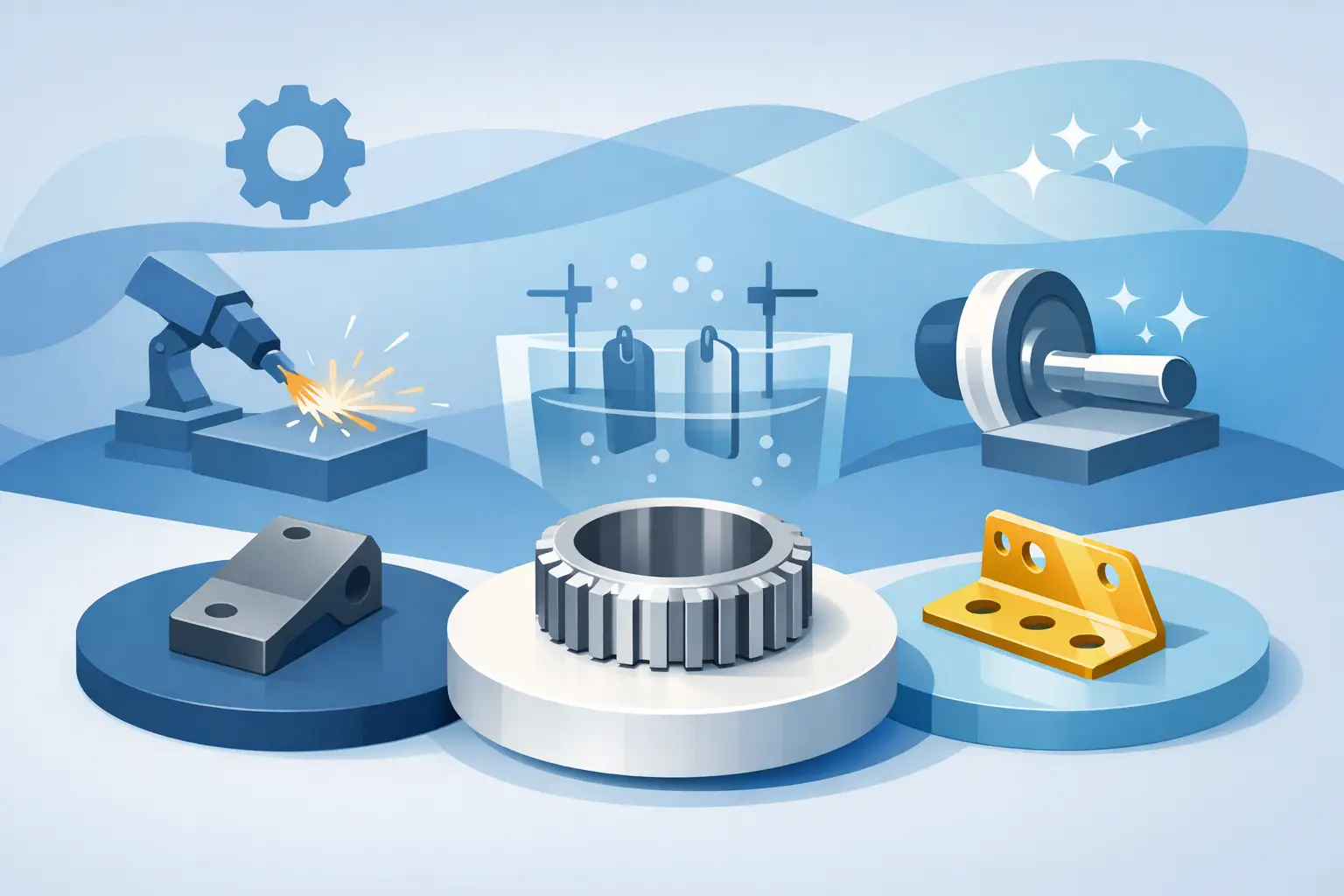
A bracket can meet every dimensional requirement on the drawing and still fail early if its finish is wrong for the operating environment. Corrosion at a cut edge, poor paint adhesion, thread buildup, galvanic interaction, or an inconsistent cosmetic surface can create installation delays and warranty exposure. Knowing how to compare metal finishing options helps procurement teams and engineers select a finish that protects the component without creating avoidable cost, tolerance, or lead-time issues.
For industrial hardware, fabricated assemblies, structural supports, and custom sheet metal parts, the best finish is rarely the most expensive one. It is the one that matches the base material, service conditions, handling requirements, appearance standard, and production volume.
Start With the Part's Actual Service Conditions
The first question is not, “Which finish looks best?” It is, “What will this part experience after installation?” A powder-coated indoor electrical enclosure and a hot-dip galvanized structural bracket used outdoors have very different protection requirements, even if both are fabricated from mild steel.
Define whether the component will be used indoors, outdoors, in a coastal environment, near chemicals, in high humidity, or in contact with soil or standing water. Marine hardware and dock components require particular attention because salt exposure can accelerate corrosion quickly, especially at crevices, fasteners, welded areas, and damaged coating edges.
Also consider temperature, abrasion, UV exposure, cleaning chemicals, and frequency of handling. A finish that performs well on an indoor machine guard may not withstand repeated impact on a material-handling assembly. Likewise, a decorative finish may be unsuitable for a structural component where coating thickness and long-term corrosion protection matter more than appearance.
How to Compare Metal Finishing Options by Performance
A practical comparison starts with five performance factors: corrosion resistance, wear resistance, coating thickness, appearance, and compatibility with the part geometry. These factors often conflict, so the decision requires trade-offs rather than a single universal answer.
Corrosion protection
For carbon steel components, zinc plating, hot-dip galvanizing, powder coating, and e-coating are common options. Zinc-based finishes provide sacrificial protection, meaning the zinc corrodes before the underlying steel. This makes zinc plating useful for many hardware items, brackets, clamps, and fasteners used in dry or moderately corrosive conditions.
Hot-dip galvanizing applies a much thicker zinc coating and is often selected for outdoor structural hardware, support systems, foundation components, and other products exposed to weather. Its durability is a major advantage, but the thickness and process temperature can affect threads, tight-fitting features, flatness, and the appearance of welded fabrications.
Powder coating creates a durable barrier layer with a broad range of colors and textures. It is frequently used where appearance and impact resistance are important. However, a powder coating is only as reliable as its surface preparation and edge coverage. On exterior steel, powder coating over a suitable pretreatment or zinc-coated substrate can provide stronger protection than either approach alone.
For stainless steel, passivation is commonly used to remove free iron contamination and support the material's natural corrosion resistance. It does not create a heavy visible coating, so it is not a substitute for a protective paint system where the environment demands one. Aluminum parts often use anodizing to improve corrosion resistance, surface hardness, and appearance while retaining a metallic finish.
Thickness and dimensional impact
Finishing affects dimensions. This is especially relevant for threaded holes, mating surfaces, press-fit features, precision bends, channels, clamps, and assemblies with close clearances. Electroplated coatings are generally thinner and more controlled than hot-dip galvanized coatings, but even a thin deposit can interfere with a tight thread or a critical fit.
Specify which dimensions are functional and whether they are measured before or after finishing. If a drawing requires a nut, threaded insert, or bore to remain within a narrow tolerance, the finishing process must be planned before production begins. Masking, oversized pre-finish holes, post-finish tapping, or selective finishing may be required.
Wear and handling resistance
A finish must survive the way the part is moved, assembled, and used. Powder coating resists many forms of handling damage, but sharp edges and impact points may still chip if coating coverage is inadequate. Anodizing can create a hard, wear-resistant aluminum surface, while certain plating systems may be better suited to sliding contacts or specialized wear conditions.
For parts that are repeatedly bolted, adjusted, stacked, or exposed to abrasion, ask where contact occurs. A finish that protects broad flat surfaces may wear faster at bearing points, slots, and corners. Designing a small radius instead of a sharp edge can improve coating coverage and help extend service life.
Match the Finish to the Base Metal and Fabrication Process
The base material sets the starting point. Mild steel needs a corrosion-control strategy in most environments. Stainless steel typically requires less added protection but may still need passivation, polishing, or a specified surface treatment for appearance, contamination control, or harsh conditions. Aluminum is lightweight and naturally corrosion resistant, but anodizing or powder coating may be chosen for improved durability and color consistency.
Fabrication sequence matters just as much. Cutting, punching, bending, and welding can leave scale, heat tint, spatter, oils, burrs, and sharp edges that affect finish quality. Welded assemblies may require grinding or cleaning before coating, particularly where a uniform cosmetic result is expected. For galvanized material, welding after coating can damage the protective layer and may require touch-up treatment.
Complex geometry should be reviewed early. Deep recesses, enclosed sections, blind holes, narrow channels, and overlapping joints can retain pretreatment chemicals or make complete coating coverage difficult. Hot-dip galvanizing also requires vent and drain provisions on hollow fabrications. These are engineering requirements, not minor shop details, and they should be addressed on the design review rather than after parts are complete.
Compare Appearance Requirements Without Over-Specifying
Not every industrial component needs a cosmetic-grade finish. Defining a high appearance standard for concealed brackets or internal supports can add unnecessary inspection and processing cost. At the same time, visible architectural hardware, equipment panels, marine fittings, and customer-facing assemblies may require uniform color, gloss, texture, or grain direction.
Be specific about what appearance means for the project. State whether color matching is required, whether minor handling marks are acceptable, and which surfaces are visible after installation. If a powder coat is selected, identify the color reference, gloss level, texture, and any required coating thickness. For brushed or polished stainless steel, define the finish direction and the surfaces that require it.
A sample approval process is often the most dependable way to align expectations. It establishes a practical reference for color, coverage, weld appearance, surface preparation, and acceptable variation before full production begins.
Evaluate Cost as Total Project Cost, Not Piece Price
Finishing cost includes more than the quoted coating price. It can influence material selection, part design, packaging, rework risk, lead time, and field performance. A low-cost plated finish may be appropriate for protected indoor hardware, while using it on an exposed outdoor installation could create replacement costs that far exceed the initial savings.
Production volume also changes the calculation. Custom color powder coating may be economical for repeat orders but less efficient for small one-time batches. Hot-dip galvanizing can be cost-effective for durable structural components, yet its minimum lot charges, handling requirements, and dimensional effects should be considered. Specialized plating or masking may be justified for precision components, but only where the performance requirement supports it.
Ask suppliers to quote the finish in the same condition it will be delivered: finished, inspected, protected, packed, and ready to ship. This avoids surprises involving touch-up, thread cleanup, masking, or extra packaging needed to prevent surface damage during export transport.
Specify Inspection Requirements That Can Be Verified
A finish specification should be measurable. Terms such as “good quality,” “rustproof,” or “galvanized as required” leave too much room for interpretation. Instead, identify the finish type, applicable standard where relevant, coating thickness, color or appearance requirement, masking areas, and corrosion-test expectation when needed.
Inspection may include visual checks, coating-thickness measurement, adhesion testing, salt-spray testing, or verification of functional dimensions after finishing. The required test should reflect the application. Salt-spray results are useful for comparing certain coating systems, but they do not perfectly reproduce every field environment. A knowledgeable manufacturing partner will help distinguish a meaningful test requirement from one that adds cost without improving the installed product.
For export orders, confirm packaging requirements as part of the finish plan. Finished components need protection from abrasion, moisture, and part-to-part contact during container loading and transit. A quality finish can be compromised after inspection if packaging is treated as an afterthought.
Use a Cross-Functional Review Before Release
The strongest finish decisions come from input across engineering, procurement, manufacturing, and installation teams. Engineering defines environment and performance needs. Procurement evaluates total cost, supplier capability, and schedule. Manufacturing reviews geometry, tolerances, process sequence, and repeatability. Site or assembly teams can identify handling risks that may not appear on the drawing.
At Metallix Exports, this review is particularly valuable for custom fabricated products and export-ready orders where material, fabrication, finishing, packing, and shipment must work as one controlled process. A finish should be selected alongside the part design, not added as a final purchasing line item.
The most reliable choice is the finish you can clearly specify, consistently manufacture, inspect with confidence, and protect through delivery. When those requirements are established before production, the finished part is better positioned to perform as designed on the job site, production line, or installed system.


