
 E-mail :
 Call Us :
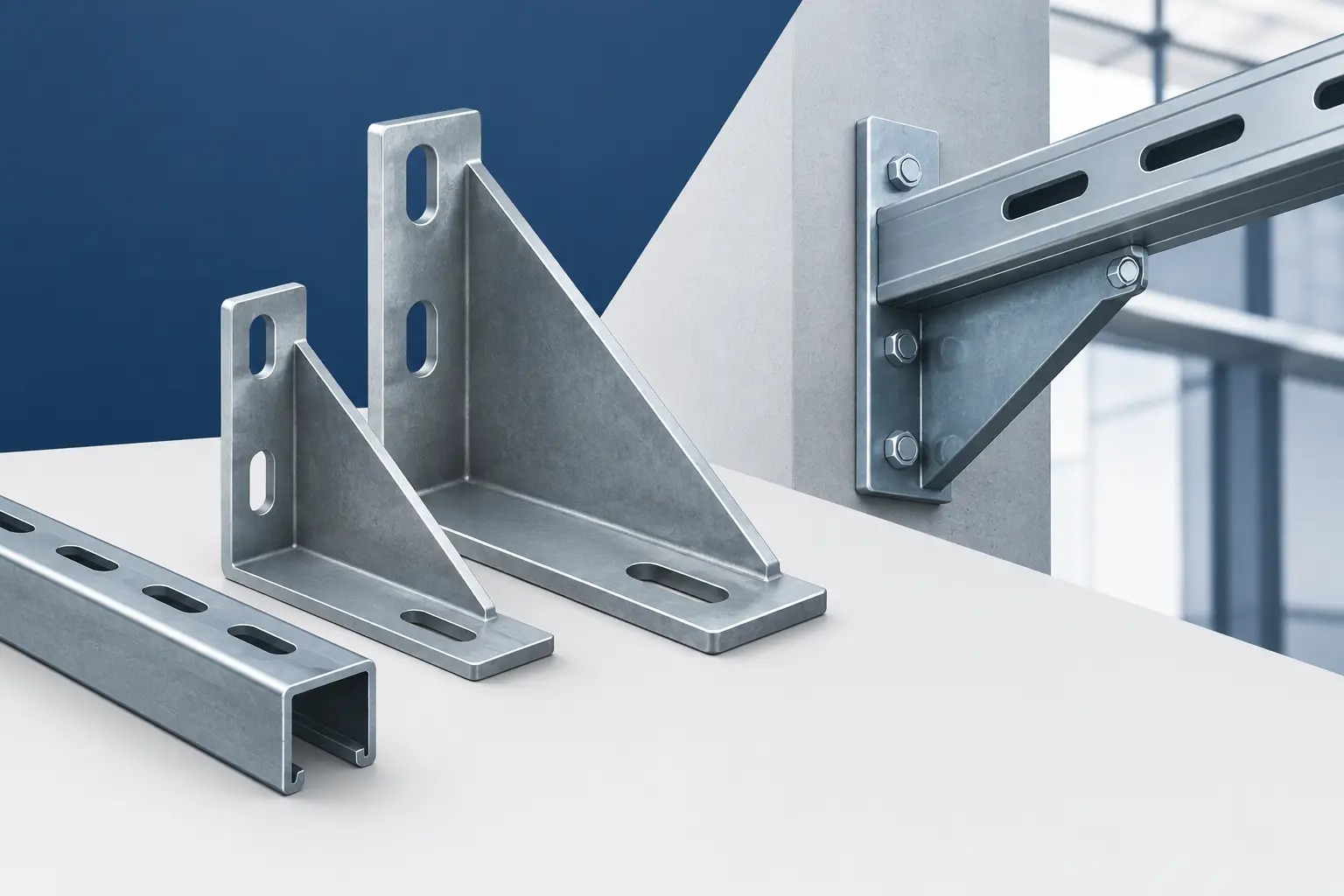
A support system rarely fails because the channel looked inadequate on paper. Failure usually starts at the connection: an undersized bracket, an incorrect hole pattern, a finish unsuited to the environment, or a load applied in a direction the assembly was not designed to carry. Heavy duty channel brackets are the connection hardware that turns strut channel into a dependable structural support system for pipe, cable tray, HVAC equipment, machinery, framing, and industrial installations.
For procurement teams and engineers, the objective is not simply to purchase a thicker piece of formed steel. It is to specify a bracket that fits the channel profile, transfers load predictably, installs efficiently, and remains serviceable over the expected life of the project. That requires attention to geometry, material, fastening method, corrosion exposure, and production consistency.
What Heavy Duty Channel Brackets Do
Channel brackets connect strut channel to walls, ceilings, floors, posts, equipment frames, or other channel members. Common configurations include 90-degree angle brackets, gusseted corner brackets, flat joining plates, U-shaped fittings, cantilever arms, and multi-hole connection brackets. Their purpose is straightforward: create a stable path for force from the supported item through the channel and into the building structure or supporting frame.
The word “heavy duty” should refer to more than material thickness. A bracket intended for demanding service needs adequate section strength, properly located bends, sufficient bearing area around holes, and a connection layout that resists rotation. A well-designed bracket can carry substantial loads without requiring excessive material. Conversely, a thick bracket with poorly placed holes or inadequate gusseting can still allow movement, bending, or fastener failure.
This distinction matters in real installations. A wall-mounted channel supporting a pipe rack creates downward shear at the anchor points and a bending moment at the bracket. A suspended trapeze support places different demands on the fittings and rod connections. A machine-frame application may introduce vibration, repeated loading, or lateral force. The bracket must suit the actual load path, not just the channel size.
Selecting Heavy Duty Channel Brackets by Application
The first specification question is where the bracket will be used and how the load reaches it. This determines the geometry and fastening arrangement more reliably than selecting from a general catalog description.
Wall, Floor, and Ceiling Mounting
For direct mounting to concrete, structural steel, timber, or masonry, the bracket must provide a stable mounting face and enough hole spacing for the selected anchors. A 90-degree angle bracket may be suitable for light to moderate support, while a gusseted angle bracket is typically preferred where the channel projects outward and creates a cantilever load.
Anchor selection is part of the bracket decision. The bracket may have the capacity to resist a load, but the assembly is only as strong as the substrate and anchor system. Concrete strength, edge distance, base-metal thickness, wood species, and available embedment all affect allowable capacity. Engineering review is warranted when supporting critical equipment, concentrated loads, or safety-related systems.
Channel-to-Channel Framing
When forming racks, equipment supports, or modular frames, channel brackets must maintain alignment while resisting the expected force directions. Flat plates and 90-degree fittings work well for straightforward joints. Three-hole and four-hole brackets provide greater restraint where torsion or lateral movement is a concern. Gusseted fittings are particularly useful at frame corners that see repeated loading or where a long channel member increases leverage on the joint.
Compatibility with the channel profile matters. Hole centers, slot dimensions, channel width, and strut nut engagement must work together. A nominally similar bracket may not seat correctly in another manufacturer’s channel or may limit adjustment during installation. For projects using unistrut-compatible systems, confirm dimensional compatibility before releasing a production order.
Outdoor, Marine, and Corrosive Environments
Corrosion resistance often determines the useful life of brackets more than their initial load capacity. Pre-galvanized steel can be appropriate for controlled interior settings, while hot-dip galvanized steel is commonly selected for exterior construction, utility structures, and locations exposed to weather. Stainless steel may be the right choice for coastal, marine, food-processing, chemical, or washdown applications.
There are trade-offs. Hot-dip galvanizing provides durable protection but can add coating thickness that affects close-fitting holes or threaded interfaces. Stainless steel offers excellent corrosion performance in many environments, but grade selection still matters, especially around chlorides. Aluminum reduces weight and resists corrosion well in certain applications, but it has different strength characteristics and can require isolation from dissimilar metals. The right material depends on the exposure, expected maintenance access, and project life cycle.
Key Details That Affect Bracket Performance
A dependable specification should identify the details that control fit and strength rather than relying only on a product name. These four areas deserve particular attention:
- Material grade and thickness: Mild steel, galvanized steel, stainless steel, and aluminum each offer different strength, forming, weldability, and corrosion characteristics. Thickness must suit both the applied load and the bracket geometry.
- Hole pattern and tolerances: Hole diameter, slot length, center-to-center spacing, and positional tolerance determine whether the bracket assembles cleanly with channel, strut nuts, bolts, and anchors.
- Forming and reinforcement: Bend radius, leg length, return flanges, and welded gussets influence stiffness. Reinforcement should be located where it reduces deflection without obstructing fasteners or installation access.
- Surface finish: Powder coating, zinc plating, hot-dip galvanizing, passivation, and specialized finishes should be chosen for the service environment, not appearance alone.
Load ratings should also be interpreted carefully. A stated rating may assume a particular channel size, fastener grade, anchor type, load direction, and safety factor. It may not apply to a modified hole pattern, a longer cantilever, or a different installation substrate. When the installation departs from the tested or engineered arrangement, the rating should be reviewed rather than assumed.
Standard Parts or Custom Fabrication?
Standard heavy duty channel brackets are efficient when the installation matches common channel dimensions and connection patterns. They reduce design time, simplify replacement, and can help distributors and contractors maintain inventory. For repetitive commercial installations, standard parts are often the most economical choice.
Custom brackets become valuable when a project has limited clearance, unusual channel spacing, nonstandard loads, specific coating requirements, or a need to consolidate multiple connection functions into one component. A custom fabricated bracket can incorporate offset legs, additional mounting holes, welded gussets, captive hardware, or application-specific geometry. This can reduce field modifications, eliminate secondary parts, and shorten installation time.
The key is to provide complete production information early. A useful request package includes material specification, thickness, drawing dimensions, hole details, tolerances, finish, weld requirements, expected annual quantity, and packaging needs. If the bracket interfaces with an existing strut system, a sample or channel profile drawing helps prevent fit issues. These details allow a manufacturer to evaluate manufacturability before tooling, cutting, bending, welding, and finishing begin.
Manufacturing Quality Is a Structural Requirement
Bracket performance depends on repeatability. Small variations in bend angle, hole position, or weld placement can create alignment problems across a large installation. In high-volume or contract manufacturing programs, controlled punching or laser cutting, precision press-brake forming, qualified welding, and documented inspection processes help keep parts consistent from the first shipment to the next.
For welded brackets, inspect both structural adequacy and practical fit. Excess weld buildup can interfere with channel seating or bolt access. For galvanized components, drain and vent provisions may be needed for certain hollow or welded forms. For plated or coated parts, masking requirements should be defined where electrical bonding, close tolerances, or threads are involved.
Packaging also deserves attention, particularly for export shipments. Brackets with finished surfaces can be damaged by metal-to-metal contact in transit, and mixed hardware kits can create installation delays if components are not clearly labeled. A capable manufacturing partner plans for part protection, traceability, count accuracy, and shipment configuration alongside fabrication.
A Better Way to Specify Channel Support Hardware
The most efficient purchasing process starts with the installation, not the SKU. Identify what is being supported, the maximum load including reasonable allowances, the force direction, mounting substrate, environment, channel profile, and required service life. Then select or design the bracket around those conditions.
For complex projects, involve the fabrication supplier before the final design is locked. Metallix Exports can support standard and custom channel hardware requirements with precision cutting, punching, bending, welding, assembly, and finishing capabilities. Early manufacturing input can identify opportunities to simplify a part, improve installation access, or combine components without compromising the engineering intent.
The right bracket is rarely the most elaborate one. It is the component that fits the channel correctly, transfers the required loads with confidence, withstands its environment, and arrives ready for predictable installation.


