
 E-mail :
 Call Us :
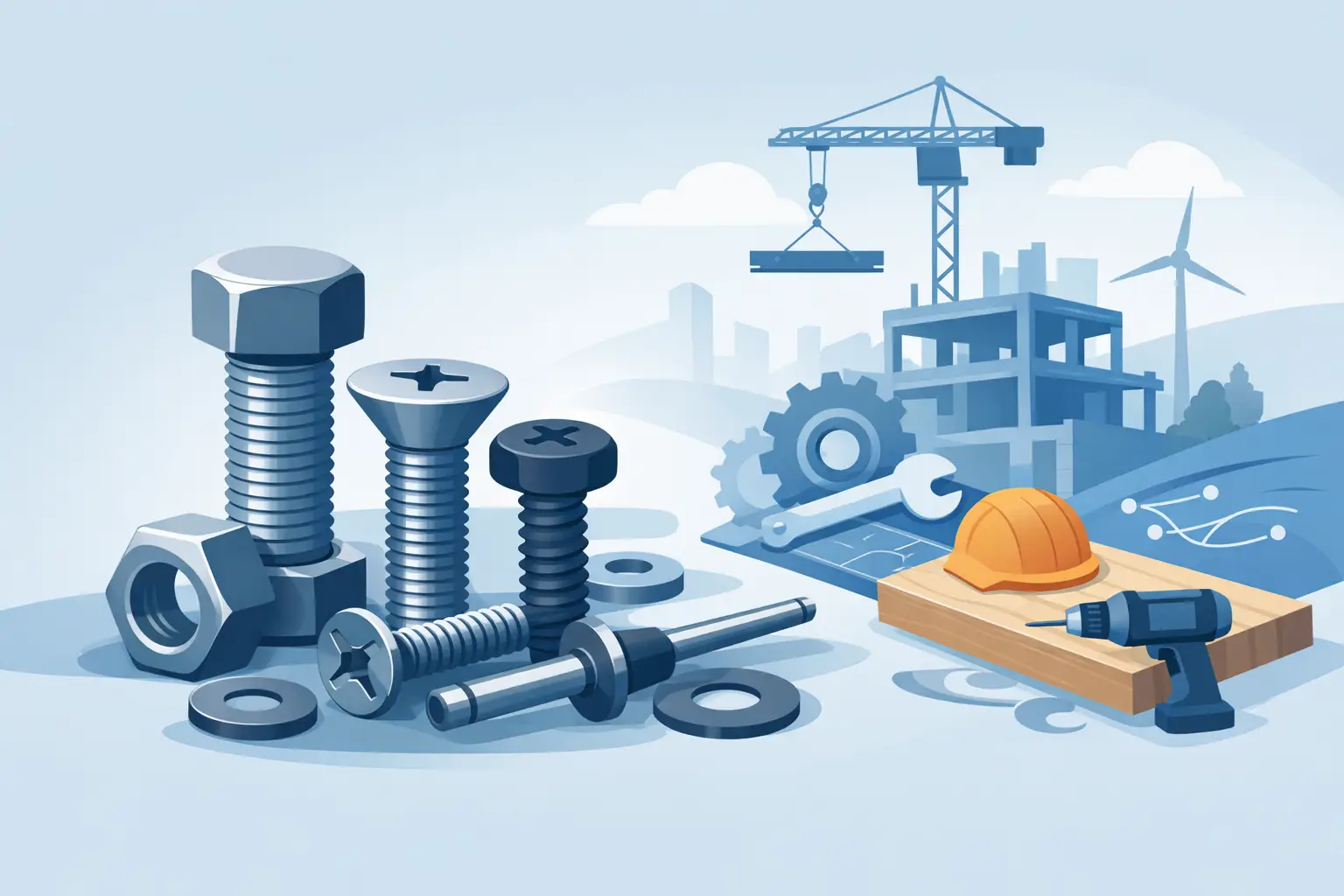
A fastener that misses tolerance by a fraction can slow an installation crew, create rework on the shop floor, or compromise long-term performance in the field. For procurement teams, engineers, and OEM buyers, fasteners are not a low-attention commodity. They are load-bearing, schedule-sensitive components that have to match the application, the material environment, and the production plan.
In industrial and construction supply, the cost of choosing the wrong part rarely shows up on the purchase order. It shows up later as stripped threads, corrosion, fitment issues, inconsistent assembly time, or field failures. That is why specification discipline matters from the start.
Why fasteners matter more than their unit cost
On paper, fasteners often look simple. In practice, they influence structural integrity, assembly efficiency, maintenance access, and product consistency. A bolt, nut, washer, clamp, anchor, or specialty hardware item has to do more than hold two parts together. It has to perform under vibration, moisture, load variation, temperature change, and repeated use.
For OEMs and project buyers, this creates a practical sourcing challenge. The right fastener is rarely defined by size alone. Material grade, coating, thread quality, dimensional accuracy, and compatibility with mating parts all affect performance. When those details are inconsistent from batch to batch, downstream operations feel the impact immediately.
This is especially true in sectors such as HVAC support systems, electrical installations, framing hardware, marine assemblies, industrial machinery, and foundation-related hardware. In these environments, a fastening solution has to work not only in theory but also under actual installation conditions.
Selecting fasteners by application, not assumption
Specification-driven buying starts with application. That sounds obvious, but many supply issues begin when standard hardware is selected for a nonstandard environment. A dry indoor installation, for example, does not place the same demands on a component as an exterior structural frame, a dock system, or a corrosive industrial setting.
Material choice affects service life
Mild steel fasteners are widely used because they are cost-effective and suitable for many controlled environments. Stainless steel becomes a stronger option where corrosion resistance matters, particularly in marine, outdoor, washdown, or high-humidity conditions. Aluminum may be useful where weight reduction is a priority, while galvanized products offer a practical middle ground for many construction and support applications.
The trade-off is straightforward. Higher corrosion resistance or tighter performance requirements usually increase part cost. But if the application exposes hardware to moisture, chemicals, or long service intervals, the lower-priced option can become the expensive choice over time.
Finish and coating are not cosmetic decisions
Surface finishing plays a direct role in durability and appearance, but also in compatibility with the operating environment. Zinc plating, galvanizing, powder coating, and other finishes help protect the base material and, in some cases, support compliance with project requirements.
What matters is fit between finish and use case. A finish suitable for warehouse racking may not be appropriate for coastal infrastructure. Likewise, a coating that improves corrosion resistance may affect thread interaction or torque behavior if not properly controlled. Buyers should treat coating specifications as a functional requirement, not a secondary detail.
Tolerance and fit drive assembly efficiency
A fastener that technically meets nominal dimensions can still cause installation problems if tolerance control is inconsistent. Poor thread formation, out-of-spec hole alignment, and variation in formed or fabricated mating hardware can all slow production.
For manufacturers and contractors, this becomes a labor issue as much as a quality issue. Crews spend more time adjusting, forcing alignment, or replacing parts. Over a large production run or construction schedule, those small delays accumulate quickly.
Standard fasteners vs. custom fabricated hardware
Many buyers start with standard catalog items, and in many cases that is the right decision. Standardized fasteners support quicker quoting, easier replenishment, and simpler cross-project planning. They are especially effective when the application is common, the installation method is proven, and dimensional requirements align with standard industry formats.
Custom hardware becomes necessary when the assembly, load path, installation space, or project specification moves beyond off-the-shelf constraints. This is common in structural supports, brackets, anchoring systems, framing components, marine mounting hardware, and OEM assemblies where surrounding parts are already customized.
When standard products work best
Standard fasteners are usually the best fit when the project needs predictable availability, repeat ordering, and compatibility with established systems. They also help distributors and procurement teams reduce complexity when multiple sites or crews are working from the same approved part list.
The advantage is speed and consistency. The limitation is that standard parts are only efficient if they truly match the application.
When custom solutions add value
Custom fasteners or fabricated hardware are often justified when installation conditions create unusual load demands, spacing constraints, corrosion exposure, or integration requirements. In these cases, modifying the assembly around a standard component may cost more than producing the right hardware from the start.
A capable manufacturing partner can support this process through material selection, dimensional control, forming, welding, finishing, and repeatable production planning. For buyers managing both standard hardware and project-specific components, consolidating those needs with one supplier can reduce vendor fragmentation and improve quality consistency.
What B2B buyers should evaluate in a fastener supplier
Price matters, but industrial buyers know it is only one part of the decision. The real question is whether a supplier can deliver fasteners that perform consistently and arrive in line with production or project schedules.
Manufacturing capability matters
A supplier with broad metalworking capabilities can usually provide more reliable support when requirements shift. Cutting, punching, bending, welding, forming, assembly, and finishing all matter when fasteners interface with brackets, channels, clamps, post bases, or other fabricated systems.
This matters because fastening hardware rarely exists in isolation. It is part of a larger assembly. When the supplier understands both the hardware and the fabricated metal components around it, fitment problems are easier to prevent.
Quality control should be visible, not assumed
Industrial buyers should look for evidence of process discipline. That includes dimensional inspection, material traceability where required, batch consistency, and control over finishing quality. In export supply, packaging and shipment preparation also matter because damaged threads, mixed parts, or incomplete labeling can create receiving problems long before installation begins.
The strongest suppliers do not present quality as a slogan. They build it into production flow, inspection routines, and communication.
Lead time reliability is part of product quality
A technically correct fastener that arrives late still creates a project problem. For contractors and OEMs, missed delivery windows can hold up assemblies, create labor gaps, and force emergency buying from secondary sources.
That is why schedule performance should be evaluated alongside part quality. Reliable suppliers plan capacity, maintain process control, and communicate early when a specification or timeline needs adjustment. Metallix Exports works in that model, serving customers who need both precision and dependable shipment support across standard and custom hardware requirements.
Common sourcing mistakes with fasteners
One frequent mistake is treating all fasteners with the same basic dimensions as interchangeable. They are not. Differences in raw material, coating thickness, thread quality, and fabrication accuracy can change field performance significantly.
Another issue is under-specifying the environment. Buyers may define size and quantity clearly but leave out exposure conditions, mating materials, installation method, or expected load behavior. That creates risk because the part may be manufactured correctly to an incomplete requirement.
There is also a tendency to separate hardware sourcing from fabricated component sourcing. In some projects, that works. In others, it leads to tolerance mismatch between the fastener and the bracket, clamp, support channel, or structural piece it is supposed to join.
A better approach to fastener procurement
The most effective procurement process starts with the end use, then works backward through material, finish, tolerance, and volume planning. Buyers should define the actual operating environment, the type of load or movement involved, compatibility with adjacent components, and any installation constraints. From there, the supplier can recommend whether a standard product is sufficient or whether custom fabrication will provide better performance and lower total risk.
This approach is not about overengineering every order. It is about matching the hardware to the job with enough precision to avoid preventable delays and failures. In industrial manufacturing and construction, that discipline protects both cost and credibility.
The right fasteners do their job quietly. They fit the first time, perform over time, and let the larger system deliver what it was designed to do. That is the standard serious buyers should expect from every order.


