
 E-mail :
 Call Us :
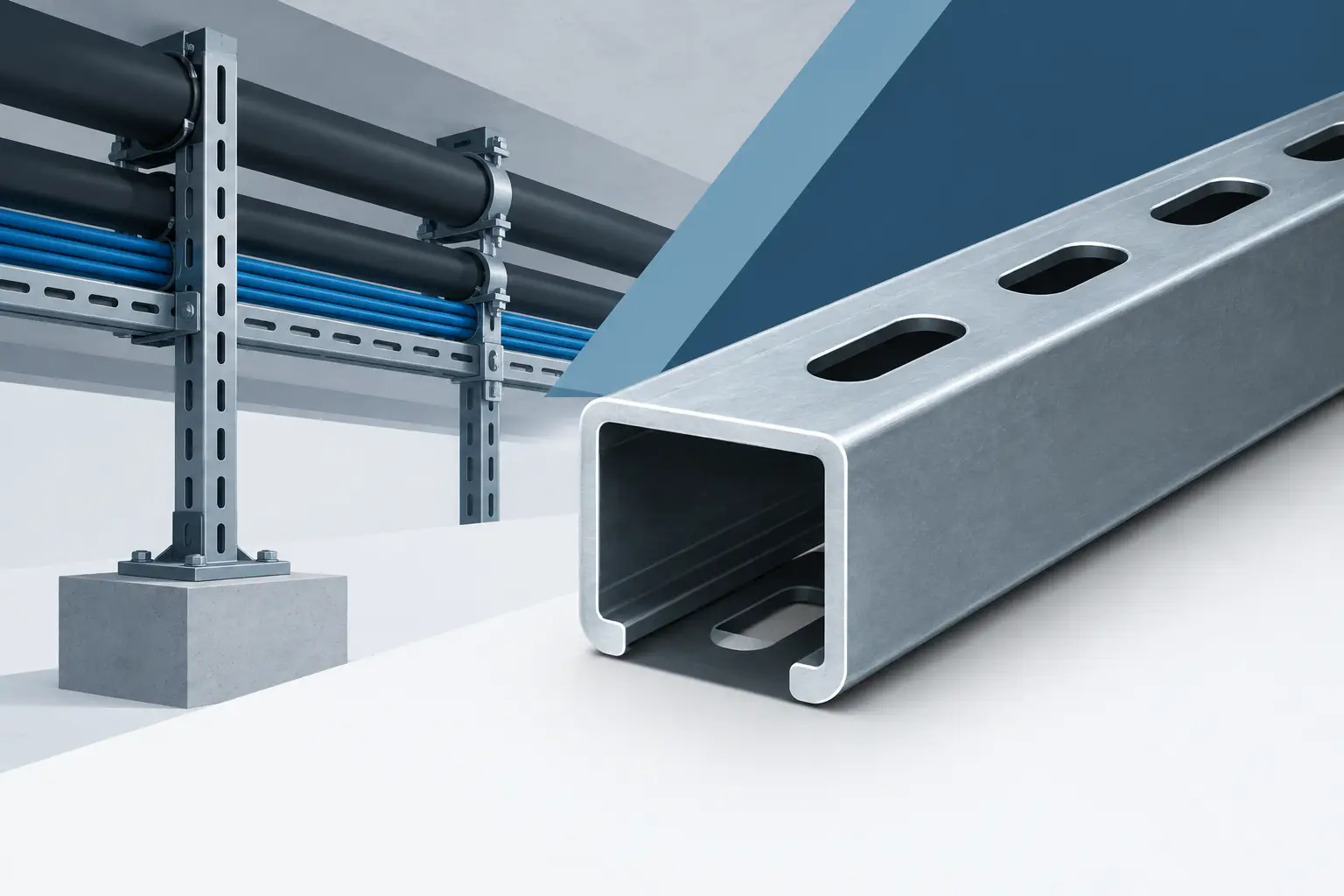
A support system can look adequate on a drawing and still create problems in the field. Long spans, concentrated equipment loads, vibration, and limited attachment points quickly expose the limits of shallow framing channel. Deep uni strut gives engineers and contractors a larger channel profile for building stronger, more stable support assemblies without moving to fully welded structural steel for every application.
For procurement teams, the value is not simply a deeper piece of metal. It is a repeatable framing component that can work with channel nuts, spring nuts, brackets, clamps, and threaded rod to support mechanical, electrical, HVAC, industrial, and infrastructure installations. The correct selection depends on load path, span, corrosion exposure, connection design, and the tolerance requirements of the complete assembly.
What Deep Uni Strut Is Designed to Do
Deep uni strut is a deeper version of standard slotted or solid strut channel. Common standard strut profiles are often around 1-5/8 inches deep, while deep channel profiles provide additional section depth to improve stiffness and load-carrying potential. Dimensions, wall thickness, slot pattern, and available lengths vary by manufacturer and project specification.
That extra depth matters because channel stiffness rises significantly as material is positioned farther from the center of the section. In practical terms, a deep channel can reduce deflection over longer spans or provide more capacity where equipment creates higher point loads. It is commonly considered for trapeze supports, pipe racks, cable-tray frames, rooftop equipment supports, machinery guards, solar framing details, and custom industrial assemblies.
A deeper profile is not automatically the right choice. It adds weight, may require more clearance, and can increase material cost. The decision should be based on an engineered support layout rather than the assumption that a larger channel solves every loading concern.
Where Deep Uni Strut Makes a Practical Difference
In many projects, standard channel is efficient for short runs and moderate service loads. Deep channel becomes more useful when the design is affected by span length, movement, or concentrated loads. A few additional inches of channel depth can help a frame maintain alignment and reduce visible sag between supports.
For HVAC and MEP contractors, this can be relevant when supporting larger pipe bundles, valve stations, duct accessories, cable trays, or equipment installed above congested ceilings. In industrial plants, deep channel can provide a flexible basis for service platforms, instrumentation supports, guarding, and utility routing that may need adjustment after installation.
The modular nature of strut framing is a commercial advantage as well as an installation advantage. Assemblies can often be reconfigured with compatible fittings rather than cut apart and rewelded. That can reduce field labor where layouts change, provided the fittings and connections are specified for the actual design load.
Depth helps, but the full section still matters
Channel depth is only one part of the performance picture. Steel gauge, material grade, return lip geometry, slot configuration, and the direction of loading all affect capacity. A deep, light-gauge channel may not be suitable for the same duty as a deep, heavier-gauge channel.
Slots also deserve attention. Slotted channel improves adjustability and installation speed, but the openings alter the effective section and can affect load performance compared with solid channel. If a support carries substantial loads or must meet a project-specific calculation, use the applicable manufacturer data and have the final arrangement reviewed by the responsible design professional.
Selecting the Right Deep Uni Strut Configuration
A reliable specification begins with the assembly, not the channel alone. Identify what is being supported, where the loads enter the frame, the distance between anchors, and the orientation of each member. A horizontal cross member loaded at midspan behaves differently from a vertical member carrying axial load, and both behave differently when braced against lateral movement.
Material selection follows the operating environment. Pre-galvanized steel can be a practical option for many dry interior applications. Hot-dip galvanized finishes are commonly selected where outdoor exposure or more demanding corrosion conditions are expected. Stainless steel may be appropriate in wet, corrosive, food-processing, marine, or chemical environments, although it involves a higher initial material cost. Aluminum can reduce weight in selected applications, but its strength, connection behavior, and corrosion compatibility must be evaluated separately.
Connection hardware must match the channel and the duty of the installation. Channel nuts, bolts, washers, angle brackets, post bases, beam clamps, and threaded rod are all part of the load path. An underspecified bracket or an improperly tightened connection can limit an otherwise capable channel system. For vibration-prone equipment, consider whether locking hardware, bracing, isolation components, or a different support approach is required.
Fabrication Details That Affect Field Performance
Standard deep channel is well suited to repetitive installations, but many projects need more than cut lengths and off-the-shelf fittings. Custom hole patterns, welded brackets, formed end caps, mounting plates, gussets, and preassembled frames can reduce field modification and create a more controlled installation.
Precision matters most at interfaces. Hole locations need to align with equipment mounting points, anchors, and adjoining channel components. Cut length tolerances affect fit-up across a multi-member frame. Weld quality and finishing must be appropriate to the application, especially where fabricated components will be exposed outdoors or in corrosive service.
For OEMs and distributors, a manufacturing partner that can produce channel-compatible components alongside custom fabricated hardware can simplify sourcing. Rather than managing separate suppliers for brackets, clamps, base plates, and welded assemblies, buyers can consolidate specifications and quality requirements through one production workflow.
Metallix Exports supports this type of requirement with sheet metal cutting, punching, bending, welding, forming, assembly, and surface finishing for standard and project-specific structural hardware. For export programs, consistent packing, labeling, and dimensional control are also part of delivering components that arrive ready for distribution or installation.
Avoid Common Specification Gaps
The most frequent problems with strut support systems are usually created before installation. A channel may be selected based only on its overall size, with no clear review of span, loading, anchors, or fitting capacity. The result can be avoidable deflection, difficult installation, or a frame that requires last-minute reinforcement.
Another issue is mixing components without confirming compatibility. Similar-looking channels and fittings can differ in dimensions, slot spacing, lip shape, or nut engagement. If a system is intended to be compatible with a particular strut standard, confirm profile dimensions and test fitment during sampling or first-article review.
Finish requirements should be stated clearly instead of described simply as “galvanized.” Procurement documents should identify the required coating or finish type, material, thickness where relevant, and any post-fabrication treatment. Cutting, drilling, and welding after coating can leave exposed areas that require specified repair procedures.
Finally, distinguish between a support frame and a fully engineered structural system. Deep channel can be an efficient building block, but seismic requirements, wind loading, dynamic equipment loads, life-safety applications, and unusual anchor conditions may require project-specific engineering and approvals.
A Better Way to Source Deep Channel Assemblies
For recurring programs, provide suppliers with a complete request package: channel profile and gauge, material and finish, cut lengths, slot or hole details, hardware requirements, expected annual volume, packaging needs, and applicable drawings or standards. This reduces quotation ambiguity and makes it easier to compare suppliers on technical capability as well as price.
For a one-time project, it is equally useful to identify which elements must remain adjustable in the field and which can be preassembled. Pre-fabricating repeatable subassemblies can reduce installation time, while retaining bolted adjustment where site conditions are uncertain. The right balance depends on labor conditions, shipment constraints, and the likelihood of layout changes.
Deep uni strut performs best when it is treated as part of a complete, well-defined support system. Start with the actual loading and environment, specify the interfaces carefully, and use fabrication support where it removes field uncertainty. That approach produces framing that is easier to install, more consistent across projects, and better suited to the service conditions it will carry.