
 E-mail :
 Call Us :
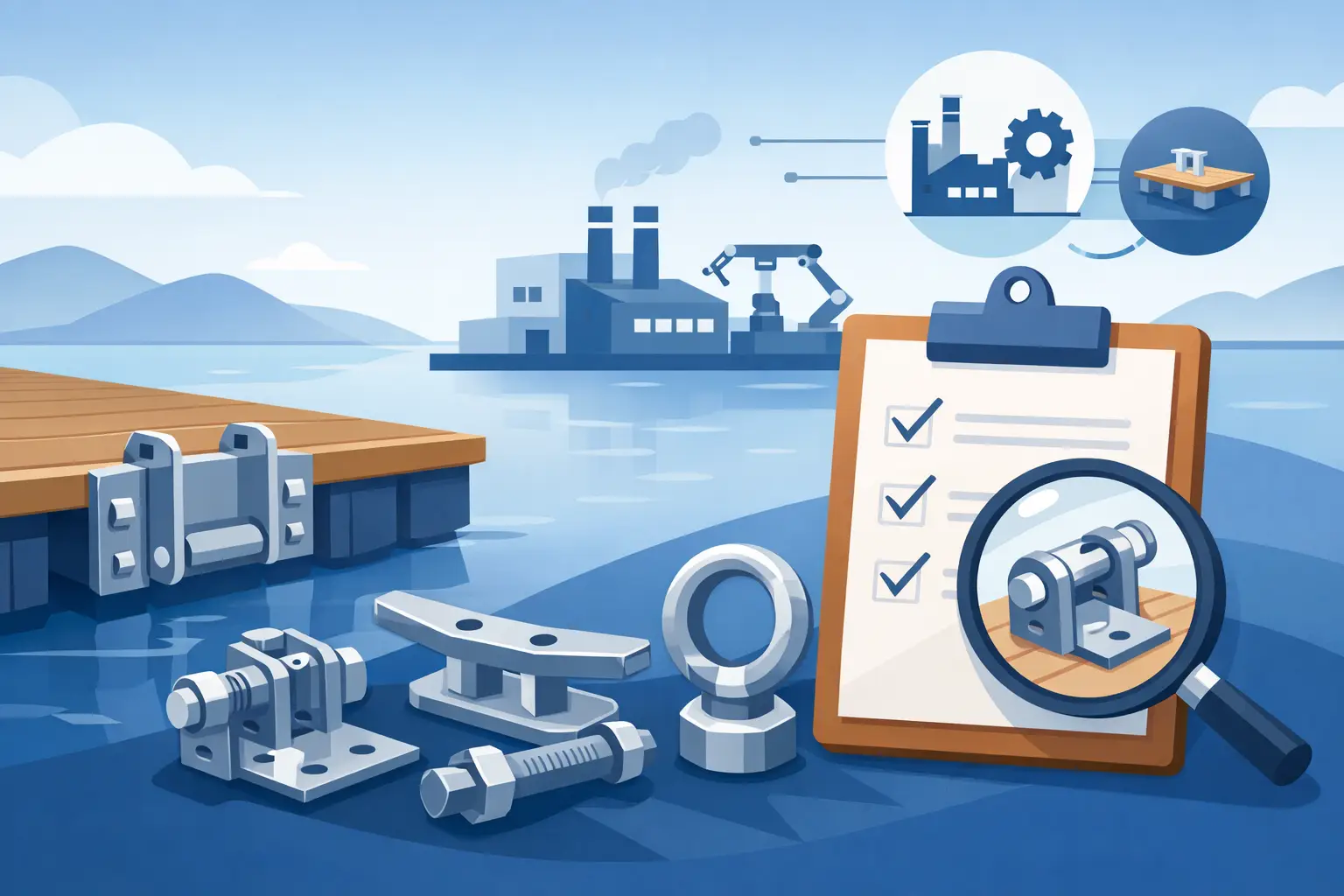
A floating dock that shifts under load, corrodes too early, or installs with field-fit problems usually does not fail because of the concept. It fails because the hardware was treated like a commodity. When evaluating a floating dock hardware manufacturer, buyers need to look past catalog photos and focus on engineering discipline, material control, fabrication accuracy, and supply reliability.
For OEMs, marine contractors, distributors, and procurement teams, dock hardware is not a minor line item. Brackets, hinges, connectors, corner assemblies, mooring components, and mounting plates all influence structural performance, ease of installation, maintenance intervals, and long-term ownership cost. The right supplier helps reduce rework, shorten install time, and keep marine projects on schedule. The wrong one creates delays that show up on the jobsite, not on the quote sheet.
What a floating dock hardware manufacturer should actually deliver
A capable floating dock hardware manufacturer does more than produce metal parts. The real value is in repeatable manufacturing that aligns with application requirements. That means understanding load paths, movement between dock sections, fastener compatibility, corrosion exposure, and the practical realities of installation over water.
In marine hardware, dimensional consistency matters. If hole patterns vary, plate thickness is inconsistent, or formed parts drift outside tolerance, installation crews lose time making adjustments in the field. That adds labor cost and introduces quality risk. A manufacturer with disciplined cutting, punching, bending, welding, and finishing processes gives buyers a much more predictable result.
The same principle applies to standard and custom work. Many projects use a mix of proven hardware designs and application-specific modifications. A supplier that can support both is often more useful than one that only offers off-the-shelf parts. In practice, buyers benefit from fewer vendors, clearer accountability, and better coordination between design intent and production output.
Material selection is not a simple price decision
Marine environments are demanding, but they are not all the same. Freshwater exposure, brackish water, saltwater, seasonal removal, and permanent installation each create different performance demands. That is why material choice should be matched to the use case instead of driven only by initial piece price.
Steel hardware can be a strong and economical option when the design, coating system, and environment are properly aligned. Galvanized finishes are commonly used where corrosion resistance and cost need to be balanced. Stainless steel may be preferred for more aggressive environments or where appearance and longer corrosion resistance are priorities. Aluminum can be beneficial where weight reduction matters, though it must be considered carefully in relation to strength, wear, and galvanic interaction with other components.
A reliable manufacturer should be able to discuss these trade-offs clearly. If every application gets the same generic recommendation, that is usually a warning sign. Marine hardware decisions are rarely one-size-fits-all, especially when dock systems vary in size, anchoring method, wave action, and traffic load.
Why fabrication accuracy matters in floating dock systems
Dock hardware works as part of an assembly, not as isolated pieces. A hinge bracket that is slightly off, a connector plate with poor flatness, or a welded assembly with inconsistent geometry can affect alignment across multiple dock sections. Those issues may not appear serious on a shop table, but they become expensive once pontoons, framing, decking, and anchoring systems are involved.
This is where manufacturing capability becomes a purchasing factor, not just a production detail. Precision cutting, controlled hole placement, accurate bending, and consistent weld quality all contribute to better fit-up in the field. Buyers who manage recurring dock builds or distribution programs should pay close attention to repeatability across batches, not just whether the first sample looked acceptable.
A good manufacturing partner will also understand that tolerance decisions should reflect real application needs. Overengineering every part can increase cost without improving performance. Loose tolerances, on the other hand, often shift hidden cost downstream to installers and end users. The best outcome is practical precision - tight where function requires it, efficient where it does not.
Standard hardware versus custom dock hardware
Some buyers need proven standard hardware for repeatable projects. Others need custom brackets, reinforced plates, special mounting geometries, or connection systems adapted to site-specific conditions. Most serious marine programs fall somewhere in between.
That is why a floating dock hardware manufacturer should have enough production flexibility to support both standardization and customization. Standard product lines support speed, known performance, and simpler purchasing. Custom fabrication supports unique layouts, higher load requirements, retrofit conditions, and brand-specific dock systems.
For OEMs and distributors, this matters commercially as well as technically. A supplier that can handle custom adjustments without disrupting lead times gives buyers more room to respond to customer requirements. That flexibility becomes especially valuable when projects involve mixed materials, variable dimensions, or phased delivery schedules.
Metallix Exports operates in this kind of manufacturing space, where standard structural hardware and custom fabricated metal components are both part of the supply model. For B2B buyers, that combination can simplify sourcing and reduce the friction that comes from managing multiple specialized vendors.
Quality control should be visible, not assumed
In industrial purchasing, confidence usually comes from process visibility. A supplier may promise quality, but buyers need to understand how that quality is maintained. For floating dock hardware, that includes raw material traceability, dimensional checks, weld inspection, finish consistency, and packing methods that protect parts during shipment.
This is particularly important for export orders and large-volume programs. Hardware that leaves the factory in acceptable condition but arrives mixed, damaged, or poorly labeled still creates operational problems. A dependable manufacturer pays attention to production control and shipment readiness with the same discipline.
Buyers should also ask how the manufacturer handles revisions, repeat orders, and specification control. Engineering drawings, approved samples, finish requirements, and packaging instructions all need to be managed consistently. In marine and construction-related supply, many avoidable disputes start when a supplier treats documentation as secondary.
Lead times, scale, and supply continuity
A dock project can stall over a missing connector set just as easily as it can over a major structural issue. That is why lead time performance matters as much as technical capability. A strong supplier should be able to explain production planning, batch scheduling, and how it manages both routine orders and urgent requirements.
Scale is part of this conversation, but bigger is not always better. Some large suppliers are efficient with standard volume parts but slow to respond when custom work is needed. Smaller shops may offer flexibility but struggle with capacity or consistency. The right fit depends on order profile, forecast stability, and whether the buyer needs container-level production, recurring replenishment, or project-based fabrication.
For procurement teams, supply continuity often comes down to one question: can this manufacturer support us beyond the first order? A dependable answer includes process capability, communication discipline, and the ability to maintain quality as volumes change.
How to evaluate a floating dock hardware manufacturer
The strongest evaluations combine technical review and commercial review. Buyers should look at product range, material options, fabrication processes, tolerance control, finishing capability, and past experience with structural or marine-related hardware. At the same time, they should assess quoting clarity, responsiveness, packaging standards, export handling, and on-time delivery performance.
It also helps to look at whether the manufacturer understands the installed condition of the hardware. Suppliers that know how dock systems are assembled tend to ask better questions about loading, movement, corrosion exposure, and fastener selection. That usually leads to fewer mistakes and more useful recommendations.
Price should still matter, but it should be evaluated in context. A lower unit cost can disappear quickly if hardware requires field modification, arrives late, or produces warranty issues. In marine applications, the total cost picture includes installation efficiency, service life, replacement frequency, and the operational cost of supplier inconsistency.
The best manufacturing partner reduces project risk
Choosing a floating dock hardware manufacturer is really about risk control. Buyers are not just sourcing metal parts. They are selecting a partner that influences structural reliability, installation speed, inventory planning, and customer satisfaction.
The manufacturers that stand out are the ones that combine engineering understanding with disciplined production. They can work from established specifications or custom drawings, maintain dimensional consistency, offer appropriate material and finish options, and ship with the reliability that project schedules require. That combination is what turns hardware sourcing from a recurring problem into a dependable part of the supply chain.
If you are buying for a dock system, marina project, OEM line, or distribution program, the best next step is to evaluate capability before volume. A supplier that can meet the drawing is useful. A supplier that can meet the drawing, repeat it accurately, and support your timelines is the one worth building around.


