
 E-mail :
 Call Us :
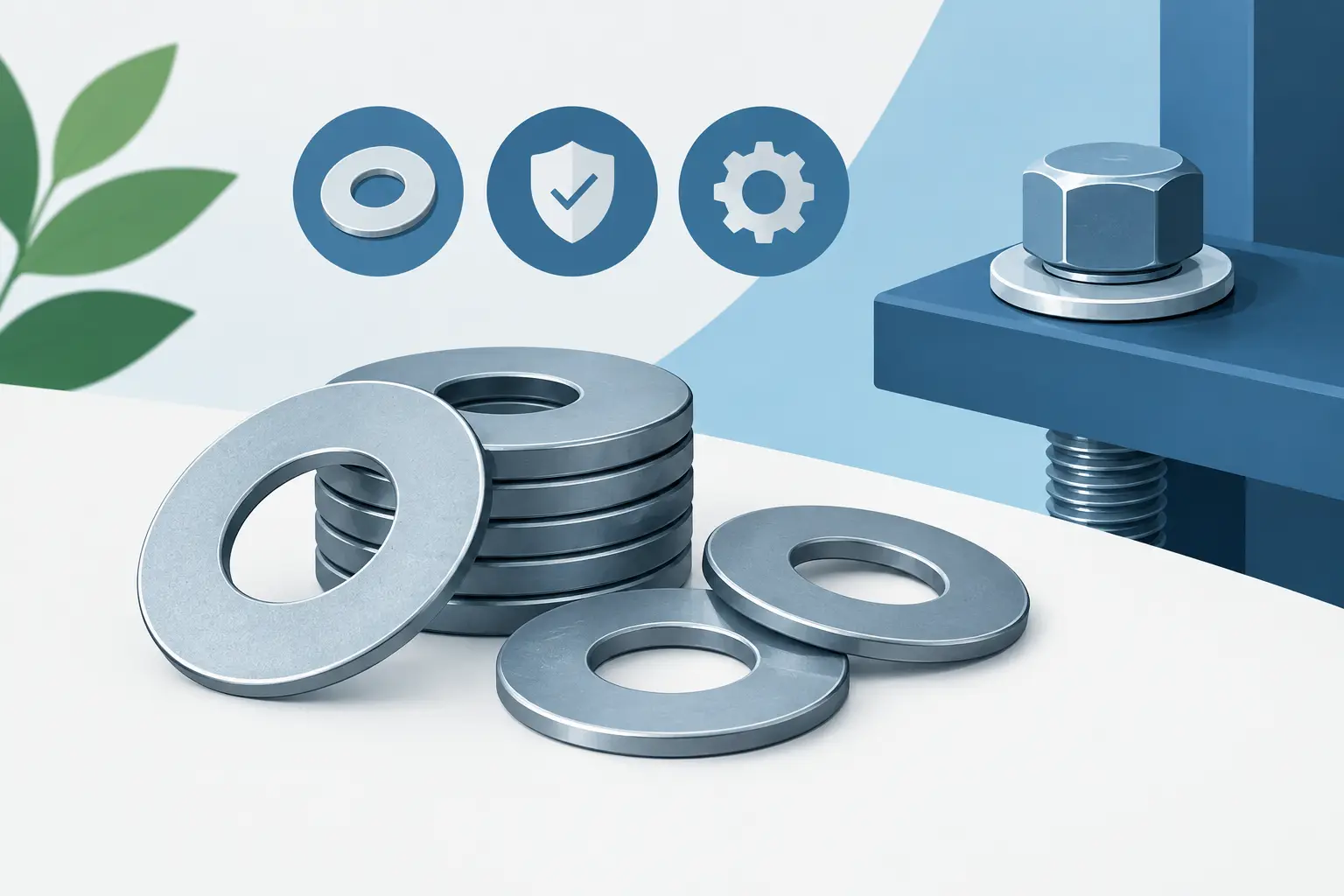
A fastener assembly can fail long before a bolt breaks. Localized bearing pressure can mark a painted surface, deform thin sheet, pull through an oversized hole, or reduce the clamp load that keeps a joint secure. Flat washers address these practical issues by distributing load across a wider area, creating a cleaner bearing surface, and supporting more consistent assembly results.
For procurement teams and engineers, the washer is not a minor line item. Its inside diameter, outside diameter, thickness, material, hardness, and finish all affect fit, corrosion performance, and long-term joint reliability. Selecting the right washer starts with the application rather than the assumption that one standard part suits every assembly.
What Flat Washers Do in an Assembly
A flat washer is a simple, generally circular component with a central hole sized for a bolt, screw, or threaded rod. It sits beneath the fastener head, nut, or both. Its primary function is to spread the compressive load from the fastener across the material being joined.
This load distribution matters most where the base material is relatively thin, soft, coated, slotted, or prone to deformation. In sheet metal fabrications, for example, a washer can prevent a nut or bolt head from digging into the surface as torque is applied. In framing, equipment mounting, marine hardware, and structural support assemblies, it can provide a more stable bearing interface and help preserve the intended connection geometry.
A washer does not automatically prevent loosening. Standard flat washers are not locking devices, and they should not be specified as a substitute for proper joint design, correct torque, compatible fasteners, or a suitable locking method when vibration is a concern. Their value is in controlled load transfer and surface protection.
Specifying Flat Washers for the Actual Load
The correct specification begins with the bolt or screw size, but it should not end there. A washer must provide sufficient clearance for the fastener shank while maintaining enough bearing area to support the connected material. The relationship among inside diameter, outside diameter, and thickness should match the connection rather than simply follow a catalog default.
Inside Diameter and Fit
The inside diameter must accommodate the fastener without excessive interference. A washer that is too tight may not seat properly, especially where plating, coating buildup, or dimensional variation is present. A washer with too much clearance can shift during installation and may not provide the expected bearing support around a hole.
For standard bolted connections, commonly recognized washer dimensions offer a practical starting point. However, custom assemblies often require nonstandard inside diameters for specialty fasteners, anchor rods, insulated hardware, or clearance around formed features. Confirm the fastener diameter, thread profile, tolerance requirements, and installation method before finalizing the hole size.
Outside Diameter and Bearing Area
Outside diameter determines how broadly the load is distributed. A larger outside diameter is useful when fastening into thin sheet, wood, composite panels, or oversized and slotted holes. It can reduce the risk of pull-through and minimize distortion around the connection point.
More bearing area is not always better. An oversized washer may interfere with adjacent bends, welds, channels, brackets, or access for tools. It can also create an unintended load path in a tightly designed assembly. The right outside diameter provides support without compromising fit or installation.
Thickness and Hardness
Thickness contributes to the washer's ability to remain flat under clamp load. A thin washer can be suitable for light-duty applications or limited-clearance assemblies, while heavier connections may require a thicker, harder washer that resists cupping, embedding, and deformation.
Washer hardness should be compatible with the fastener grade and the joint materials. If a high-strength fastener bears against a washer that is too soft, the washer may deform under torque and reduce the consistency of preload. Conversely, a hard washer against a soft or finished surface may require a different interface solution to avoid surface damage. The connection should be evaluated as a complete system.
Material and Finish Affect Service Life
Material selection should reflect the operating environment, mating materials, required strength, and finish of the surrounding assembly. Mild steel flat washers are widely used for indoor equipment, structural hardware, and general industrial fabrication. They are economical, readily available, and suitable when corrosion exposure is controlled or when a protective finish is applied.
Stainless steel washers offer improved corrosion resistance for outdoor, marine, food-processing, and moisture-prone environments. Grade selection still matters. Different stainless grades provide different balances of corrosion resistance, formability, and cost. Using stainless hardware near aluminum, galvanized steel, or other metals also requires attention to galvanic compatibility where moisture is present.
Aluminum washers are lightweight and can be a practical choice for aluminum assemblies where material compatibility and weight matter. Copper washers may be used in specialized electrical, sealing, or corrosion-related applications, depending on the connection design. Galvanized washers provide a useful protective coating for many construction and outdoor steel applications, though the coating type and thickness should align with the rest of the system.
Finish is more than an appearance decision. Zinc plating, hot-dip galvanizing, passivation, powder coating, and other finishes influence corrosion resistance, dimensional fit, and compatibility with adjacent components. Coating buildup can affect the inside diameter and the seating surface. When washers are part of a visible or coated assembly, finish consistency also supports a professional final installation.
Match the Washer to the Application
In HVAC supports, strut assemblies, electrical enclosures, machinery guards, and fabricated brackets, washers often protect sheet metal around mounting points. In these applications, predictable dimensions and burr-free edges help installers achieve clean, repeatable results.
For construction and foundation hardware, the priorities may shift toward larger bearing surfaces, thicker sections, weather-resistant finishes, and compatibility with anchor rods or structural bolts. In marine and floating dock assemblies, corrosion resistance and dissimilar-metal considerations can become central to specification.
OEM buyers may also need washers designed for automated assembly. Consistent thickness, flatness, inside diameter, and surface condition help reduce feeding problems and installation variation. A component that appears simple can create costly interruptions if it nests improperly, carries burrs, or arrives with inconsistent dimensions.
When Standard Sizes Are Not Enough
Standard flat washers are efficient for common connections, but custom production is often the better option when a project has unusual hole patterns, large diameters, special materials, tight tolerances, or application-specific finish requirements. Custom washers can also be produced as part of a broader fabricated assembly, reducing the need to manage separate component suppliers.
A clear request for quotation should identify the material grade, thickness, inside and outside diameters, tolerance expectations, finish, quantity, and intended application. If the washer interfaces with a drawing-controlled bracket, channel, post base, clamp, or welded fabrication, provide the mating part information as well. This gives the manufacturer the context needed to identify potential clearance or production concerns before manufacturing begins.
Quality control should focus on the dimensions that affect installation and performance. Depending on the application, that may include hole diameter, outside diameter, thickness, flatness, burr condition, coating coverage, and material traceability. For export projects, packaging should also protect finished surfaces and keep quantities organized for receiving and field installation.
A Better Purchasing Approach for Flat Washers
Purchasing on unit price alone can be misleading when washers are critical to assembly quality. A lower-cost part that varies in thickness, has sharp edges, or does not match the specified finish can introduce rework, damaged coatings, installation delays, and avoidable field issues.
A dependable supplier should be able to support both standard and custom requirements, confirm material and finish options, manufacture to defined tolerances, and deliver consistent lots at the required scale. This is particularly valuable for buyers sourcing complete hardware packages that include brackets, channels, clamps, nuts, structural fittings, and related sheet metal components.
Metallix Exports supports industrial and construction buyers with precision metal components and custom fabrication aligned to application requirements. Bringing washer production into a coordinated sourcing plan can improve compatibility across the full assembly and simplify purchasing control.
The most useful washer specification is the one that reflects how the joint will actually be built, loaded, exposed, and maintained. Define those conditions early, and a small component can contribute meaningfully to a cleaner installation, more reliable clamp load, and fewer problems after delivery.