
 E-mail :
 Call Us :
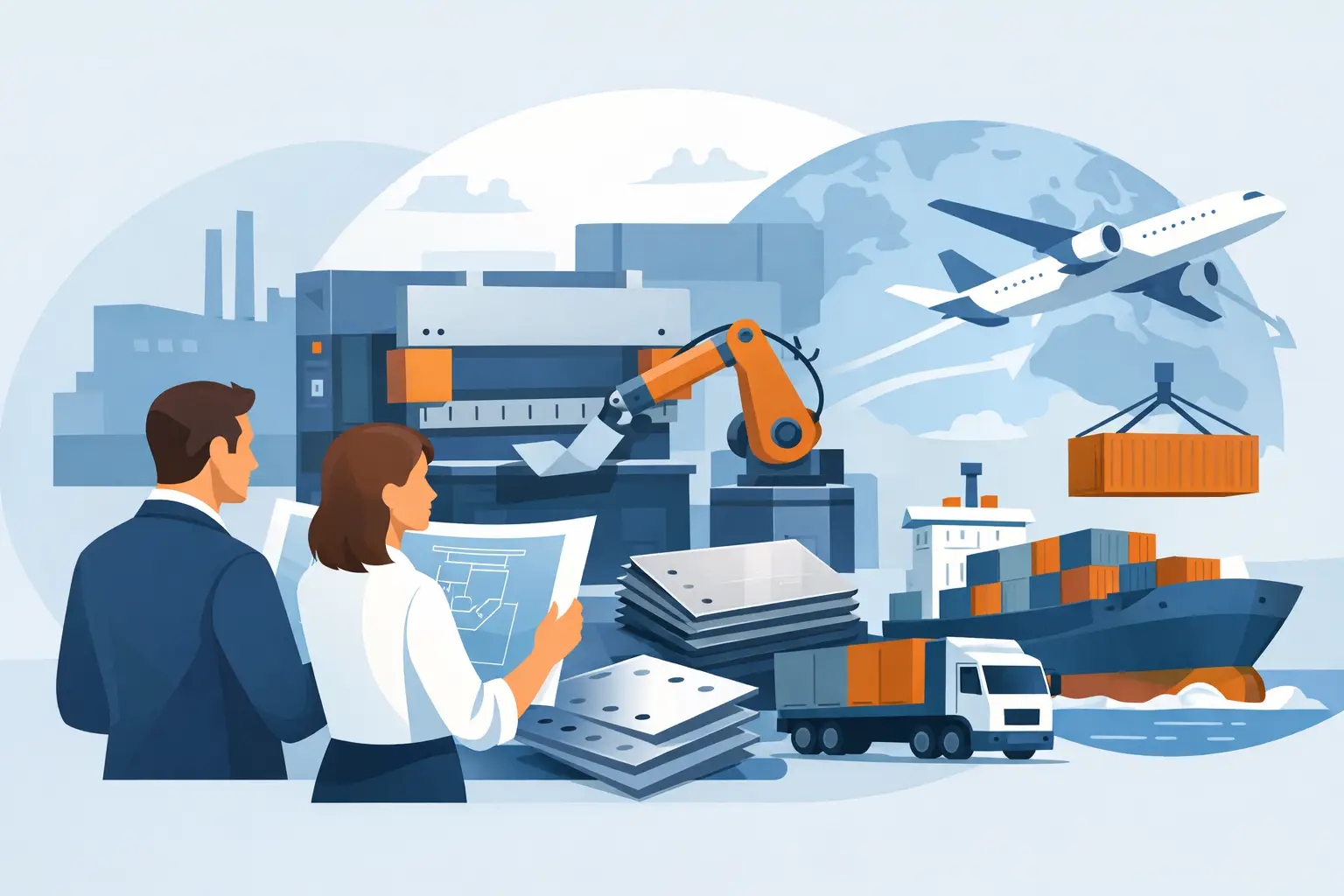
A late shipment of formed brackets or support channels rarely stays a small problem. It turns into stalled installations, rescheduled crews, backordered assemblies, and pressure from every side of the project. That is why choosing an export sheet metal manufacturer is not just a sourcing decision. It is an operational decision that affects cost, schedule, fit-up accuracy, and customer confidence.
For procurement teams, OEM buyers, and project stakeholders, the challenge is rarely finding a supplier that can cut and bend metal. The real challenge is finding a manufacturing partner that can meet exact specifications, maintain consistency across repeat orders, and ship internationally without creating avoidable risk. When the parts support structural systems, equipment assemblies, framing layouts, dock hardware, or foundation applications, the margin for error is small.
What an export sheet metal manufacturer should actually deliver
A capable export sheet metal manufacturer should offer more than fabrication capacity. The supplier should be able to interpret drawings correctly, recommend practical manufacturing methods, control tolerances, and package product for international handling. If any one of those areas is weak, the order may still ship, but the total project result suffers.
This matters even more for buyers who source both standard and custom components. A vendor may perform well on basic flat parts yet struggle when the order includes welded fabrications, formed hardware, post bases, channels, clamps, or assemblies that require multiple processes and tight dimensional control. The difference between a general metal shop and a reliable export partner is usually found in process discipline.
A strong manufacturing partner should be able to support work across mild steel, stainless steel, aluminum, copper, and galvanized sheet, while also matching the process to the application. Cutting, punching, bending, welding, forming, assembly, and surface finishing all need to work together as a controlled system, not as disconnected shop activities.
Precision matters more than quoted price
Buyers often begin with unit price, especially when comparing offshore or international options. That is understandable, but sheet metal purchasing decisions should be based on total landed performance, not just initial quote value. A lower price can disappear quickly when parts arrive with inconsistent hole locations, poor bend repeatability, incomplete finishing, or packaging that does not hold up in transit.
For industrial and construction applications, precision is not a premium extra. It is the baseline requirement. Components need to fit mating parts, align with field conditions, and support reliable installation. If a bracket, framing member, clamp, or hardware set is off by a small amount, the downstream cost may be far greater than the original manufacturing savings.
This is where engineering-led production becomes valuable. A supplier that understands tolerances, bend allowances, weld distortion, finish effects, and assembly fit can often prevent issues before production starts. That capability is especially useful when buyers need custom fabrication rather than simple catalog parts.
How to evaluate an export sheet metal manufacturer
The best evaluation process is practical. Ask how the supplier manages production, quality checks, and shipment preparation for export orders. A polished quotation is useful, but it does not tell you whether the operation is disciplined enough for repeat success.
Review process capability, not just equipment
Modern machinery matters, but equipment alone does not guarantee consistency. What matters is whether the supplier has the process control to move a part from drawing review to final packing with minimal variation. Buyers should look for evidence of stable production methods, inspection checkpoints, and an experienced team that can handle both standard lines and custom jobs.
A supplier with broad capability can also reduce vendor fragmentation. If one manufacturer can produce channels, brackets, clamps, nuts, structural hardware, and custom welded parts within one production environment, the buyer gains better coordination and fewer handoff issues. That simplification has real value for procurement and project management.
Assess drawing interpretation and technical communication
Many export problems begin before production starts. Misread dimensions, unclear tolerances, finish assumptions, and incomplete packaging instructions can all create expensive rework. A dependable export sheet metal manufacturer should ask the right technical questions early. That includes material grade, coating requirements, tolerance expectations, assembly needs, and any application-specific demands.
Good communication is not about volume. It is about accuracy and speed. Buyers need answers that are clear, technically correct, and aligned with production reality. If the supplier cannot define how the part will be made, inspected, and packed, that uncertainty usually surfaces later in the order.
Look closely at quality control discipline
Quality control should not be treated as a final checkpoint only. Reliable manufacturers build quality into each stage of production. Material verification, in-process checks, dimensional inspection, weld review, and finish validation all contribute to consistent output.
This is especially important for repeat orders and contract manufacturing. A part that performs well once but varies on the next run creates avoidable risk for OEM assembly lines and project schedules. Consistency is what separates a trial-order supplier from a long-term manufacturing partner.
Export readiness is a manufacturing capability
International shipping support is often discussed as a logistics issue, but in practice it begins on the factory floor. Parts must be packed for handling, storage, and transport conditions that may be far more demanding than domestic shipments. Incorrect bundling, poor palletization, or weak protection between finished surfaces can damage otherwise well-made product.
Export readiness also includes documentation accuracy, order traceability, and shipment coordination. B2B buyers do not need unnecessary complexity. They need product that is built correctly, identified clearly, and prepared for predictable delivery. When a supplier understands that export fulfillment is part of the manufacturing promise, the buyer sees fewer surprises.
This is one reason many international customers prefer working with a partner that already serves global markets. Export experience tends to improve practical execution. Packaging, labeling, production planning, and communication are more likely to reflect the realities of cross-border supply.
Standard products and custom fabrication should work together
Many buyers do not want one supplier for catalog hardware and another for custom metal components. It creates extra qualification work, separate lead times, and greater coordination pressure. A manufacturer with both standardized product depth and custom fabrication capability can support a wider share of the bill of materials.
That combination is particularly useful in construction, marine, infrastructure, and industrial equipment applications. A project may require standard channels, strut-compatible hardware, brackets, clamps, and fastening components alongside custom supports, welded assemblies, or foundation-related items. When these are sourced through one manufacturing partner, compatibility and scheduling become easier to manage.
At Metallix Exports, this integrated model is central to the value offered to OEMs, contractors, distributors, and project buyers. The ability to supply both established hardware lines and build-to-print components gives customers more control over sourcing without sacrificing technical precision.
The trade-offs buyers should consider
There is no single perfect supplier profile for every order. High-volume repeat parts may prioritize production efficiency and inventory planning. Specialized project hardware may place more value on engineering support, flexible fabrication, and faster response to drawing revisions. Some buyers need broad material capability, while others care most about finish quality or heavy structural reliability.
It also depends on the application. Marine hardware, foundation products, framing systems, and industrial assemblies each place different demands on fabrication methods and material selection. Buyers should be cautious about choosing a supplier based only on general metalworking capability. Application understanding matters.
The strongest choice is usually a manufacturer that can explain trade-offs clearly. If a tolerance adds cost, they should say why. If a material change affects forming or finishing, they should address it directly. That kind of transparency is valuable because it supports better buying decisions rather than pushing a quote through quickly.
What long-term buyers usually value most
After the first order, most industrial buyers focus less on marketing claims and more on repeatability. They want parts that arrive as specified, communication that stays clear when schedules tighten, and a supplier that can support growth without losing control of quality. Reliability becomes the deciding factor.
That is why the best export sheet metal manufacturer is usually not the one with the broadest promises. It is the one with the production discipline to meet specifications, the flexibility to support custom and standard demand, and the operational maturity to deliver globally with confidence.
If your business depends on metal components that must fit right, ship on time, and perform in the field, choose a manufacturing partner that treats precision and export readiness as part of the same job. That is where purchasing risk starts to drop and long-term supply confidence begins.


