
 E-mail :
 Call Us :
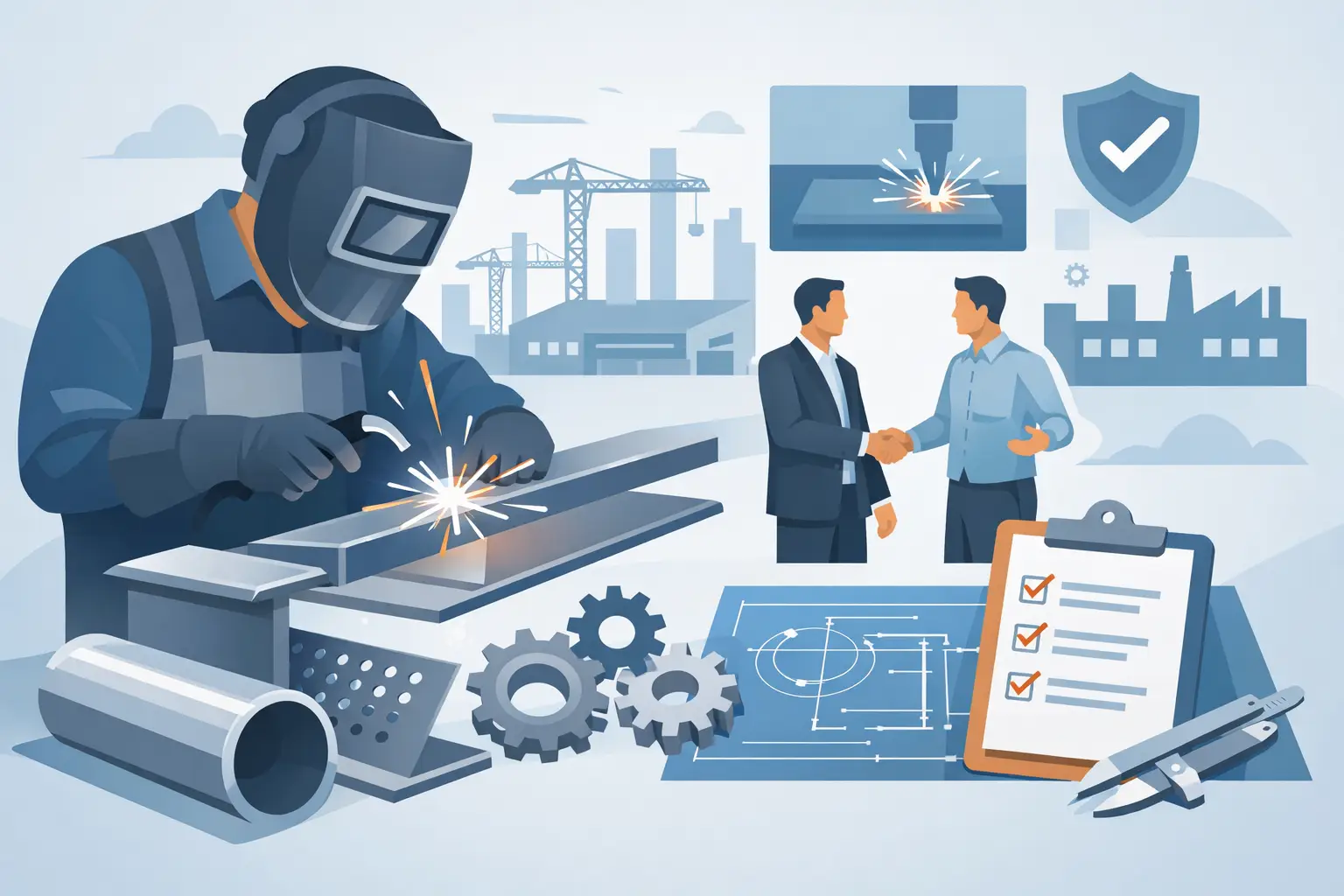
A late shipment on a welded assembly rarely starts with shipping. More often, the problem begins much earlier - unclear drawings, inconsistent weld quality, limited forming capacity, or a supplier that can weld parts but cannot manage the full fabrication process. When you are selecting a welded metal fabrication company, those gaps show up as rework, installation delays, and avoidable procurement risk.
For OEM buyers, contractors, and project teams, the right supplier is not just a shop that joins metal. It is a manufacturing partner that can hold tolerances, interpret specifications correctly, manage repeat production, and deliver finished components ready for installation or downstream assembly. That distinction matters whether you are sourcing structural brackets, support hardware, post bases, dock components, framing parts, or custom industrial fabrications.
What a welded metal fabrication company should actually provide
A capable supplier should offer more than welding stations and labor. In most industrial applications, welded parts depend on upstream and downstream processes that affect fit, strength, appearance, and delivery performance. If cutting is inconsistent, weldments will vary. If bending is not controlled, assemblies will not align. If finishing is handled separately without coordination, the part may meet the drawing but miss the project schedule.
That is why buyers often get better results from a welded metal fabrication company with integrated capabilities. Laser cutting, punching, bending, forming, welding, assembly, and surface finishing should work as one production flow, not as disconnected services. This reduces handling, shortens lead time, and gives your team a clearer line of responsibility when questions come up.
For procurement teams, the commercial value is just as important as the technical value. Consolidating standard hardware, welded fabrications, and custom parts with one supplier can reduce vendor complexity and improve planning. It also gives engineering and purchasing teams a more practical path when design revisions happen mid-project.
Why welding quality is only part of the decision
Weld quality is essential, but it should not be the only screening factor. A fabricator may produce acceptable welds on simple jobs and still struggle with repeatability, dimensional control, or production scale. That becomes a serious issue when your requirements move beyond prototypes into scheduled supply.
A dependable welded metal fabrication company should be able to discuss material behavior, joint design, part sequencing, fixture use, distortion control, and inspection methods in practical terms. Those details affect whether a bracket installs square, whether a support frame carries load as intended, and whether field teams need to modify parts on site.
Material experience also matters. Mild steel, stainless steel, aluminum, copper, and galvanized sheet each bring different fabrication challenges. Heat input, weld method, surface condition, and post-fabrication finishing need to match the material and application. A supplier that understands these variables can help prevent common failures such as warping, coating damage, poor fit-up, or unnecessary cost.
Evaluating capabilities beyond the weld cell
When buyers review suppliers, they often focus on visible equipment. Machinery matters, but process control matters more. A strong fabrication partner should be able to explain how parts move from drawing review to cutting, forming, welding, inspection, packing, and shipment. If that workflow is vague, quality and lead time usually become unpredictable.
Look closely at how the company handles drawings and specifications. Some parts are straightforward, while others include tight tolerances, mating features, installation constraints, or finish requirements that need early review. A supplier with engineering discipline will identify manufacturability concerns before production starts, not after completed parts fail inspection.
Capacity planning is another area where trade-offs matter. A smaller shop may offer flexibility on short custom runs, but it may struggle with larger release volumes or mixed product schedules. A higher-capacity manufacturer may support repeat orders and export volumes more effectively, especially when it can produce both catalog items and custom fabricated assemblies under one system. The right choice depends on your order pattern, urgency, and need for long-term supply continuity.
The value of standard and custom production in one source
Many industrial buyers do not need only one fabricated part. They need a package of components that may include channels, clamps, brackets, framing hardware, base plates, nuts, anchors, and welded assemblies. Sourcing those items across multiple vendors creates handoff risk and slows down replenishment.
A welded metal fabrication company with both standard product depth and custom manufacturing capability can simplify that model. Standardized hardware supports faster quoting and repeat supply, while custom fabrication addresses application-specific dimensions, load conditions, and mounting requirements. This approach is especially useful in construction, infrastructure, marine, HVAC, and equipment manufacturing, where off-the-shelf compatibility and project-specific fabrication often need to work together.
For example, support systems that align with unistrut-compatible layouts may require standard channels and clamps alongside custom welded brackets or reinforced frames. Foundation and anchoring applications may require fabricated post bases, pier hardware, or structural connectors tailored to jobsite conditions. In these cases, the supplier’s ability to manage both product categories can save time and reduce coordination errors.
Lead times, repeatability, and the real cost of poor supply
The lowest quoted unit price does not always deliver the lowest project cost. If welded parts arrive out of tolerance, lack finishing consistency, or require field correction, the savings disappear quickly. The same is true when deliveries slip and installation crews, production lines, or container schedules are forced to wait.
That is why buyers should look at a welded metal fabrication company through an operational lens. Can the supplier maintain repeatability across batches? Can it support forecasted demand as well as urgent replenishment? Can it package and ship fabricated assemblies in a way that protects geometry and surface finish? These questions are not administrative details. They are part of product quality.
Consistency is especially important for export orders and multi-phase projects. International buyers need documentation discipline, packaging reliability, and shipment coordination that match commercial commitments. A fabricator that is technically capable but not export-ready can still become a weak point in the supply chain.
What experienced buyers ask before awarding work
The most effective supplier conversations go beyond “Can you make this part?” A better question is “How will you make this part, control variation, and deliver it consistently?” That shift reveals how mature the manufacturing operation really is.
Buyers should ask about tolerance control on formed and welded parts, weld methods by material type, inspection checkpoints, and how nonconforming parts are handled. It also helps to ask whether the supplier supports design refinement for manufacturability. In many projects, early feedback on bend relief, hole placement, weld access, or assembly sequence can improve both cost and performance.
Commercial teams should ask equally direct questions about minimums, batch planning, release schedules, and packaging standards. A supplier that answers clearly and specifically is usually easier to work with once production begins. If responses stay general, that often signals future communication issues.
Why the right partner looks different from a general job shop
A general job shop can be useful for one-off work, repair jobs, or very simple fabrications. But when your business depends on reliable repeat supply, the standard changes. You need process discipline, application knowledge, and enough manufacturing breadth to support changing project needs without constant resourcing.
That is where an engineering-focused manufacturer stands apart. Metallix Exports, for example, supports buyers who need precision sheet metal fabrication, welded assemblies, structural hardware, and export-ready fulfillment from one source. That kind of model is valuable when timelines are fixed and specifications leave little room for variation.
For procurement and engineering teams, the strongest supplier relationships usually come from alignment, not just capacity. The right fabrication partner understands the application, reviews the details carefully, and builds around quality, repeatability, and on-time delivery. If your welded components support larger systems, installations, or field-critical hardware, that level of reliability is not a bonus. It is part of the requirement.
The best time to evaluate a fabricator is before the pressure starts. When you choose a supplier that can manage welding as part of a controlled manufacturing process, you give your project a better chance of staying on spec, on schedule, and easier to scale.


