
 E-mail :
 Call Us :
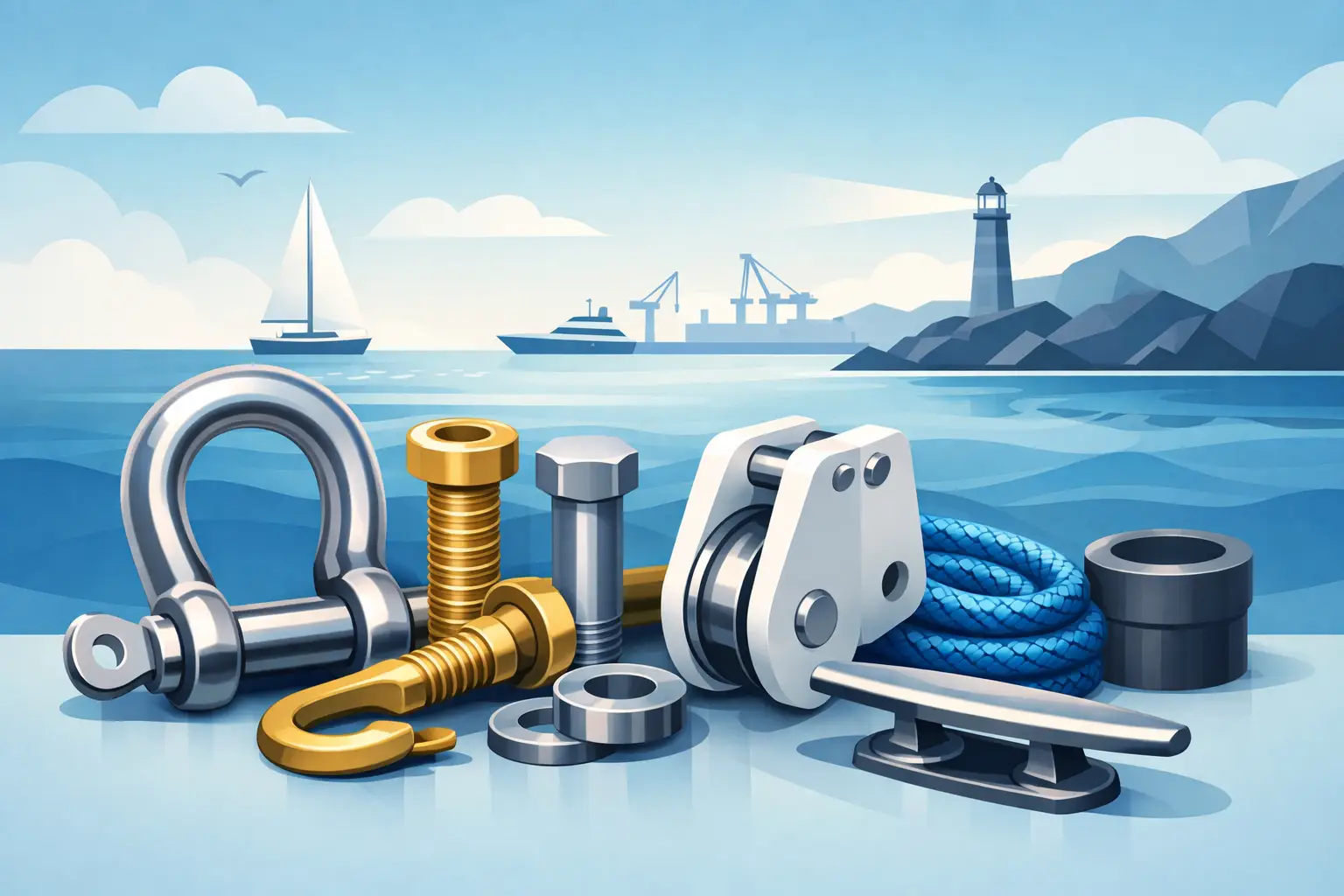
A dock cleat, hinge, bracket, or mooring fitting can appear straightforward on a drawing. In service, it must withstand salt spray, wet-dry cycling, UV exposure, vibration, impact, and sustained load. Selecting the best materials for marine hardware is therefore not a matter of choosing the most corrosion-resistant metal available. It is a specification decision that balances environment, mechanical demand, joining methods, fabrication requirements, and total cost of ownership.
For OEMs, dock builders, marine contractors, and procurement teams, the right material choice reduces replacement cycles, installation failures, warranty exposure, and inconsistent field performance. The wrong choice can corrode quickly, seize at fasteners, crack at welded zones, or create galvanic attack where dissimilar metals meet.
How to Select the Best Materials for Marine Hardware
Marine hardware should be specified against the actual exposure condition, not simply labeled as "marine grade." A covered freshwater marina has very different requirements from a saltwater floating dock, a vessel fitting exposed to continuous spray, or a mooring assembly operating near the tidal zone.
Start with the service environment. Saltwater and coastal air contain chlorides that attack many metals, particularly in crevices and areas where water remains trapped. Hardware installed in splash zones faces frequent wet-dry cycles and is often more demanding than components that remain continuously submerged. Freshwater lowers corrosion risk, but it does not eliminate it where oxygen, pollutants, abrasion, or galvanic contact are present.
Load path matters just as much. A decorative rail fitting and a structural mooring bracket do not need the same material thickness, yield strength, weld design, or safety factor. Engineers should also account for shock loading from waves, vessel movement, wind, and docking impact. A material that resists corrosion but deforms under cyclic load is not the right answer for a critical connection.
Fabrication is another practical consideration. The selected alloy must suit the required cutting, punching, bending, welding, machining, and finishing processes. Availability in the necessary sheet, plate, bar, or formed profile also affects production consistency and lead time.
Stainless Steel for High-Visibility and Corrosion-Critical Parts
Stainless steel is among the most widely specified options for marine hardware because it combines strength, clean appearance, and corrosion resistance. However, stainless performance depends heavily on alloy selection, surface condition, design details, and maintenance.
Type 316 Stainless Steel
Type 316 stainless steel is commonly preferred for saltwater-exposed hardware. Its molybdenum content improves resistance to chloride corrosion compared with Type 304, making it a strong choice for cleats, hinges, latches, rail fittings, brackets, fasteners, and fabricated assemblies used near coastal or saltwater environments.
For fabricated parts, smooth surfaces and proper weld finishing are essential. Heat tint, embedded carbon steel particles, rough welds, and unsealed crevices can become starting points for corrosion. Post-fabrication cleaning and passivation help restore the protective oxide layer and support a more consistent service life.
Type 316 is not immune to failure. In stagnant saltwater, tight crevices, or poorly drained assemblies, it can still experience pitting and crevice corrosion. It is also more expensive than carbon steel or aluminum. Its value is highest where appearance, corrosion resistance, and long-term reliability justify the higher material cost.
Type 304 Stainless Steel
Type 304 stainless steel can be suitable for protected marine applications, interior vessel components, freshwater installations, and hardware with limited chloride exposure. It is generally more economical than 316 and offers good formability and weldability.
For permanently exposed saltwater hardware, Type 304 is usually a compromise. Procurement specifications should avoid treating all stainless steel as interchangeable. Identifying the grade on drawings, purchase orders, and inspection records helps prevent substitutions that look acceptable at delivery but perform poorly in the field.
Duplex Stainless Steel
Duplex stainless steels provide higher strength and stronger resistance to chloride stress corrosion cracking than common austenitic grades. They are well suited to heavily loaded, corrosion-critical marine components, including structural fittings, high-capacity brackets, specialized mooring hardware, and parts operating in aggressive offshore or coastal conditions.
The trade-off is material cost and more controlled fabrication. Welding procedures, filler selection, and heat input require closer management than standard stainless work. Duplex is best specified where its mechanical and corrosion advantages directly solve a defined project risk rather than as a default upgrade for every component.
Hot-Dip Galvanized Steel for Structural Marine Hardware
Hot-dip galvanized steel remains a practical, cost-effective option for many dock, marina, and waterfront structural applications. The zinc coating protects the underlying steel through barrier protection and sacrificial action, making it useful for channels, support brackets, post bases, clamps, framing hardware, and larger fabricated components.
For freshwater docks, inland marinas, and applications where periodic inspection is feasible, galvanized steel often provides excellent value. It also offers high structural strength and is readily available in forms suited to custom fabrication.
Saltwater changes the equation. Zinc is consumed faster in chloride-rich environments, especially in splash zones and areas subject to abrasion. Galvanized steel can still be used in some coastal structures, but coating thickness, drainage, maintenance access, and expected replacement intervals should be specified realistically. For severe saltwater exposure, a duplex coating system - galvanizing followed by a compatible protective coating - may improve lifecycle performance.
Fabrication sequence is critical. Welding, drilling, cutting, or grinding after galvanizing exposes bare steel unless those areas are repaired with an approved zinc-rich system. For complex fabricated assemblies, hot-dip galvanizing after welding and final fabrication is often the more dependable approach, provided drain holes, vent holes, and distortion control are incorporated into the design.
Aluminum for Lightweight Marine Assemblies
Aluminum is a strong candidate where low weight, corrosion resistance, and ease of handling are priorities. It is widely used in floating dock structures, gangways, access systems, railings, frames, and vessel components where reducing dead load supports performance and installation efficiency.
Marine-grade aluminum alloys, including 5052 and 5083 for corrosion-resistant sheet and plate applications, are commonly selected for saltwater exposure. Alloy 6061 is frequently used where higher strength and structural sections are required, though the design should consider changes in mechanical properties around welded zones.
Aluminum naturally forms a protective oxide layer, but it is vulnerable to galvanic corrosion when directly connected to stainless steel, copper alloys, or carbon steel in the presence of an electrolyte. Isolation washers, nonconductive bushings, compatible coatings, and controlled drainage are not minor details. They are essential parts of the assembly specification.
Aluminum also has a lower modulus than steel, meaning it deflects more under the same load. A lightweight bracket may require increased section thickness, gusseting, or a revised profile to achieve the required stiffness. This is a design consideration, not a reason to avoid aluminum where it offers operational advantages.
Bronze and Copper Alloys for Specialized Marine Service
Bronze alloys have a long record in marine service, particularly for components requiring corrosion resistance, wear performance, and dependable behavior in contact with seawater. Silicon bronze and aluminum bronze are often used for fittings, fasteners, bushings, valves, propeller-related components, and specialized mooring or vessel hardware.
Aluminum bronze offers high strength and strong resistance to corrosion and wear. Silicon bronze is valued for its corrosion resistance, formability, and suitability for certain fasteners and cast or fabricated details. These alloys can be especially effective where stainless steel may gall, where bearing surfaces are involved, or where compatibility with existing bronze systems is required.
Their limitation is cost. Copper alloys are typically more expensive than steel, stainless steel, and aluminum, and not every fabricator maintains the same production capacity across bronze grades. They should be selected for their specific functional advantages, not merely for their marine reputation.
Galvanic Compatibility Is Part of Material Selection
Many marine hardware failures occur at the interface between otherwise suitable materials. When dissimilar metals are electrically connected and exposed to saltwater, the less noble metal may corrode at an accelerated rate. Aluminum connected directly to stainless steel is a common concern, while copper alloys can also create compatibility issues with aluminum and galvanized steel.
The solution is usually a controlled assembly design: isolate dissimilar metals where possible, use appropriate washers and sleeves, apply compatible coatings, and prevent standing water at contact points. Fastener selection must be considered with the base material. A high-grade stainless fastener installed in thin aluminum without isolation can create a localized corrosion problem that undermines the entire fitting.
Specify the complete connection, including fasteners, washers, coatings, sealants, and installation method. A material callout without these details leaves too much to field interpretation.
Build Material Decisions Into the Manufacturing Specification
A dependable marine component begins with a clear drawing and a manufacturable specification. Beyond alloy grade, define material form, thickness, finish, weld requirements, tolerances, corrosion-protection steps, and inspection criteria. If a part will be galvanized, include drainage and venting requirements. If it will be fabricated from stainless steel, identify finish expectations and cleaning requirements after welding.
For custom hardware, prototype evaluation can reveal issues that drawings alone may not show, such as difficult access for fasteners, water-trapping geometry, excessive flex, or coating damage during assembly. This is particularly valuable for floating dock hardware, mooring systems, and structural fittings that interface with wood, composite decking, aluminum frames, or concrete structures.
Metallix Exports supports marine and waterfront projects with precision sheet metal fabrication, structural hardware production, welding, forming, finishing, and custom manufacturing built around application-specific requirements. A capable manufacturing partner should be able to assess whether the specified material can be produced consistently at the required tolerance and finish level, then support repeatable delivery as project volumes grow.
The best material decision is the one that matches the real operating environment and the complete assembly design. Specify for the water, the load, the joining method, and the expected service life, then validate the choice before it becomes a costly field repair.


