
 E-mail :
 Call Us :
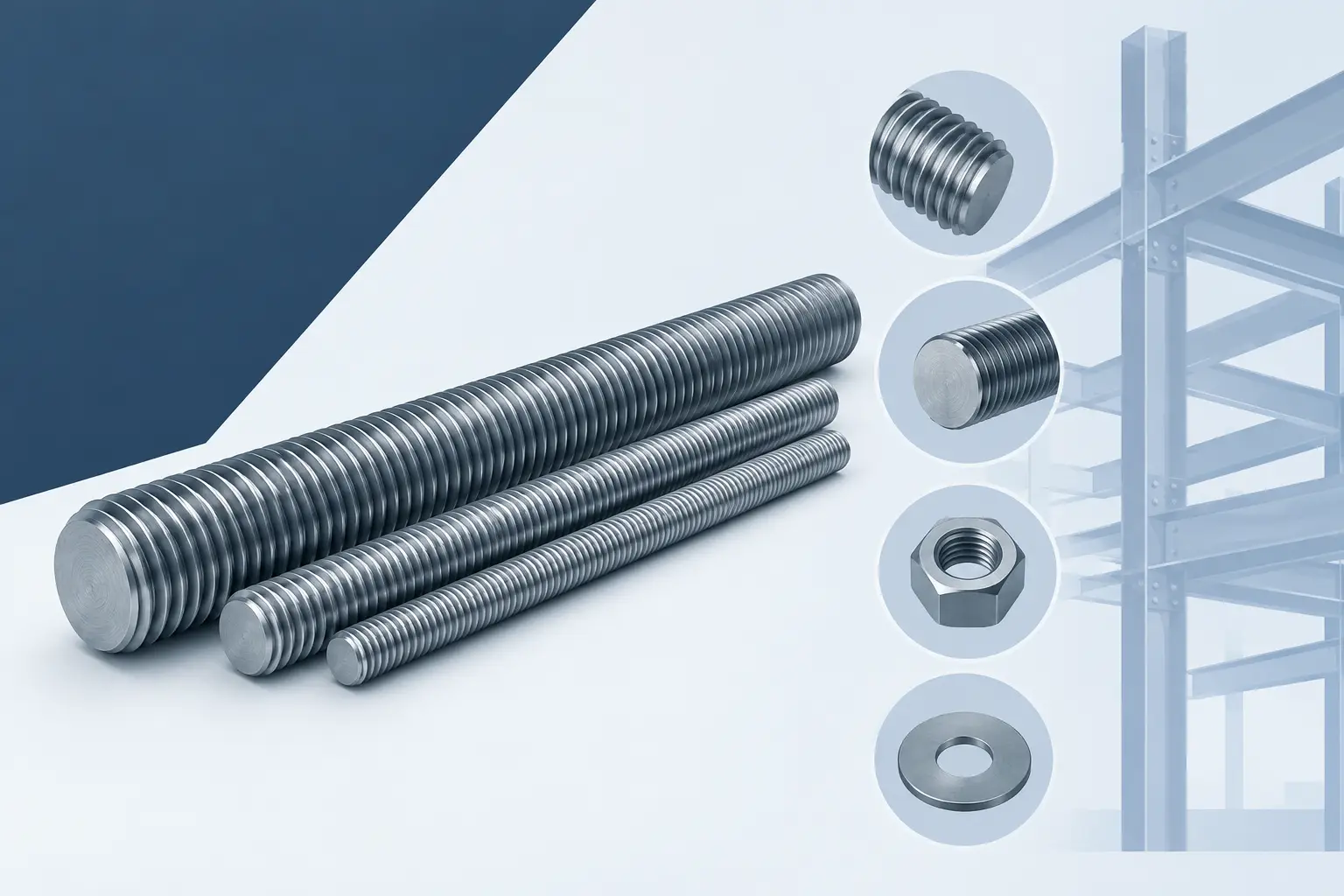
A threaded rod may be a small line item in a bill of materials, but it can determine whether a support assembly stays aligned, a hanger carries its intended load, or an anchor connection performs as designed. All-thread rods provide continuous adjustment and flexible cutting lengths, making them a practical fastening solution across construction, mechanical systems, equipment fabrication, and industrial installations. Their apparent simplicity, however, makes specification discipline even more important.
For purchasing teams and engineers, the right choice is not simply the rod with the matching diameter. Material, strength grade, thread form, corrosion protection, engagement length, and installation conditions all affect performance. A rod that is suitable for an indoor support application may be a poor choice for an exposed coastal assembly or a high-load structural connection.
What All-Thread Rods Are Used For
All-thread rod is a long, continuously threaded fastener designed to accept nuts, washers, couplers, and other threaded hardware at virtually any point along its length. Unlike a standard bolt, it has no formed head. This permits field adjustment and makes the rod useful where exact dimensions are established during installation rather than at the factory.
In industrial and construction work, threaded rod is commonly used for suspended HVAC, electrical, and piping supports; strut channel assemblies; equipment mounting; concrete anchoring; bracing; fabricated frames; and custom connection hardware. It is also widely used by OEMs that require adjustable fastening points in machines, enclosures, racks, and assemblies.
That versatility has a trade-off. Because all-thread rod is frequently cut, coupled, bent into an assembly, or installed with multiple nuts and washers, its performance depends on the entire connection. Specifying the rod alone without considering the surrounding hardware can create a weak point in an otherwise well-designed system.
Start With Load, Not Diameter
Diameter is an essential starting point, but it should follow the required load and connection design rather than replace them. Tensile demand, shear forces, vibration, installation angle, unsupported length, and the strength of the attached members must all be considered. A larger diameter can improve tensile capacity, but it does not automatically resolve issues such as inadequate thread engagement, poor anchor capacity, or buckling in a long compression application.
Threaded rod is particularly vulnerable to buckling when used as a slender compression member. A rod that performs well in tension may not be appropriate for compressive loading without proper lateral support. Similarly, vibration can loosen a basic nut-and-washer assembly even when the rod itself has ample strength. Lock nuts, prevailing-torque nuts, double-nutting methods, thread-locking products, or engineered locking systems may be required depending on the application.
For critical structural, lifting, life-safety, or code-governed installations, design loads and allowable capacities should be verified against the applicable engineering standard and local project requirements. Product substitutions should never be made on diameter alone.
Strength Grades Must Match the Application
Low-carbon steel rod can be economical and effective for general-purpose indoor fastening, light support systems, and noncritical fabricated assemblies. Higher-strength alloy or heat-treated threaded rod may be needed where the connection carries significant tensile load or where the project specification calls for a defined grade.
The grade must be identified clearly. Strength values vary by standard and material type, and visually similar rods may have substantially different mechanical properties. Procurement documents should specify the required standard, grade, diameter, thread series, finish, and any certification requirements. If a project calls for a particular grade, accepting an unspecified "equivalent" can create compliance and liability concerns.
It also helps to distinguish between the rod's nominal strength and the capacity of the completed joint. Nut grade, washer hardness, thread engagement, couplers, welds, and the connected substrate can limit the assembly well before the rod reaches its stated tensile capability.
Material and Finish Determine Service Life
Corrosion resistance is often the deciding factor in threaded rod selection. Plain carbon steel may be suitable in dry, controlled interiors, but it is not a long-term answer for wet, exterior, chemical, or marine environments. Once corrosion begins at the threads, tightening adjustment and future maintenance become more difficult, while section loss can reduce capacity.
Zinc-plated threaded rod offers a basic layer of protection for many indoor and mildly exposed applications. Hot-dip galvanized rod provides heavier protection and is commonly selected for exterior construction, utility supports, and galvanized steel assemblies. The coating process can affect thread fit, so nuts must be compatible with the finished rod rather than selected as an afterthought.
Stainless steel is often selected where moisture, washdown conditions, atmospheric exposure, or corrosive environments require stronger resistance. The correct stainless grade depends on the exposure. For example, an installation near saltwater may need a more corrosion-resistant option than a general outdoor application. Stainless hardware can also experience galling during assembly, particularly under high tightening loads. Suitable lubrication, compatible nuts, and controlled installation practices help reduce that risk.
Where dissimilar metals are joined, galvanic corrosion should be reviewed. A stainless threaded rod combined with galvanized components may be appropriate in some applications, but environmental conditions and electrical isolation requirements can change the outcome. The best material selection is always tied to the full assembly and operating environment.
Thread Series, Engagement, and Length Matter
Coarse threads are widely used in construction and general industrial work because they install quickly and tolerate normal handling conditions well. Fine threads may offer improved adjustment and tensile area in certain sizes, but they are less forgiving of damage and may not be suitable for every field environment. Matching nuts, couplers, and accessories to the thread series is mandatory.
Adequate thread engagement is equally important. A nut should engage enough full threads to develop the intended capacity, while couplers must provide the proper engagement from both rod ends. Rod cut in the field should have clean, undamaged threads. A poorly cut end can cross-thread a nut, reduce engagement, and slow installation across an entire support package.
Length should account for washers, nuts, connection plates, adjustment range, couplers, and any required projection beyond the nut. Ordering a rod that is only long enough on paper often produces field modifications that cost time and introduce inconsistency. Standard lengths work well for repeatable systems, while custom-cut lengths can reduce waste and installation labor on high-volume fabricated assemblies.
Specify the Complete Fastening Package
A dependable threaded-rod installation is a system, not a single product. When preparing a purchase order or fabrication package, define the components that directly affect fit and performance:
- Rod material, grade, diameter, thread series, and required length
- Protective finish or corrosion-resistance requirement
- Compatible nuts, washers, couplers, and locking hardware
- Required documentation, marking, testing, or material traceability
- Packaging and cut-length requirements for efficient site or production handling
This level of detail reduces substitution risk and prevents a common procurement problem: receiving individual components that are technically available but not properly matched. It also simplifies inspection, particularly when a project requires consistent finishes, traceable lots, or repeatable assembly dimensions.
Manufacturing Support for Standard and Custom Requirements
For standard support systems, readily available threaded rod sizes and matching hardware can keep projects moving. For OEM and fabricated applications, the requirement may extend beyond standard stock. Custom lengths, welded assemblies, formed brackets, mounting plates, strut-compatible components, and finished hardware packages can reduce vendor fragmentation and improve consistency at installation.
Metallix Exports supports industrial buyers with precision metal fabrication and hardware solutions built around application requirements. When threaded rod is part of a larger bracket, channel support, anchor assembly, or equipment frame, coordinating the related components through one manufacturing partner can improve dimensional control, packaging accuracy, and delivery planning.
The most cost-effective all-thread rod is not always the lowest-priced option per foot. It is the one that arrives with the correct grade, compatible hardware, finish, and dimensions for the job - allowing crews and production teams to install it correctly the first time.