
 E-mail :
 Call Us :
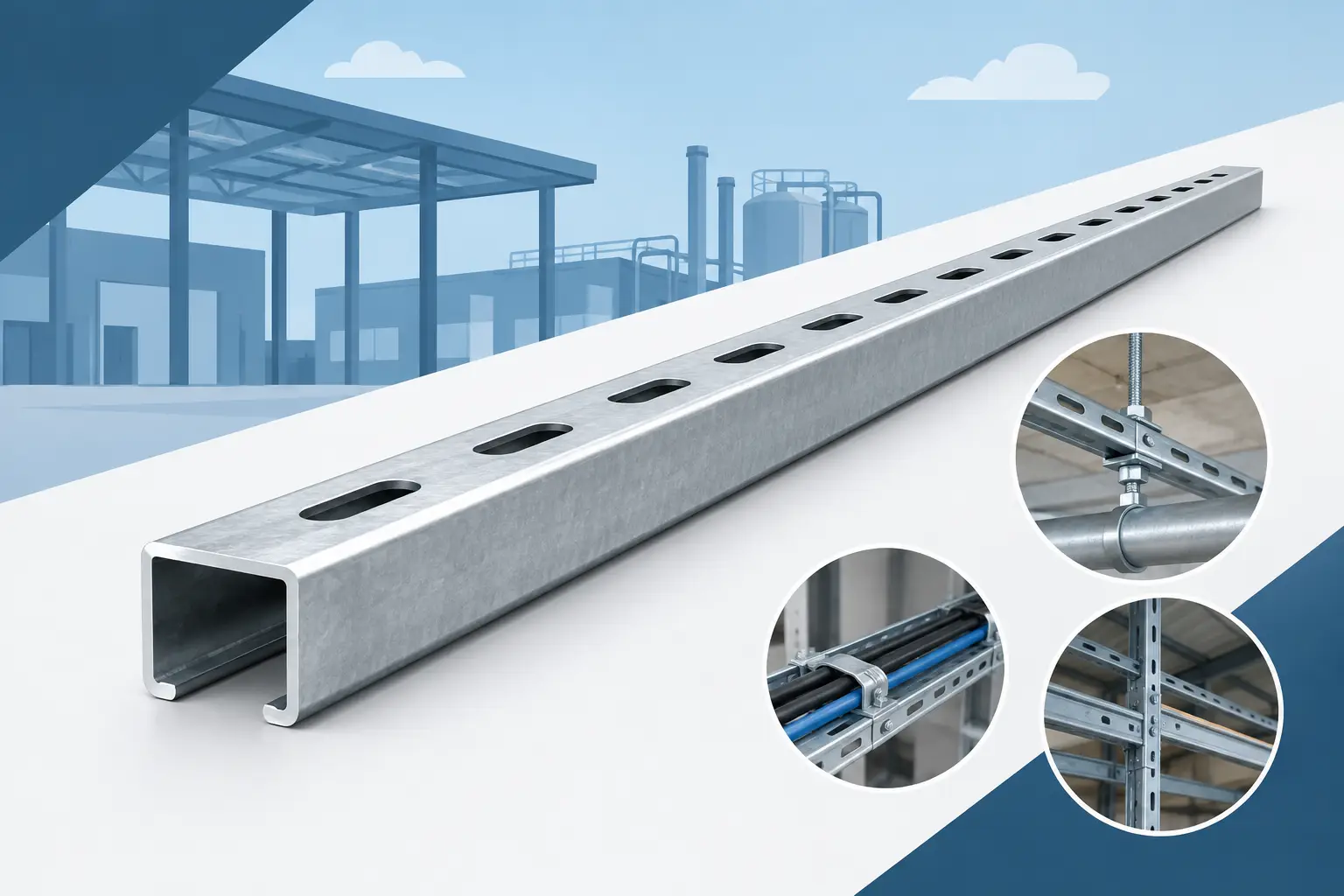
A 10-foot channel can eliminate a splice, simplify a long trapeze run, and reduce installation time. It can also create avoidable issues if gauge, profile, slot pattern, finish, and handling requirements are not defined before ordering. For buyers specifying 12 guage strut channel 10 feet, the correct choice is not simply the heaviest item on a catalog page. It is the channel that fits the design load, installation environment, compatible hardware, and shipping plan without introducing unnecessary material or field labor.
What 12 Gauge Means for Strut Channel
In common North American usage, 12-gauge steel is approximately 0.1046 inches thick before coating. That nominal thickness provides substantially more section strength than lighter-gauge channel, but thickness alone does not determine how a channel will perform. The channel's profile depth, flange geometry, steel grade, slot configuration, span, and direction of loading all affect its usable capacity.
A 12-gauge strut channel is often selected for support frames, pipe and conduit racks, cable-tray supports, HVAC trapezes, equipment stands, and secondary structural assemblies. It is a practical option where lighter channel may deflect too much or where a project requires added confidence around concentrated loads, longer spans, or frequent support points.
Procurement teams should avoid treating gauge as a stand-alone performance specification. A deep channel and a shallow channel made from the same thickness will behave differently. Likewise, a slotted channel can have different published load characteristics than a solid-back channel of the same profile. Request the supplier's dimensions and load data for the exact product being quoted.
Why a 10-Foot Length Changes the Buying Decision
The main value of a 10-foot length is continuity. Where a support run can be completed with one channel rather than two shorter pieces, the assembly may need fewer splice plates, bolts, and installation steps. Fewer joints can also produce a cleaner result and reduce locations where alignment problems can occur.
That advantage depends on the jobsite. A 10-foot piece requires room for unloading, staging, cutting, and maneuvering. In confined mechanical rooms, on elevated platforms, or inside finished buildings, a shorter length may be easier and safer for crews to handle. Transportation is also a consideration. Longer bundles need proper packaging and can be subject to carrier length limitations or handling surcharges.
For repeatable production work, a 10-foot channel can improve material yield. Fabricators can plan cut lengths around standard stock, reduce offcuts, and prepare kits for field assembly. For one-off installations with irregular dimensions, however, ordering exact cut lengths may reduce cutting time and minimize surplus material.
Specify the Channel Profile Before Comparing Prices
A quote for “12-gauge strut” is incomplete unless the channel profile is identified. Standard strut systems commonly use a channel approximately 1-5/8 inches wide, but depths vary. Shallow channels are useful where clearance is limited. Deeper profiles offer greater stiffness and are commonly chosen for heavier support requirements.
The back of the channel may be solid or slotted. Slotted channel gives installers flexibility to position threaded rod, clamps, and brackets without drilling. Solid channel can be preferable where the design calls for maximum continuity, a particular fastening layout, or a cleaner appearance. The right selection depends on the assembly, not a general preference for one style.
Compatibility must also be defined carefully. If a project uses existing channel nuts, spring nuts, fittings, clamps, or brackets from a unistrut-compatible framing system, profile dimensions and lip geometry must match the mating components. “Compatible” should mean confirmed fit through dimensional control, not an assumption based on a similar-looking photograph.
Details to Include on a Purchase Specification
A clear specification prevents the most common sourcing errors. At minimum, identify the channel width and depth, material thickness, 10-foot length, solid or slotted back, slot size and spacing where applicable, finish, quantity, and packaging requirements. If the channel will be cut, punched, welded, or supplied as part of an assembly, include drawings with tolerances and revision control.
For engineered installations, state the support spacing, expected point loads, distributed loads, and load direction. This gives the manufacturer or project engineer the information needed to verify whether the selected profile is suitable. It also helps avoid substituting a channel with matching gauge but inadequate geometry.
Select the Finish for the Actual Exposure Level
Finish selection affects service life, cost, and lead time. Pre-galvanized steel is widely used for indoor commercial and industrial support systems where moderate corrosion resistance is required. It is economical and practical for many dry environments, though cut edges and drilled areas should be considered in the corrosion plan.
Hot-dip galvanized channel offers a heavier zinc coating and is commonly specified for outdoor, humid, or corrosive locations. Because the coating is applied after fabrication, it provides coverage across edges and formed surfaces. The trade-off can be a thicker coating, a different appearance, and dimensional considerations on tightly fitting hardware.
Stainless steel is appropriate where corrosion exposure, washdown requirements, chemicals, or appearance demand a higher-performing material. It carries a higher material cost and should be matched to the environment and connected metals to manage galvanic-corrosion risk. Powder-coated or painted steel may suit controlled indoor conditions and projects requiring a specific color, but coating type and surface preparation should be confirmed.
Load Capacity Is a System Question
Channel load tables are useful, but they do not replace application review. Published values typically rely on specific assumptions about span length, support conditions, allowable deflection, channel orientation, and loading method. A channel supporting a uniform load between supports does not behave the same way as one carrying a heavy point load near midspan.
The assembly hardware matters as much as the channel. Threaded rod diameter, channel nuts, brackets, beam clamps, anchors, welds, and fastener torque can each become the limiting factor. A strong 12-gauge channel does not make an undersized anchor acceptable.
For critical supports, especially overhead systems, equipment frames, seismic bracing, or outdoor infrastructure, use project-specific engineering and applicable code requirements. The purchasing specification should preserve the required safety factors rather than relying on field judgment after material arrives.
Manufacturing Controls That Protect Project Schedules
For OEMs, distributors, and contractors, consistency across a shipment is often more valuable than a marginal difference in unit price. Channel lengths should be controlled, cut ends should be clean, slots should be free of damaging burrs, and coatings should meet the agreed finish requirement. Bundling also matters: material should arrive identified, protected from transit damage, and organized for efficient receiving.
Custom requirements deserve the same discipline. A supplier capable of cutting, punching, bending, welding, and finishing can provide channel assemblies, welded frames, mounting brackets, and complementary hardware under one coordinated production plan. This reduces vendor fragmentation and helps keep mating components aligned to the same drawing revision.
Metallix Exports supports standard and custom strut-channel requirements with manufacturing controls suited to industrial and construction procurement. For export orders, confirm bundle configuration, labeling, packing method, documentation, and delivery timing early in the purchasing cycle rather than treating logistics as an afterthought.
Questions to Resolve Before Releasing an Order
Before issuing a purchase order, confirm whether the channel is shallow or deep, solid or slotted, and intended for a standard compatible hardware system. Verify the actual material thickness, finish, required quantity, and whether 10-foot stock lengths will be supplied full length or cut into project-specific pieces.
Also confirm the loading basis and support arrangement, particularly when the channel is part of an overhead or equipment-support assembly. Finally, review packaging and freight constraints. A correctly specified 10-foot channel should arrive ready to install, not create a receiving, handling, or compatibility problem at the project site.
The best purchase decision balances strength, corrosion resistance, hardware fit, fabrication needs, and delivery practicality. When those requirements are defined together, a 12-gauge, 10-foot strut channel becomes a dependable building block for a support system that performs as intended in the field.


