
 E-mail :
 Call Us :
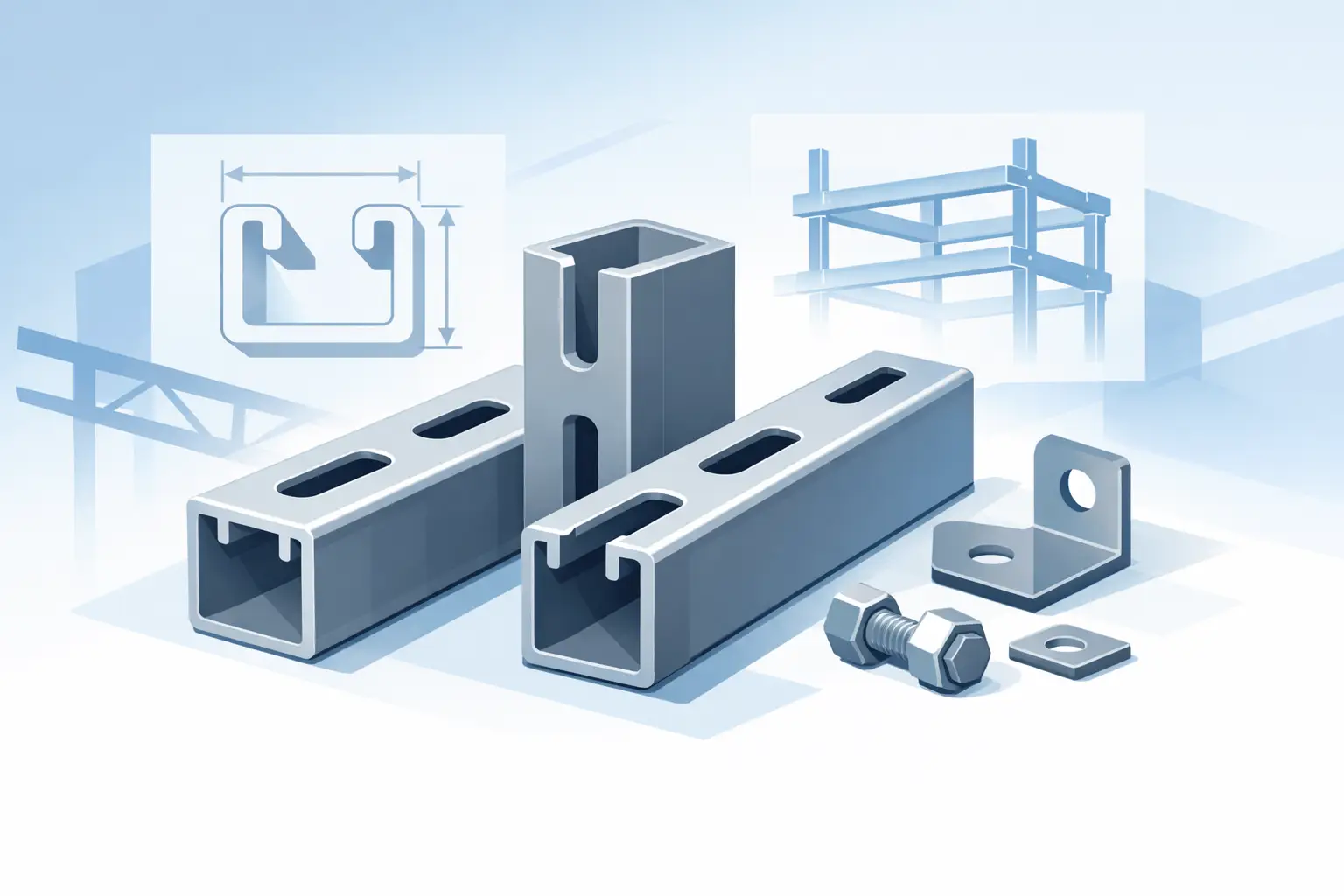
A support frame can look simple on a drawing and become complicated quickly in the field. Cable tray elevations change, pipe runs need additional clearance, equipment loads increase, and installers need a system that can be adjusted without cutting and rewelding every connection. That is why 1 5/8 x 1 5/8 uni strut channels remain a standard choice for electrical, mechanical, industrial, and construction support work.
This square-profile channel size provides a practical balance of strength, fitting compatibility, and installation flexibility. For procurement teams, the right purchase decision is not only about ordering a channel with the correct nominal dimensions. Material grade, wall thickness, slot pattern, finish, load requirements, accessories, and manufacturing consistency all affect field performance and total project cost.
What Are 1 5/8 x 1 5/8 Uni Strut Channels?
A 1 5/8 x 1 5/8 channel is a formed metal framing section with equal nominal width and depth. It is commonly used as the primary member in modular strut support systems. The channel profile accepts compatible spring nuts, bolts, clamps, brackets, and specialized fittings, allowing installers to create adjustable frames, trapeze supports, equipment stands, and service racks.
The term “uni strut” is often used generically in the market for a channel-and-fitting support system. Compatibility matters, however. Channel lip geometry, internal dimensions, slot sizing, and hardware thread engagement can differ between manufacturers. Buyers should verify the required interface dimensions when a project must connect to existing installed systems or branded accessories.
Solid channel is typically selected where greater section continuity is needed. Slotted channel offers more mounting locations and can reduce material weight, but the slot configuration must suit the attachment spacing and loading conditions. Neither option is automatically better. The correct choice depends on the support design, fastening method, and project specification.
Why This Channel Size Is Used Across Industries
The 1 5/8-inch square profile is large enough for many common support applications while remaining manageable for field crews. It is regularly specified for HVAC supports, conduit racks, cable tray frames, solar mounting structures, machinery guards, pipe supports, warehouse installations, and light industrial framing.
Its value comes from modularity. A contractor can position a fitting, make an adjustment, and secure the assembly with standard hardware. That reduces the need for site welding and helps accommodate changes that emerge after installation begins. For OEMs, the same profile can serve as a repeatable framing platform for skids, enclosures, service assemblies, or packaged equipment.
This flexibility does not eliminate engineering requirements. A channel assembly must still be evaluated for span, concentrated load, deflection, connection strength, seismic criteria where applicable, anchor capacity, and the effects of corrosion or vibration. The channel is one part of the load path, not the entire load path.
Key Specification Factors Before You Buy
Material and wall thickness
Mild steel is widely used for indoor structural framing and general-purpose support systems. It provides an economical starting point and is well suited to fabricated fittings, welded assemblies, and protective finishes. Stainless steel is often preferred in food processing, chemical exposure, marine environments, washdown areas, and other applications where corrosion resistance is a priority. Aluminum can be appropriate when weight reduction is critical, although its strength characteristics, galvanic compatibility, and fastening approach should be reviewed carefully.
Wall thickness has a direct effect on section performance and connection behavior. Two channels can share the same 1 5/8 x 1 5/8 nominal profile yet have substantially different load capabilities because of gauge, steel grade, slotting, or manufacturing tolerances. Specify thickness rather than relying on product appearance or a general channel description.
Finish and corrosion environment
Finish selection should reflect the actual installation environment, not just the initial purchase price. Pre-galvanized channel can be effective for many indoor or controlled environments. Hot-dip galvanized channel is commonly chosen for exterior exposure, industrial facilities, and higher-corrosion conditions. Stainless steel may provide the better long-term choice where moisture, salt, chemicals, or frequent cleaning make coating damage a concern.
The surrounding components must be considered as well. A corrosion-resistant channel paired with unsuitable fasteners, clamps, anchors, or cut-edge treatment can create an early failure point. Mixed-metal assemblies also require attention because galvanic corrosion can develop when dissimilar metals are exposed to an electrolyte such as water or condensation.
Slot pattern and channel configuration
Slotted channels make it easier to anchor the member directly to a wall, ceiling, floor, or supporting structure. They can also provide adjustment during assembly. Slot dimensions and center-to-center spacing should be matched to the intended bolts, anchors, and fittings.
For horizontal spans, slotting may affect the channel’s allowable load and deflection behavior compared with a solid profile. The difference can be significant in long runs or heavily loaded trapezes. Engineers and installers should use verified product data for the exact channel configuration, orientation, span, and loading arrangement rather than treating every 1 5/8-inch channel as equivalent.
Designing a Reliable Strut Support Assembly
A properly specified channel is only as reliable as the complete assembly. The first question is where the load originates. A suspended pipe rack, for example, transfers load through the pipe clamps, cross channel, vertical rods, beam clamps or anchors, and finally into the supporting structure. Each component needs adequate capacity.
Connection details deserve particular attention. Spring nuts must match the channel profile and be installed in the intended orientation. Bolts need sufficient thread engagement and appropriate tightening. Fittings should sit flat without unintended eccentric loading. Where vibration is present, locking methods and inspection access may be necessary.
Deflection is another frequent oversight. A support can remain intact yet sag enough to affect pipe slope, cable tray alignment, equipment operation, or project appearance. For systems carrying services with drainage requirements, deflection limits may be as important as ultimate strength. Specify performance expectations early, especially for long spans and multi-service racks.
For outdoor frames, account for wind, snow, thermal movement, and water collection. For seismic applications, local code requirements and engineered bracing details take priority over generic framing practices. A standard channel system can be highly adaptable, but it should not be used as a substitute for application-specific structural design.
Sourcing 1 5/8 x 1 5/8 Uni Strut Channels for Consistent Production
Industrial buyers often face a familiar challenge: one supplier provides channel, another provides fittings, and a third produces project-specific brackets. Dimensional variation, mismatched finishes, and separate delivery schedules can create avoidable installation delays. Consolidating compatible components with a manufacturing-focused supplier improves control over fit, quality, and shipment planning.
For recurring programs, provide a clear specification package that identifies material, thickness, channel length, solid or slotted configuration, slot dimensions, finish, required tolerances, labeling, packaging, and inspection expectations. If the channel will connect to existing hardware, include physical samples or verified drawings when possible. “Compatible” should be defined by measurable dimensions, not assumed from a product name.
Custom fabrication can also reduce field labor. Pre-punched channel, cut-to-length members, welded frames, gusseted brackets, base plates, and assembled support kits can be supplied to match the installation sequence. This approach is especially useful for OEM equipment builders, distributors serving repeat customers, and contractors managing large, standardized projects.
Metallix Exports supports standard and custom strut-system requirements through precision sheet metal fabrication, forming, punching, welding, finishing, and export-ready packaging. The objective is straightforward: deliver components that arrive ready to fit the specified application, with consistent quality and dependable production coordination.
Questions to Resolve Before Release
Before issuing a purchase order, confirm whether the stated dimensions are nominal or controlled to a specific tolerance. Confirm the channel’s actual wall thickness, profile geometry, slot details, finish standard, length tolerance, and straightness requirements. These details are particularly important when channels are paired with automated assembly, proprietary nuts, or predesigned brackets.
Also establish who is responsible for load calculations and code compliance. A manufacturer can produce to drawing and specification, but the project engineer or responsible design authority should define the required capacity, safety factors, environmental conditions, and approved installation method. Clear responsibility protects both project performance and procurement schedules.
The best channel choice is rarely the lowest-cost piece on a line-item comparison. It is the channel system that fits the hardware, carries the intended load, withstands the environment, and reaches the jobsite in a form crews can install without rework. When those requirements are specified clearly, 1 5/8 x 1 5/8 strut channel becomes more than a commodity - it becomes a dependable building block for the entire support system.


